 Starvard
What Is Actually Working in VR
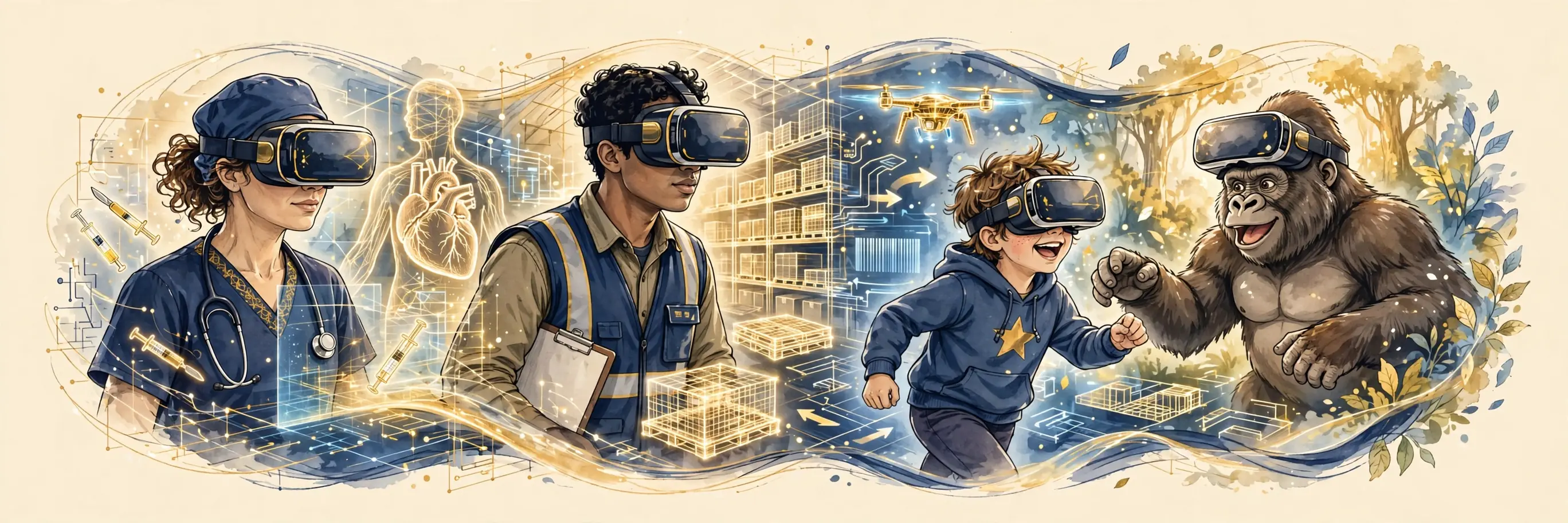
A kids' gorilla game with a million daily players, a rhythm game still selling years later, Walmart cutting an eight hour class to fifteen minutes, and surgeons training faster in headsets. The wins look unrelated. They are not.
For every headline about virtual reality failing, there is a quieter set of facts about where it is plainly working. Not promising. Not almost there. Working now, with numbers attached, in games people play every day, in training programs at national scale, and in a randomized clinical trial. This post collects the strongest documented wins and asks what they have in common.
Why any of this works at all: presence
Start with the science, because every win in this post runs on the same engine. Mel Slater, a professor at the University of Barcelona who has studied virtual reality for decades, breaks the core illusion into two parts. The first he calls Place Illusion: the feeling of being in the place you see, which happens when you perceive the virtual world the way you perceive the real one, by turning your head, bending, reaching, walking, with the world responding naturally to your body. The second is Plausibility Illusion: the sense that the events unfolding around you are really happening, that the virtual person is actually talking to you, that the virtual drop below you is actually a drop.
When both illusions hold at once, something remarkable happens, and Slater's lab has demonstrated it for years. People respond realistically to situations they know perfectly well are not real. Their hearts race on a virtual ledge. They flinch, they duck, they sweat. They also form a third illusion, ownership of the virtual body they see when they look down, treating a pair of rendered hands as their own hands. Your reasoning mind files the whole experience under fiction. Your older, deeper systems file it under memory of a place you went and things that happened to you.
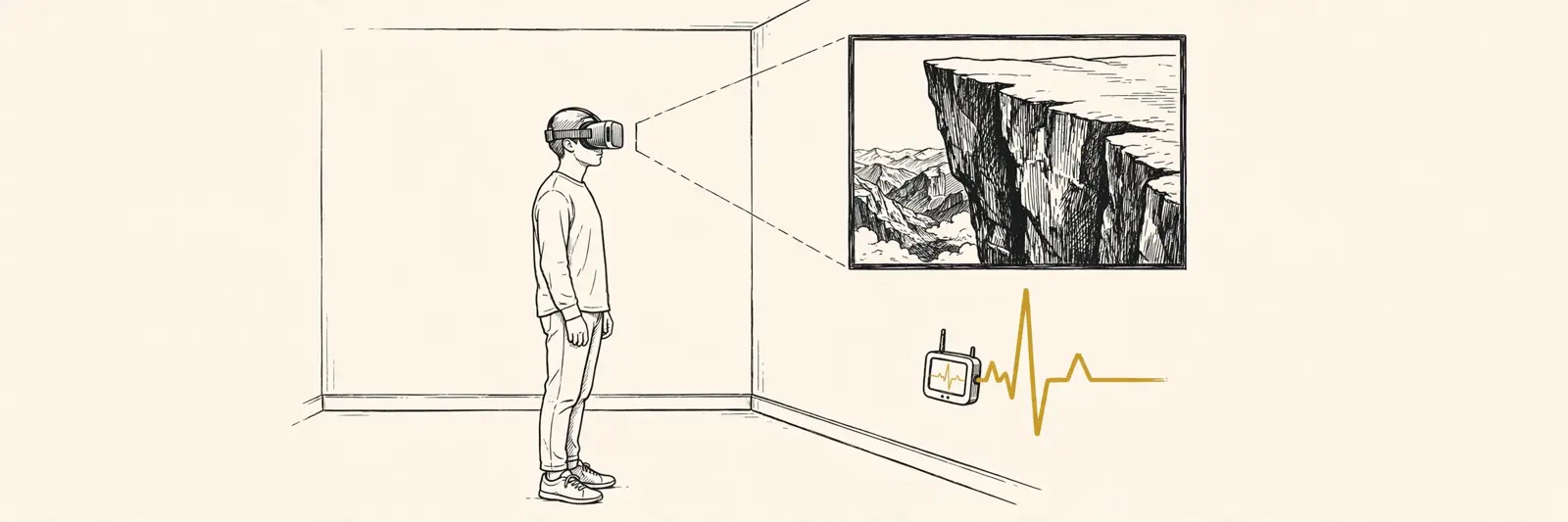
That filing decision is the whole ballgame. It is why practice inside a headset can transfer to the real world: your brain logs the repetitions as experience, not as observation. It is why a fake height can treat a real phobia: the fear response is genuinely triggered, in a place a therapist can control completely. And it is why the games that win feel less like games and more like places kids go after school. Everything below is presence, cashed in.
Games that became places
The biggest success story in VR is a free game where you play a gorilla with no legs, moving only by swinging your arms. Gorilla Tag, made by the small studio Another Axiom, passed $100 million in total revenue, according to figures the studio shared with Road to VR. It has drawn 10 million lifetime players, with 3 million monthly active users and 1 million daily active users. The average play session runs close to 60 minutes, a remarkable figure for any game, and the money comes mostly from cosmetic items players buy to dress up their gorillas.
Notice what the arm swinging does, beyond being fun. The motion your eyes report is motion your arms and body actually make, so your visual system and your balance system agree, and the sensory conflict that makes people sick in other VR games never starts. There is no joystick sliding your viewpoint around while your body sits still. Gorilla Tag's design is not just charming. It is physiologically honest, and it is a big reason a young audience can play for an hour at a time.
The other giant is older and simpler. Beat Saber, the rhythm game where you slash blocks with light sabers in time to music, had generated $255 million in lifetime sales by October 2022, according to internal Meta documents reported by The Wall Street Journal and covered by UploadVR. Years after release it remains a fixture at the top of the Quest charts. Both hits share a design secret: your body is the controller. There is nothing to learn before the fun starts, and the fun is physical in a way no flat screen can copy.
And these are not two lonely exceptions at the top of a dead store. At the Game Developers Conference in March 2026, Meta's director of games, Chris Pruett, told developers that more than 100 Quest titles each grossed over $1 million in 2025, that in-app purchase revenue grew more than 10 percent, and that the Horizon+ subscription service passed 1 million subscribers while paying out almost $20 million to developers. A healthy middle class of VR games is earning real money, not just the two famous names.
The business model inside Gorilla Tag deserves a closer look, because it explains the whole category. The game is free. What players buy is identity: hats, colors, and outfits for a gorilla that other players will see. That only works because the game is a place where other people are present to see you. A cosmetic in an empty world is worthless; a cosmetic in a crowded world is a social signal, the same reason the clothes on your own back are worth more than the clothes in your closet. Presence creates the audience, the audience creates the status, and the status creates the revenue. It is the economic engine of the biggest flat screen games, rebuilt in a medium where the social signal is stronger because the people are, to your brain, actually there.
Social VR turned into appointment viewing
On New Year's Eve, as 2025 turned into 2026, nearly 150,000 people were inside VRChat at the same time, a concurrent user record for the platform, reported by UploadVR. Ten days later, on January 10, 2026, more than 110,000 people put on headsets simultaneously to watch a virtual comet strike the world of Gorilla Tag, the payoff to weeks of in-game storytelling. More than 1 million unique users played Gorilla Tag across that single weekend.
Another Axiom's marketing chief Jake Zim called these live events "the modern version of Must See TV," and he pointed at the hardware condition underneath the success: the ecosystem depends on a low cost headset that parents trust and kids can use, sold where families actually shop. Social VR did not win by building a corporate metaverse. It won by giving a young audience a place to hang out and reasons to show up at the same time.
The mechanics of the comet event show how deliberately that is done. Weeks of in-game storytelling built toward a single moment that would happen once, at a set time, in a shared place. A place you can visit any time is easy to postpone. A moment you can miss is not. Presence is what makes the trick work: because the world feels like somewhere, "being there" when the comet struck is a genuine memory and a story to tell friends who were not there, which is precisely the emotion that once sold out stadiums and filled appointment television slots. The platforms did not set out to build a television network. They built places, then learned to schedule weather in them.
Fitness: the workout people do not notice doing
Here is a win hiding in plain sight: VR has quietly become real exercise, and this one is measured with laboratory equipment rather than self reported enthusiasm. The Virtual Reality Institute of Health and Exercise, working with researchers at San Francisco State University, tests VR games the way an exercise lab tests treadmills, with players breathing into a metabolic cart that measures actual oxygen consumption, and rates each game against known activities.
The numbers are not gentle. The fitness game Supernatural averaged 11.44 METs across a 30 minute workout in the Institute's testing, with a peak five minute average of 12.49 METs. A MET is a multiple of the energy you burn at rest, and anything above 10 is vigorous exercise, in the territory of a hard run. For a 60 kilogram person, that pace works out to roughly 12 to 13 calories burned per minute. The boxing game Thrill of the Fight measured between 9.74 and 15.32 calories per minute in earlier Institute testing, comparable to rowing. These are not step counts or guesses. They are gas exchange measurements.
The most useful finding is psychological. Researcher Jimmy Bagley, who runs much of the testing, keeps finding the same gap: people rate their perceived exertion in VR well below what the instruments say they are actually doing. The game absorbs the attention that would otherwise be spent noticing fatigue. You are not enduring a workout; you are chasing a score, dodging, punching, moving to music, and the exercise happens underneath the play. The Institute itself exists because of that gap: its director, Aaron Stanton, started it after realizing he had exercised for more than 100 hours in VR without ever thinking of it as exercise.
The honest caveat is that fitness in VR still rides on the same hardware and habit problems as everything else in this post. Subscriptions churn, novelty fades, and a sweaty headset is nobody's favorite object. But as a proof of the underlying point, the lab data is hard to argue with: put the body to work inside a place that holds attention, and people will do harder physical work, for longer, while enjoying it more. No gym has ever solved that problem as elegantly.
Training where practice used to be expensive
Training is the oldest win in this entire field, older than the term virtual reality. Edwin Link patented his Link Trainer in 1929, building the machine out of player piano and organ bellows technology, and pilots nicknamed it the Blue Box. After a series of fatal accidents flying blind on instruments, the US Army Air Corps bought its first Link Trainers in 1934. By the Second World War roughly 10,000 of the machines were in use, Link estimated they had trained 500,000 pilots during the war, and over two million airmen in total passed through them. The principle was proven almost a century ago: rehearsing a dangerous, expensive skill in a simulation that cannot kill you produces people who perform better in the real machine. Every VR training result below is that principle with better graphics and a cheaper box.
The clearest modern business case is Walmart. Working with the training company Strivr, Walmart deployed VR training to more than 2.2 million frontline associates across 4,700 store locations. For the rollout of its in-store Pickup Towers, Strivr's case study reports that VR cut training time by 96 percent, from 8 hours down to 15 minutes, because associates could learn the machine in a virtual store before the real equipment was even installed.
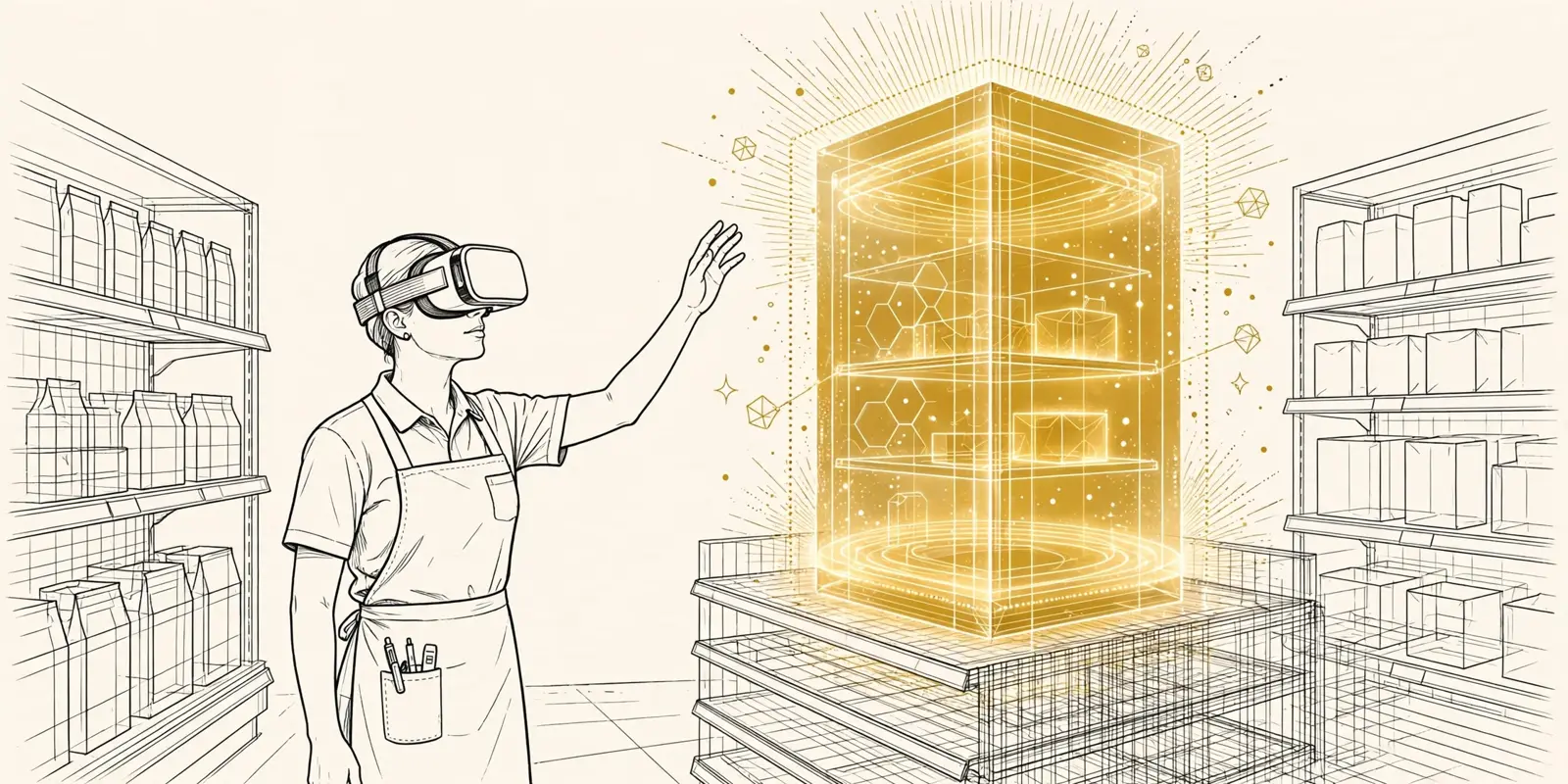
Shorter was also better. Strivr reports that 70 percent of the associates who trained in VR scored higher on post-training skills assessments than those who trained the traditional way, with scores running 10 to 15 percent higher on average. Walmart went on to build more than 60 immersive training experiences with Strivr, covering customer service, safety, tornado warnings, and even active shooter response, the kind of rehearsal you cannot stage in a real store with real customers.
The deepest value in that catalog is not the routine module. It is the rare catastrophe. A store may face a tornado or an armed attacker once in a decade, and the response has to be right the first time, from people who have never done it. You cannot rehearse either event in a real store, with real customers, real alarms, and real panic. In a headset you can, repeatedly, until the correct actions are reflexes instead of a poster in the break room. This is the general law underneath every training win in this post: the value of simulation rises as the real event gets rarer, more dangerous, and more expensive to get wrong. Link's pilots facing instrument failure in cloud, a bomber crew learning to refuel, a surgical resident learning an operation, a sales associate facing a gunman. Same law, a century apart in time, identical in structure.
The military version of the same story arrived with fresh data in October 2026. At Barksdale Air Force Base in Louisiana, student pilots learning to fly the B-52 bomber now train first on a VR refueling simulator called EARL, built by a small company, Specular Theory, pairing a headset with physical throttles and a yoke. A peer reviewed study of 233 trainees, published in the Journal of Aviation/Aerospace Education and Research, found that students who learned on the headset under a structured curriculum needed an average of 1.7 fewer sorties and 39 fewer minutes of real flight time to reach refueling proficiency than students trained the traditional way. The practical result is stark: VR trained students now make contact with the tanker on their first live flight, a skill that once took several sorties to learn in the air. The instructor behind the program describes the task as trying to park a half million pound aircraft into a twelve foot box in the sky, in a jet that burns roughly 3,000 gallons of fuel an hour. Every practice run in the real jet is expensive and depends on a tanker, the weather, and maintenance all cooperating. In the headset, the run costs almost nothing and can be repeated all afternoon. That is the Link Trainer argument, verbatim, a hundred years later.
Medicine: practice without patients
Surgery is training at its highest stakes, and it produced the hardest evidence in this whole field. In a randomized clinical trial published in JAMA Network Open, 18 senior orthopedic surgery residents learned a complex shoulder replacement procedure either in immersive VR or from technical video. The VR group then performed the procedure on cadaver specimens, scored by evaluators who did not know which group each resident was in.
The VR-trained residents scored 15.9 against 9.4 on the standard OSATS surgical skills scale. They completed their training repetitions 387 percent faster than the video group. The researchers calculated a transfer effectiveness ratio of 0.79, meaning 60 minutes of VR training substituted for 47.4 minutes of real operating room training time, and found the VR system 34 times more cost effective than the control. VR did not replace real practice. It made the expensive hours count for more.
Watch: Osso VR Visual Enhancements Reel (2020), from Osso VR. The reel shows what modern surgical VR looks like from the inside: anatomy, instruments and an operating room rendered at a fidelity earlier trainers could not reach.
The same logic is already in live hospitals. The Register reported that doctors at UC San Diego completed 60 clinical trials during real surgeries using Apple Vision Pro to keep patient information in view while operating, and that Purdue University trains manufacturing students inside digital copies of semiconductor and pharmaceutical facilities, places too costly or too delicate for beginners to learn in directly.
Therapy: fear, rehearsed safely
The second medical win is not about hands but about fear, and it may be the most human result in this post. Exposure therapy, the standard treatment for phobias, works by facing the feared thing in graded steps until the brain learns it is survivable. Its practical problem is logistics: a therapist cannot conjure a tenth floor atrium, a crowded train, or a street full of strangers on demand, at exactly the difficulty the patient can handle today. VR can, and presence does the rest, because as Slater's work predicts, the fear response fires even though the patient knows the height is not real.
The landmark trial came from Oxford professor Daniel Freeman's team, published in The Lancet Psychiatry in 2018. One hundred adults, who had lived with a fear of heights for an average of 30 years, received automated VR therapy: a virtual coach guided them through activities in a virtual ten storey building, for about two hours of total time in the headset across five sessions. The results were unusually clean. Every single participant in the VR group improved. The average reduction in fear was 68 percent, half the participants reduced their fear by more than three quarters, and there were no adverse events. A treatment with no therapist in the room, delivered by software, outperformed what most patients could access at all.
Watch: Virtual Reality therapist, from Oxford VR. Professor Daniel Freeman explains the idea himself: a virtual coach, a building full of graded challenges, and therapy that patients can repeat as often as they need.
The follow up scaled the idea to harder ground. The gameChange trial, published in The Lancet Psychiatry in 2022, tested automated VR therapy for agoraphobic avoidance in people with psychosis, the patients who find it hardest to leave home, across nine NHS trusts in England. It was described as the largest clinical trial of VR for mental health ever run, and its clearest finding was that the people with the most severe difficulties benefited the most. Greater Manchester's NHS trust, which hosted part of the trial, reported that patients could practice everyday situations, a bus, a cafe, a street, that their condition had made impossible, and then walk out and do the real versions.
Notice the shape these therapies share with everything else in this post. The feared situation is a place. The treatment is going there, repeatedly, at rising difficulty, with the body and brain fully involved, in sessions short enough to finish. A leaflet about heights does nothing. A video about heights does a little. Standing on the virtual ledge, heart pounding, while a calm coach talks you through looking down, teaches the nervous system something it actually keeps.
The honest complications
A post about what is working owes you the fine print, and there is real fine print.
Transfer is partial, not total. The surgical trial's own math says a VR hour substitutes for about 47 minutes of operating room training, not 60. VR is a multiplier on scarce expert time and expensive equipment, not a replacement for either. Pilots still fly real jets, residents still operate on real people, and any training program that forgets that will produce confident beginners, which is the most dangerous kind.
The therapy evidence is strong and narrow at the same time. Heights and agoraphobic avoidance are proven in rigorous trials. That is not the same as proof for every condition, and the successful trials used carefully designed clinical software with virtual coaches built by specialists, not whatever is on the app store this week. The distance between a Lancet Psychiatry trial and a wellness app is the distance between medicine and marketing.
Social VR's engine is also its responsibility. The audience driving the records is young, teenagers most of all, gathered in spaces built by small companies. Jake Zim's own point, that the whole model rests on parents trusting the headset and the platform, cuts both ways: that trust has to be re earned continuously, through moderation and safety work that never shows up in a revenue headline. And fitness, for all its lovely lab data, still depends on people choosing the headset again tomorrow, competing against every other demand on their evening, in a device that gets hot and leaves a mark on your face.
None of that cancels the wins. It does locate them. Every documented success in this post is a session: a song, a match, a workout, a fifteen minute module, a procedure, a therapy visit. Nothing that is working yet asks anyone to live in a headset, work in one for eight hours, or replace a real place they love with a copy. The wins are all visits. The industry failed when it sold relocation. It is succeeding, measurably, at visits.
The pattern underneath the wins
Lay the wins side by side and four traits keep appearing. First, the body does the work: swinging arms, slashing beats, reaching for a machine, guiding a surgical tool. Every success uses the one input a headset has that a phone does not. Second, sessions are built around doing, not watching: a song, a match, a fifteen minute module, a procedure. Third, the experience repeats well. Players return for events and cosmetics, workers rehearse rare emergencies, residents run the same procedure again and again at no risk. Fourth, the hardware bar is low where the wins are biggest. Gorilla Tag thrives on an inexpensive Quest, and Walmart trains millions on standalone headsets, not on $3,500 flagships.
Add a fifth trait, visible only when you collect the evidence in one place: every win here is measured. Lap times and tanker contacts, assessment scores and surgical grades, calories from a metabolic cart, fear reductions in a randomized trial. The metaverse era ran on adjectives. The working era of VR runs on instruments, and the instruments keep returning the same verdict.
That is the honest map of VR's value in 2026. It earns its keep where being inside the situation is the point: play that moves your body, practice that would be dangerous or costly in real life, and gatherings that feel like being somewhere together. Where VR merely imitates a screen, it struggles. Where it replaces a place, it wins.
John Carmack, the former Oculus chief technology officer, warned years ago that setting out to build "the metaverse" as a grand project was a trap, and that the winning move was to concentrate on actual products people use today. The record of the last few years reads like a footnote to that warning. The grand project absorbed the billions. The products, a gorilla game, a rhythm game, a fifteen minute training module, quietly did the work.
Why this belongs at Starvard
Starvard exists to teach skills in the ways people actually learn them, and VR training research is some of the best evidence anywhere that doing beats watching. That principle runs through our Learning course, and the attention and presence these headsets demand is the subject of our Focus course.
Watch
Walmart: Walmart Virtual Reality in Academies. Walmart's own look at how its training academies use VR, the program Strivr later scaled to millions of associates.
Gorilla Tag: Something BIG is Coming to Gorilla Tag... The official teaser for the January 2026 comet event that pulled more than 110,000 players into the game at once.
Sources
Road to VR, reporting Another Axiom's figures for Gorilla Tag revenue, lifetime players, monthly and daily active users, and session length: roadtovr.com
UploadVR, January 2026, on the Gorilla Tag comet event, the VRChat New Year's Eve record, and Jake Zim's comments: uploadvr.com
UploadVR, reporting The Wall Street Journal's account of internal Meta documents, for Beat Saber's $255 million in lifetime sales by October 2022: uploadvr.com
Strivr, customer case study on Walmart, for the 2.2 million associates, 4,700 locations, training time cut, and assessment results: strivr.com
JAMA Network Open, randomized clinical trial on immersive VR training for orthopedic surgical residents, for the OSATS scores, training speed, and transfer effectiveness ratio: jamanetwork.com
The Register, January 2026, for UC San Diego's Vision Pro surgical trials and Purdue University's training facilities in VR: theregister.com
UploadVR, March 2026, reporting Chris Pruett's GDC talk, for the 100 plus Quest titles grossing over $1 million in 2025 and the Horizon+ subscriber and payout figures: uploadvr.com
Voices of VR, Kent Bye's interview with Mel Slater on the science of presence, for Place Illusion, Plausibility Illusion, and virtual body ownership: voicesofvr.com
Virtual Reality Institute of Health and Exercise, its tested profile of Supernatural, for the average and peak MET measurements made with San Francisco State University researchers: vrhealth.institute
Road to VR, on the VR Health and Exercise Institute's findings, for the calorie burn measurements for games including Thrill of the Fight and the perceived exertion gap: roadtovr.com
Hartzell Propeller, on the evolution of flight simulation, for the Link Trainer's 1929 patent, the 1934 Army Air Corps purchase, and the wartime training totals: hartzellprop.com
Defence Blog, October 2026, reporting the Journal of Aviation/Aerospace Education and Research study of 233 B-52 trainees on the EARL virtual reality refueling simulator: defence-blog.com
EurekAlert, reporting The Lancet Psychiatry 2018 study by Daniel Freeman and colleagues, for the automated VR therapy trial for fear of heights, its 100 participants, and the 68 percent average fear reduction: eurekalert.org
Greater Manchester Mental Health NHS Foundation Trust, on the gameChange trial of automated VR therapy for agoraphobic avoidance in psychosis, across nine NHS trusts: gmmh.nhs.uk