 Starvard
The Shops, Schools and Offices Staffed by AI Agents
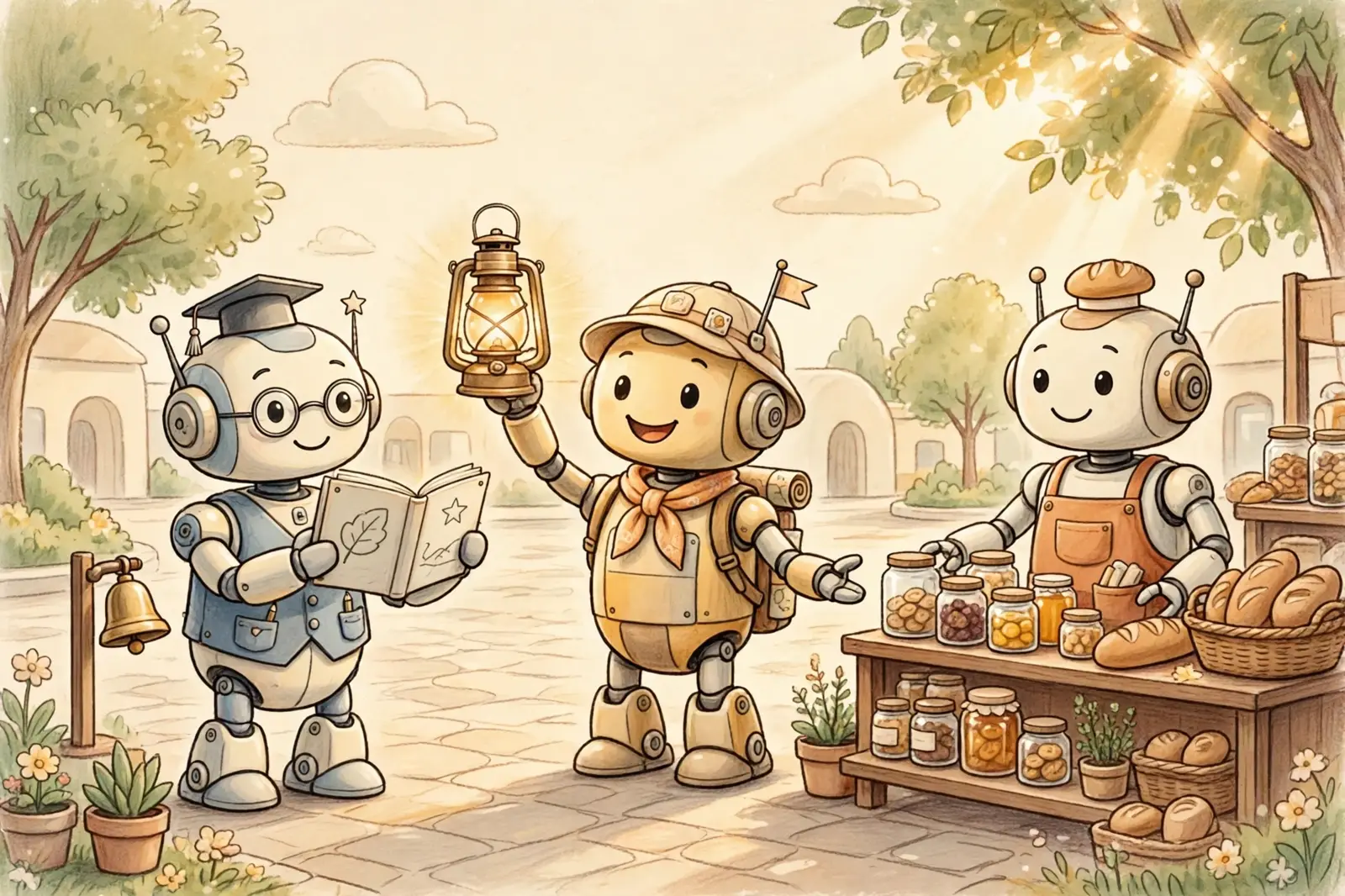
Walk into a virtual place with nobody in it and you understand the problem instantly. The shelves are perfect, the lighting is lovely, and the whole thing feels like a screensaver. Places do not run on architecture. They run on staff: the person who notices you arrive, answers the question you actually meant to ask, and remembers you next time. For decades, virtual worlds could only fake that with scripted puppets. Now they are hiring. Shops, museums, classrooms, offices and social worlds are quietly filling their rosters with AI agents, and this post walks the floor place by place and job by job: who got hired, what the work actually looks like, what visitors think of the service, and what happens to the staff when the place closes.
Shops and brand worlds: the greeter is the store
Start with the first principle of retail. A store is not really a room full of products. Products are the excuse. The store is the person who reads you in the first ten seconds: what you are looking for, what you can afford, what you would love if someone showed it to you. Online shopping deleted that person and replaced them with a search box, which is efficient and joyless. Virtual stores were supposed to bring the room back. The surprise of the last few years is that they only started working when somebody brought the staff back too.
The clearest example is Emperia, a London company that builds virtual stores for brands. In January 2023 it raised a $10 million Series A led by Base10 Partners, and its client list reads like a mall directory: Dior, Bloomingdale's, Burberry, Lacoste, Christie's, Sunglass Hut and Getty Images. Emperia reports, and these are the company's own numbers, that its virtual stores lift conversion rates by an average of 73 percent compared with traditional e-commerce, with an average return on investment of 750 percent. Treat those figures the way you would treat any vendor's brochure, but notice what the company says drives them: not prettier shelves, but guided selling, hosts who walk you through the room, and layouts rearranged around how visitors actually behave.
Walmart took the same technology mass market. Walmart Realm launched in May 2024, built on Emperia's platform with Sawhorse Productions, and it runs in an ordinary web browser. Instead of aisles, it opened three small worlds curated by online creators: So Jelly, an underwater shop curated by Mai Phammy; Y'allternative, a western themed shop from Makenzie and Malia; and Go Chromatic, a metallic future city from Nava Rose. Shoppers collect gamified sparks for prizes while they browse. The interesting part is what happened next: Walmart kept restaffing and redecorating. Seasonal shops arrived for back to college and the holidays, and in August 2025 the retailer opened a fresh wave of storefronts, starting with a K-pop themed shop, tied to its Walmart Delivers trucks. A Walmart executive said the space had attracted millions of younger shoppers, which is a company claim, but the refreshes themselves are the harder evidence. Retailers do not renovate dead malls.
The most complete shop staff in any virtual world, though, was built by one hobbyist. Mantella is a free mod for Skyrim, first uploaded in August 2023 and still updated in April 2026, that gives more than 3,000 of the game's characters real time voice conversation. The blacksmith knows her trade, her town, the time of day and the sword you just picked up. Shopkeepers and innkeepers remember your previous conversations, can share their inventory with you, can be talked into following you, and take offense if you insult them. Characters even start conversations with each other. One player's review describes asking a blacksmith what she wanted to be when she grew up and suddenly realizing they were just having a conversation. That is the whole retail insight in miniature. The moment the person behind the counter can answer an unscripted question, the shop stops being a menu and becomes a place.
Museums and heritage: talking to the artist
Museums learned the same lesson from the other direction. A museum already has the objects and the wall labels. What it cannot scale is the docent: the human who notices which painting stopped you, tells you the story behind it, and handles the question nobody planned for. So museums have started hiring the artists themselves.
At the Musée d'Orsay in Paris, the exhibition "Van Gogh in Auvers-sur-Oise: The Final Months" drew 793,556 visitors in about four months, beating the museum's previous attendance record by nearly 70,000 people. Beside the painting Wheatfield with Crows stood "Hello Vincent", an AI recreation of van Gogh built by the startup Jumbo Mana and trained on 900 of his letters plus early biographies. Visitors picked up a microphone and talked to the painter one on one. According to the New York Times, the most frequently asked question was why he ended his life, and the AI gently steers those answers toward resilience: "Cling to life, for even in the bleakest of moments, there is always beauty and hope." The same exhibition included a virtual reality experience, "Van Gogh's Palette", that stepped visitors inside a painting. Think about what the job actually is here. The label on the wall can tell you when the painting was made. Only the docent gets asked about despair, and gets asked it hundreds of times a day.
Florida's Dalí Museum in St. Petersburg opened "Ask Dalí" on April 11, 2024. You pick up a replica of Dalí's famous Lobster Telephone from 1936 and ask the artist anything. His voice was recreated from archival interview recordings, and the answers come from OpenAI's GPT-4 grounded in his own writings, including Mystical Manifesto, Diary of a Genius and The Secret Life of Salvador Dalí. The museum's creative partner told NPR the AI had already answered more than 3,000 questions in its first days. People ask about life, love and death, and of course about the melting clocks. Two honest details keep this grounded. First, the museum's team monitors the answers, because a docent who improvises needs a supervisor. Second, the reviews are mixed in the best way: Elliott King, a scholar of surrealism at Washington and Lee University, told NPR that Dalí would have been tickled by the exhibit, while finding some of the answers too mundane. The museum had run an earlier interactive version of the artist, "Dalí Lives", since 2019. The pattern across both museums is identical: the AI staff member is not there to recite facts. He is there to be approached.
Classrooms and tutors: practice partners who never get tired
Language learning has a staffing problem that no school budget can solve. Fluency comes from conversation, conversation needs a patient partner, and patient partners who speak French and never judge your accent are scarce. Virtual worlds turned out to be a natural classroom, and AI tutors are now the staff.
IMMERSE runs live language classes inside virtual reality, led by human teachers, with AI avatar tutors powered by GPT-4 available around the clock for role play practice: ordering in a restaurant, surviving a shopping trip, handling small talk at a virtual home. The company's own fact sheet reports more than 250,000 learners across 97 countries, an average class rating of 4.9 out of 5, and an 88 percent platform engagement rate, which it contrasts with a 10 to 20 percent industry average. Those are company reported figures. The independent evidence is smaller and more interesting. In a study run by researchers from the University of Illinois at Urbana-Champaign, UC Santa Barbara and the University of North Texas, 54 high school students practiced French and Spanish with IMMERSE's AI avatars. Ninety two percent said they felt less nervous speaking to the avatars than in normal classroom activities, 61 percent said the conversations taught them new phrases, and 70 percent said the headset helped them focus by removing distractions. Corporate pilots point the same way: in a 45 day pilot at one employer, 40 employees completed 119 live classes and 541 AI powered activities, and afterwards every participant said they felt more confident and less anxious. Santander Open Academy has partnered with IMMERSE to teach English, Spanish and French to 20,000 people in Brazil. The tutor's real job, it turns out, is not knowledge. It is being safe to be bad in front of.
The pioneer was Mondly VR, which launched on February 1, 2017 as the first virtual reality language experience with speech recognition and a chatbot tutor. It teaches 30 languages through role play: making friends on the train to Berlin, ordering dinner in a Spanish restaurant, checking into a hotel in Paris, with instant pronunciation feedback. Mondly's listing says its platform has passed 45 million downloads worldwide, a company claim. The honest footnote lives on the same page: the VR app's Steam reviews are Mixed, with 53 percent of 60 user reviews positive. Being first bought Mondly a decade of head start; it did not buy it love.
The boldest classroom experiment is not about language at all. Dreamscape Learn, built by Arizona State University with Dreamscape Immersive, casts biology students as field biologists in an intergalactic wildlife refuge, solving lab problems inside a story. In ASU's fall 2022 study, students using it were 1.7 times more likely to earn an A on lab assignments, with a median score of 96 percent, and rated the experience 4.4 out of 5. In November 2025 the program went mobile for the Pendergast Elementary School District near Phoenix: a 16 seat classroom inside a 46 foot trailer that rotates among 12 schools to reach 3,000 middle schoolers. A teacher there reported attendance on pod days rising to 90 percent, which might be the most honest satisfaction metric in this entire post. Kids vote with their feet. And the honesty cuts both ways: by April 2026, ASU's student newspaper was reporting mixed feelings among students as the virtual labs replaced traditional ones. A staffed world can win on outcomes and still lose some of the room.
One more classroom deserves a line, because its students are adults and its subject is courage. VirtualSpeech puts AI avatars in virtual rooms and lets employees rehearse the conversations they dread: the difficult review, the angry client, the big presentation. The avatars respond and push back, then score the performance. The company reports more than 350,000 completed practice sessions, a 93 percent would recommend rate, and a Deutsche Telekom program that trained 1,200 employees and measured a 20 percent average skill increase after as little as 30 minutes of practice. Company reported, again, but the job description is the tell: this is a sparring partner, hired precisely because rehearsing on a real colleague would be unfair to the colleague.
Offices and front desks: the loneliest lobby on earth
The virtual office ran into the staffing problem in its purest form. A company can build a beautiful digital campus, with a lobby, meeting rooms and a rooftop deck, and none of it matters if a new hire logs in, looks around, and finds absolutely nobody. Physical offices solve this with a front desk: one human whose whole job is to make the building legible and welcoming in the first thirty seconds. Virtual offices shipped the building without the human.
The longest running attempt is Virbela, which says it pioneered the first enterprise metaverse: persistent, fully brandable virtual campuses that run on ordinary PCs and Macs with headsets optional, and support thousands of people online at once. Its named customers include the real estate brokerage eXp Realty, DXC Technology, Fujitsu and MIT Sloan. In a physical office park those logos would mean busy corridors. Online, they mostly proved how hard the front desk problem is: a campus that size needs greeters, guides, event hosts and helpers on shift around the clock, and human beings are expensive, timezone bound and occasionally asleep. That gap is exactly where agent receptionists and facilitators are being hired now: characters who welcome arrivals, route visitors to the right room, run the icebreaker, take the meeting notes and never leave the desk unmanned. The office did not fail because the rooms were wrong. It failed at the door, and the door is a staffing job.
Notice, too, where the office world's energy quietly moved. The most successful "office" products in this post are not campuses at all. They are the rehearsal rooms: VirtualSpeech's practice partners and the corporate training simulations spreading across the industry, places where the staff exist to be talked at, interrupted and argued with. The virtual office survives where somebody is on duty.
Social worlds and greeters: the regulars, the hosts and one famous flight attendant
Second Life is the oldest staffed world still standing, and its numbers explain why its residents take staffing seriously. Linden Lab's executive chairman told GamesBeat that the world runs an economy of about $650 million a year, that Linden paid out $79 million to creators in the twelve months ending June 2024 and $1.1 billion over the platform's life, and that its roughly 600,000 residents have been there an average of about 14 years. Linden takes a 10 percent cut and employs about 160 people. These are the company's own figures, shared by its chairman, and they describe something rare: a virtual place with regulars. Regulars expect the club to have a host, the gallery to have a guide, the shop to have someone behind the counter.
So when Linden Lab, working with the agent platform Convai, released its AI Character Designer, residents immediately put the characters to work. Linden's own description lists elaborate roleplay scenarios and immersive visitor greeters, and resident accounts add the rest of the roster: shopkeepers who mind the store, assistants, tour guides, hosts at venues, characters at places like Castaway Cove who remember your earlier conversations. For a world built by its residents, hiring an agent looked like every other kind of building: you wrote your greeter's personality, gave her a backstory and knowledge of your place, and put her on shift. She never slept, never moved away, never quit. We will come back to what happened next in the honesty section, because it is the saddest story in this post.
Hospitality found the same pattern at airline scale. Qatar Airways introduced Sama in 2022 as a digital cabin crew member who guided visitors through QVerse, the airline's virtual world, narrating tours of the premium check in area at Hamad International Airport and the cabins of its aircraft. She was, at first, a scripted guide. In March 2024, at the ITB Berlin travel show, the airline unveiled Sama 2.0, rebuilt with digital human company UneeQ as a conversational agent. The airline gave her a written backstory (a childhood in Doha, training as a flight attendant), a name that means "sky" in Arabic, and a real job: answering questions in real time about flights, destinations and support, inside QVerse and the airline's app, learning from passenger interactions, and handing you to a human agent when a question beats her. Then the job grew again. In February 2026 the airline opened QVerse Island inside Fortnite, recreating Doha's airport, its indoor garden and its lounges, with Sama as host, guide and brand ambassador, sending players through missions that can unlock real world rewards including flight tickets. One employee, three promotions: scripted guide, conversational crew, game show host. Fortnite's audience runs to tens of millions of players, and the airline decided the person who should meet them at the virtual airport was its agent.
The owner's shift: hiring, training and firing software
Every staffed world has a human on the other side of the counter, and their job has changed shape completely. The owner of a virtual shop, museum exhibit or classroom no longer performs the service. They cast it.
Casting starts with writing. A Second Life greeter exists because a resident wrote her personality, her welcome lines and what she knows about the venue. Sama answers the way she does because Qatar Airways and UneeQ wrote her backstory and her boundaries, including the rule that she escalates to a human when she is out of her depth. The Dalí Museum's team monitors the AI's answers, the way a manager listens in on a new hire's first week. IMMERSE's teachers run the live classes and choose the role play scenarios their students then rehearse with the avatars. Emperia's brand teams watch visitor analytics and rearrange the store, the digital equivalent of moving the display table after watching where customers actually walk.
The rest of the shift is maintenance and money. The staff's knowledge goes stale, so somebody updates the inventory, the exhibition dates, the syllabus. The staff sometimes misbehave, so somebody reads the transcripts. And the staff charge rent: agent platforms bill for conversation time, which our companion post on AI agents in VR breaks down in detail, so the owner's real skill is deciding which hours of the day deserve a live agent and which can be covered by a sign and a search box. The pattern rhymes with every previous wave of the internet. First the owner did the work. Then the owner hired people. Now the owner writes, trains, supervises and occasionally fires software, and the quality of the place rises or falls on how well they do that invisible job.
The honesty section: closures, deletions and empty rooms
Now the part of the tour where we walk past the shuttered storefronts. The graveyard matters, because the staff of a virtual place do not get laid off when it closes. They get deleted, and so does everything they knew about you.
AltspaceVR was one of the first social VR worlds, launched in 2015 and famous for live events, comedy nights and even a VR church. Microsoft bought it in 2017 and shut it down on March 10, 2023, to focus on its Mesh platform, in the same season it laid off 10,000 people. Mozilla Hubs, the browser based world that needed no headset and no install, closed on May 31, 2024. Mozilla's own farewell numbers say its demo server alone had hosted 115,732 custom avatars, 215,923 scenes and meetups for close to 10 million attendees. Ten million guests is not a failure of demand. It is a failure of the business model underneath the demand, and Mozilla at least handed the open source code to a community foundation, so the rooms can still be rebuilt by anyone willing to host them. Glue, a Finnish platform for virtual team meetings, watched its parent company declared bankrupt on April 8, 2024, and announced within days that the service itself was profitable and had found a new home: a rescue, not a death, and a useful reminder that the obituary and the acquisition press release are sometimes the same document.
The most instructive ending belongs to Ready Player Me, the avatar platform whose characters populated more than 10,000 apps and games. Netflix acquired it in December 2025, about 20 of its staff joined Netflix, and on January 31, 2026 the public platform switched off, including the developer tools other worlds used to build their people. Exported avatar files kept working. Everything hosted simply stopped. If your world's staff wear rented faces, the landlord can sell the building.
And then there is Second Life, where the world survived and the staff did not. Linden Lab paused its AI Character Designer effective September 1, 2025. From that date, residents' AI characters no longer function or appear in the world, and Linden's notice is blunt about the rest: character profiles, long term memory and personality data are permanently deleted and cannot be downloaded. Every greeter who remembered your name, every shopkeeper who knew your taste, gone on schedule, in a world that is otherwise still open for business. Convai remains a Linden partner and the company says this is not the end of AI in Second Life. But the lesson for anyone staffing a world is now written in a real FAQ: your employees' memories live on someone else's server, under someone else's roadmap, and a pause announcement is all it takes.
Underneath the closures sits the quieter problem: empty rooms. A staffed world still needs visitors, a greeter with nobody to greet is a screensaver with a salary, and several of the places in this post are one budget review away from learning that. The technology, on the evidence above, works better than the economics do.
What makes a staffed world worth visiting twice
So what separates the places that earn a second visit from the ones that become trivia questions? After this whole tour, four things keep showing up.
Memory. The blacksmith who remembers your last visit, the tutor who knows which phrases tripped you yesterday, the greeter who recalls your name: every beloved staffer in this post is beloved because the relationship accumulates. It is also why the deletions hurt. Memory is the product, and whoever hosts the memory holds the power.
A real job with real stakes. The staff who thrive are not decorations. They carry grades (Dreamscape's lab results), sales (Emperia's stores), confidence (the 92 percent of language students who felt safer practicing), and actual flight tickets (Sama's Fortnite missions). When the agent's work matters to the visitor, the visit matters too.
A human who cares, visibly. A museum team reading transcripts, a teacher choosing scenarios, an airline writing its crew member a childhood: visitors can feel the difference between a place somebody tends and a demo somebody abandoned. Tending is the moat.
And a reason to return that refreshes. Walmart Realm redecorates with the seasons. Sama keeps learning from passengers. The tutor's next lesson builds on the last. A staffed world worth visiting twice is, in the end, run like every good physical place you know: somebody is there, they remember you, the work is real, and the lights are on because a person decided they should be.
Why this belongs at Starvard
Every place in this post is a small business, a classroom or a career wearing a headset, and Starvard teaches all three sides of it. How AI Works explains the models that let a shopkeeper hold a conversation and a docent improvise an answer. E-Commerce covers the virtual storefronts, conversion math and guided selling behind places like Walmart Realm. And Remote Work takes on the virtual offices, front desks and distributed teams that Virbela's campuses were built for. The staff may be software now. The skills to hire, train and supervise them are human skills, and they are learnable.
Watch
- Art from the Machine, "ChatGPT in Skyrim VR | Mantella - Lip Sync & In-Game Awareness Update": youtube.com/watch?v=Gz6mAX41fs0. The mod's creator shows shopkeepers and townsfolk who know the time, the stock and what you just did: the retail staff of this post, working a shift.
- Arizona State University (ASU), "Dreamscape Learn at ASU Polytechnic - Immersive Learning in Action": youtube.com/watch?v=VSddKe4K1r4. The virtual biology classroom in real use, students working as field biologists inside the refuge.
- Arizona State University, "Introducing Dreamscape Learn": youtube.com/watch?v=1gTxlWp_mi0. ASU's president makes the original pitch for replacing the lab bench with a story, the bet the Pendergast school district later took on the road.
Sources
- Tech.eu, "Helping brands including Dior and Burberry manage their metaverse storefront, London's Emperia raises $10 million", January 25, 2023. Emperia's funding, client list and company reported conversion and ROI figures.
- Retail Dive, "Walmart launches immersive digital shopping experience", May 29, 2024. Walmart Realm's launch, its three creator curated shops and the Emperia partnership.
- Retail Dive, "Walmart Realm adds new digital storefronts to woo Gen Z, Gen Alpha", August 21, 2025. The 2025 storefront refresh and Walmart's claim of millions of younger shoppers.
- Nexus Mods, Mantella mod page, first uploaded August 19, 2023, version 0.14 updated April 28, 2026. The 3,000 plus conversational characters, memory, inventory sharing and VR support.
- Smithsonian Magazine, "Musée d'Orsay Breaks Attendance Records With Interactive Vincent van Gogh Exhibition", February 15, 2024. The 793,556 visitor record and the Hello Vincent installation.
- NPR, via North Country Public Radio, "An AI Salvador Dalí will answer any question when called on his famous 'lobster phone'", April 2024. Ask Dalí's launch, its GPT-4 grounding and the 3,000 questions answered in its first days.
- IMMERSE, company fact sheet, checked October 2026. Company reported learner numbers, ratings, engagement and pilot results.
- IMMERSE, "Recent study finds 92% of language students are less anxious when speaking with IMMERSE's AI powered avatars", 2024. The university study of 54 high school students.
- ASU News, "ASU, Dreamscape Learn bring immersive VR biology classrooms to Phoenix school district", November 20, 2025. The grade study, the Pendergast mobile classroom and the attendance report.
- The Arizona State Press, "Dreamscape Learn is replacing ASU's traditional labs, students have mixed feelings", April 2026. Student reaction as virtual labs replaced traditional ones.
- Steam, "Mondly: Learn Languages in VR" store listing, checked October 2026. The February 2017 launch, 30 languages, the 45 million download claim and the Mixed review summary.
- VirtualSpeech, homepage, checked October 2026. Company reported practice sessions, recommendation rate and the Deutsche Telekom training results.
- Virbela, homepage, checked October 2026. The enterprise campuses, concurrency and named customers including eXp Realty and MIT Sloan.
- GamesBeat, "Linden Lab has spent $1.3B building Second Life and paid $1.1B to creators", December 20, 2024. Second Life's economy, creator payouts, user numbers and average tenure, as shared by Linden's chairman.
- Linden Lab, "AI Character Designer update", 2025. The September 1, 2025 pause and the permanent deletion of character memory and personality data.
- UneeQ, "UneeQ and Qatar Airways elevate passenger experiences with Sama 2.0, the first digital human in aviation", March 6, 2024. Sama 2.0's conversational abilities, backstory and human escalation.
- The Traveler, "Qatar Airways Launches QVerse Island, a Virtual Doha Inside Fortnite", February 10, 2026. Sama as host and guide in Fortnite, with real world rewards.
- Engadget, "Microsoft will shut down AltspaceVR on March 10th", January 21, 2023. The AltspaceVR closure and the pivot to Mesh.
- UploadVR, "Mozilla Hubs Is Shutting Down, Will Be Handed To Community", February 16, 2024. The May 31, 2024 shutdown and Mozilla's avatar, scene and attendee totals.
- Glue Collaboration, company announcement, April 10, 2024. The parent company's bankruptcy and the service's rescue.
- AIN, reporting TechCrunch, on Netflix's acquisition of Ready Player Me, December 23, 2025. The acquisition and the January 31, 2026 platform shutdown.