 Starvard
The Psychology of Human Thought · Chapter 9 of 19
Chapter 9: Problem Solving
by Joachim Funke
Problem solving is essential for humans to survive in a world that is full of surprises and challenges. Let us start with an example. Imagine the legendary situation on April 11, 1970, when the commander of the “Apollo 13” moon mission, James Lovell, told the people on the ground, »Houston, we’ve had a problem!« One of the oxygen tanks had exploded and brought the mission close to a catastrophe. Through a lot of creative measures (we would call them problem-solving activities), finally a safe re-entry to earth atmosphere was possible. A similar situation happened decades later, at the launch of the space shuttle “Discovery” on July 26, 2005. Film footage from more than 100 surveillance cameras showed that several tiles had fallen off the insulation of the outer tank of the rocket shortly after the launch. These tiles protect the space shuttle from overheating when re-entering the atmosphere. Fortunately, the damage could be fixed by repair carried out for the first time in space and thus the life-threatening situation could be averted (in our terms: the problem could be solved). Our other example does not have such a happy ending and shows just how existential problem solving can be: on February 1, 2003, similar damage to the rocket insulation had caused the “Columbia” to explode and the 7 crew members were killed while millions of people watched the deadly launch live on TV.
spectacular way: to be pursuing a goal (in this case, to complete the mission and return to earth alive again) and suddenly not know if and how this goal can be achieved because there is an obstacle or a barrier.
Problem solving is one of the highest forms of mental activity we know. The problem solutions resulting from this activity have contributed significantly to the success (and thus survival) of the human species, not only on the individual level, but also on a cultural level (e.g., in the form of speaking, writing, and numbering). To this day we know of no other creature besides humans on this planet who shape their lives in a comparable way through planned action and problem solving. However, this is no cause for unrestrained optimism in unlimited progress. These human capabilities also harbor the greatest destructive potential that has ever been observed in a species.
This chapter presents important concepts and results from the field of problem-solving research. The two parts of the term problem solving suggest starting with the problem part (differentiations that have to be made regarding the types of problems - not all problems exhibit the same characteristics) and then moving on to the solving part (which consists of different phases and has a temporal characteristics). Different theories will be described, together with an overview of methods as to how to analyze problem solving activities. Finally, the main aspects of this chapter will be summarized.
Of course, problems like these are far from commonplace. But life-threatening situations in space shuttles show what it means to have a problem in a
https://doi.org/10.17885/heiup.470.c6672 Psychology of Human Thought • Chapter 9 • 155
Funke Problem Solving
9.1 The Problem Part: WhatConstitutes a Problem?
solving problems. It begins – according to Dewey – with a feeling of doubt (= the problem), continues
with the identification of the problem, the search for relevant facts, and the formulation of first draft solutions. Then it comes to the examination of the solutions and, if necessary, to the reformulation of the problem, and finally ends in the selection and realization of the solution assumed to be correct.
Problems are normally embedded in certain domains. A domain can be as exotic as “space shuttle” or as normal as “playing cards” or “driving a car”. In each domain, a given situation can be described as a state that can be changed by means of operators (tools). For example, the current state of my chessboard can be changed by using one of the possible regular moves (the operators) that brings me closer to my goal of a win (goal state). Sometimes there are barriers on the way from a starting point to the goal state. So, if a person wants to reach a certain goal state in a given domain and does not know how to reach it or how to overcome a barrier, this person has a problem.
According to Pretz, Naples, and Sternberg (2003, p. 3f.) problem solving runs through the following stages (they call it the “Problem-Solving Cycle”):
“1. Recognize or identify the problem.
2. Define and represent the problem mentally.
3. Develop a solution strategy.
The important parts of a problem can be identified as follows: the actor wants to reach a goal in a specific domain, there are different states, changesbetween states are possible with the help of opera-tors, barriers on the way from a given to a goal state have to be overcome. For example, in case of the space shuttle mentioned earlier, the problem consists in tiles having fallen off, the goal is to come back safely to Earth, and operators were the activities that moved the given to the goal state.
4. Organize his or her knowledge about the problem.
5. Allocate mental and physical resources for solving the problem.
6. Monitor his or her progress toward the goal.
7. Evaluate the solution for accuracy.”
There are different types of problems, depending on the clarity of the goal description and depending on the tools that can be used for changing the states of affair: In terms of the clarity of the goal description, a well-defined problem with clear goal descriptions (e.g., winning chess) is differentiated from an ill-defined problem that has no clear goal (e.g., the political situation in the Middle East: what would be the best political goal here?).
This is an idealized sequence of steps, and good problem solvers adapt this sequence to the situational requirements. For example, in some cases the representation step may require some effort whereas the step of allocating resources might be short. Pretz et al. call this sequence a “cycle” because the solving of one problem often generates new problems and, thus, requires the cycle to run again with the new problem.
The assumption of different phases of problem solving, described early by Bales and Strodtbeck (1951) and later by Witte (1972) as the “phase the-orem” of problem solving, has both a descriptive and a prescriptive side: it is descriptive, as it is intended to describe the processes actually taking place in problem solving; it is prescriptive, insofar as this sequence also intends to serve as a rule for “good” problem solving. As Lipshitz and Bar- Ilan (1996) point out, this theorem in its manifold manifestations is indeed an important component of
9.2 The Solving Part: What are theSteps to the Solution?
Traditionally, different phases of the course of action are differentiated into action-theoretical approaches (cf. Cranach & Tschan, 1997; Dörner & Wearing, 1995; von Wright, 1974; Werbik, 1978). Dewey (1910) already explained in his book How we thinkthat people take a certain sequence of steps when
156 • Psychology of Human Thought • Chapter 9
Problem Solving: What are the Theories? Funke
the problem-solving literature, but the descriptive as well as prescriptive validity is not very well supported by empirical evidence, perhaps because these distinctions are logical rather than empirical. Thus, the various phases of the course of action, which will be discussed in more detail below, only have an ordering and thus meaningful function. A distinction is made here between the following five phases: a) goal formulation, b) hypothesis formation, c) planning and decision-making, d) monitoring, and e) evaluation:
seen (usually also unforeseeable) disruptions during the execution of the plan and require corrective interventions up to and including the termination of the plan.
e) Evaluation. The final phase consists of examining whether the result of the action corresponds to the objective(s) formulated at the beginning. Further action and problem solving might be necessary.
Fischer, Greiff, and Funke (2012) see the process of complex problem solving as a mixture of two phases, namely knowledge acquisition and knowledge application. These authors emphasize the importance of (1) information generation (due to the initial intransparency of the situation), (2) information reduction (due to the overcharging complexity of the problem’s structure), (3) model building (due to the interconnectedness of the variables), (4) dynamic decision making (due to the eigendynamics of the system), and (5) evaluation (due to many, interfering and/or ill-defined goals).
a) Goal elaboration. At the beginning of an action there is a goal (motivational: a desired satisfaction of a need; cognitively: a target state to be reached) whose specificity can vary. The more unspecific the goal is (e.g., in the case of an ill-defined problem), the more effort must be put into working out the goal, to overcome dialectical barriers.
b) Hypothesis formation. Before acting, it is necessary to model the environment in which one acts. To this end, assumptions must be formulated about the relationships between the variables involved in order to exert an appropriate influence on this environment. Depending on the characteristics of the environment (e.g., computer simulations; see below), hypotheses can be formed and tested during the individual steps of an action.
In contrast to conceptions of more or less ordered processes, there is the assumption of "muddling through". Coming from the field of policy-making in public administration, Lindblom (1959, 1979) argues that decision-making in complex situations cannot follow a simple means-ends relationship. Instead, he proposes a kind of "incrementalism" (=muddling through), i.e. small changes towards certain goals following a series of trials, errors, and revised trials.
c) Planning and decision making. Based on the hypotheses, intervention sequences need to be formulated that seem suitable for transferring the initial state into the goal state. This preparation of future decisions is called planning – an important component of actions, since it contains the preparations for a good (in the sense of target-oriented) course of action. In Funke and Glodowski (1990), this phase is referred to as the creation of a plan, which is intended to underline the constructive aspect. However, efficient planning is based as much as possible on experience (retrieval from long-term memory) and reusing “old” plans, thus minimizing the effort (in computer science this aspect is called “re-usability”, see Krueger, 1992).
9.3 Problem Solving: What are theTheories?
In the short modern history of problem-solving research, there have been three major theoretical approaches to problem solving: Gestalt theory (including insight problem solving), action theory, and information-processing theory. The basic ideas, important terms, and the respective definition of a problem are given for all three approaches. A review of problem solving theories can be found in the recent paper by Fischer, Greiff, and Funke (2012).
d) Monitoring. The phase of drawing up the plan is followed by a phase of plan monitoring, intended to ensure that the implementation of the plan does not in fact give rise to much disruption due to “frictions” (Clausewitz, 1832). Frictions occur as unfore-
Psychology of Human Thought • Chapter 9 • 157
Funke Problem Solving
9.3.1 Gestalt Theory
could be transformed into a good gestalt by restructuring as a result of insight, according to Gestalttheoretical assumptions. The problem-solving process thus presupposes the recognition of the bad and the good gestalt as well as the existence of insight.
Problem-solving theories based on Gestalt principles were developed in analogy to concepts from the psychology of perception in Germany at the beginning of the 20th century (for a short history of Gestalt concepts, see Wertheimer, 2010). The basic idea at that time was that the field of perception does not consist of isolated elements but rather is organized in groups or shapes. In line with the principle of supersummativity, according to which the whole is more than the sum of its parts, it is also postulated in the case of thinking tasks that organized forms emerge from different parts which determine the solution. For example, look at the well-known ninedot problem, in which nine dots distributed evenly in a square have to be connected by drawing four lines without the problem solver setting down the pen. The form of the dots creates a shape, which in this case is an obstacle to the solution: the square form suggests erroneously that the lines should be drawn within the four corners of the square – in fact, however, one must go beyond this boundary in order to find a solution (see Figure 9.1).
9.3.2 Action Theories
Action theories differentiate between several stages of action: action planning, action execution, and action evaluation. They do not isolate specific psychic sub-functions but rather determine their contribution to the more comprehensive form of an action and its context. In addition, action theories address intentions that give meaning to certain behaviors (for the distinction between behavior and action, see Graumann, 1980). For example, if you see somebody on a cold winter day in a summer dress, this strange behavior can become understandable if the person explains her intention to train her immune system. Strange behavior, thus, becomes intentional action.
Action theories have an integrative function and can help to compensate for the fragmentation of psychology into separate parts by providing a general frame of reference. It is interesting from a historical point of view that at the time John B. Watson formulated his radical “manifesto of behaviorism” in the USA and recommended to psychology the restriction of theory and research to intersubjectively undisputed “pure” behavior (Watson, 1913), the Heidelberg sociologist Max Weber built a “sociology of understanding” on the basic concept of action (Weber, 1913).
Important terms from Gestalt psychologists for today’s psychology of thought are: insight and ahaexperience, restructuring, functional fixedness, and Einstellung. Insight and aha-experience describe psychological qualities based on experience that occur in the solution phase of a problem and denote the understanding of an initially incomprehensible, problematic fact (e.g., understanding of a magician’s trick). Restructuring means changes in the attentional structure (e.g., interpreting the background as foreground). Functional fixedness occurs when objects of daily use are first to be used in their natural function, but later on in a new, unusual one (e.g., a matchbox with matches to light a cigarette but that could be used later as a candleholder). The Einstellung effect occurs when a certain solution pattern becomes routine for similar problems and is executed even if there are simpler solution paths (also called set-effect; e.g., using a complicated solution sequence in filling water jars even when more simple sequences exist, Luchins & Luchins, 1950).
Definition of a problem: According to action theories, a problem is characterized as part of a goaldriven, intended action that reaches a dead end and requires active regulation processes to overcome the barrier or to find another course of action that leads to the goal state.
9.3.3 Information-Processing Theories
Theories of information processing are inspired by the idea of conceiving human cognition as symbol manipulation. Starting from the cognitive turn in the 1950s (for a more detailed description of this revolution see Gardner, 1985) and against the background
Definition of a problem: According to Gestalt theories, a problem is characterized by a bad gestalt that
158 • Psychology of Human Thought • Chapter 9
Information-Processing Theories Funke
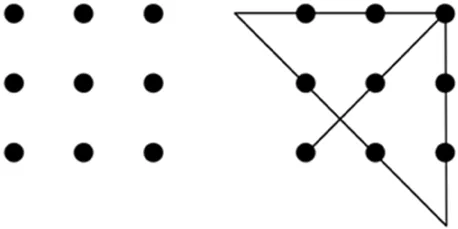
Figure 9.1: The Nine-Dot problem: Nine points distributed evenly in a square (left side) are to be connected by four lines without
setting down the pen.
of the information theory presented by Shannon and Weaver (1949), all kinds of mental activity – perception, learning, thinking etc. – were summarized under the term information processing. Information became the raw material that the organism absorbs, stores, and processes.
other than information processing (see also Chapter 11, “Nature of Language”).
9.3.3.1 Problem Space and Task Environment
When a motivated person deals with an intellectual requirement, an analysis of behavior provides information about both the task and the thought processes. Both aspects are inextricably linked, but should nevertheless be kept apart conceptually. For a better understanding, Newell and Simon (1972) therefore introduced the term task environment to describe the symbolic content that is necessary to solve a problem. This externally given information corresponds to the internally constructed problem space, which describes the subjective representation of a task, i.e. the imaginary space in which problem solving takes place during thinking. Their influential theory of problem solving is described in more detail in Textbox 9.1.
The underlying idea of interpreting information processing of the organism as symbol manipulation makes it possible to reproduce such processes on a computer (“cognitive modeling”); the division into data (symbols representing certain states) and program (symbols representing certain transformations of symbols) is unimportant considering the fact that symbols are involved in both. Important for the symbolic system of human language is its tool function for thinking. The “inner conversation of the soul with itself” (=thinking), as the Greek philosopher Plato formulated it over 2000 years ago, is nothing
Textbox 9.1: Theory of Problem Solving by Newell and Simon
In their book “Human Problem Solving”, Newell and Simon (1972) presented a theory of problem solving that has been widely and sustainably received and still represents the basis of many approaches in this field today. Two cooperating sub-processes form the core of their theory: the process of understanding and the process of searching. The process of understanding. The understanding process has the function to generate the internal
representation of the problem. The problem situation must be perceived in order to deduce from the information given initially (a) what the initial state is, (b) which operators can be used to change the state, and (c) how to recognize that an achieved state represents the goal. These three components make up the problem space, which is constituted by the process of understanding (see below for
Psychology of Human Thought • Chapter 9 • 159
Funke Problem Solving
more). Of course, the problem space can change during the solution process when new information becomes known, whether due to external circumstances or due to search processes. The search process. The search process has the function of generating the solution to the problem. This process is driven by the result of the understanding process. It searches for differences between a given state and a target state and for operators that could bring about a state change. Different search procedures for low-knowledge tasks have been called “weak methods”. They are weak because their generality is at the expense of their power. Specific methods (“Use the hammer to drive in the nail!”) are stronger, but cannot be used often (it does not help to fasten a screw). More general methods (“Find a tool to get ahead!”) are more common, but weaker (which tool to use remains open). One might think that the two processes of understanding and searching described by Newell and Simon would be executed in a fixed order (first understanding, then searching). In fact, however, problem solvers often switch back and forth between the two processes and mix them (see Chi, Glaser, & Rees, 1982; Hayes & Simon, 1976).
With their ideas, Newell and Simon (1972) pointed to an important issue for problem-solving research. They distinguish between psychological processes on the part of the problem-solving person on one hand and perfect rationality on the other hand – a distinction that results from the limited rationality (Simon, 1947) of human behavior. By the way: Herbert Simon was awarded the Nobel Prize for Economics in 1978 for these considerations and the associated criticism of the theory of the all-time rational homo oeconomicus.
the task is to assign numbers to letters so that the following addition becomes a correct one

and the problem solver also knows that D=5, a replacement process can be carried out that now rewrites the instance space as

The idea of a problem space has inspired Simon and Lea’s (1974) “dual space model”, which divides the problem space into a rule space and an instancespace. In the rule space, all possible rules of a task are represented, in the instance space all possible states. Using the example of chess, the rules represent the legal moves of each figure (the operators). The instances are all possible arrangements that the figures can take.
By applying mathematical rules, the last position of the result has to be T=0 and thus the rule space is extended. What can be done to find the complete solution?
With the method of (a) “generate-and-test”, one can simply try out arbitrary assignments of numbers to letters. More intelligent would be method of (b) knowledge-guided “heuristic search”, which does not produce arbitrary new states in the instance space but only those which fulfill certain preconditions; e.g., R must be an odd number because of the necessary carry of the second to last column and the fact that the addition of two same numbers (L+L) always produces an even-numbered result. An alternative description of this process would be the method of (c) “rule induction”, which is used to check whether
Using the example of cryptarithmetic problems (see below, Section 9.5.1.2, “Cryptarithmetic Problems”), where letters stand for numbers, the instance space consists of the individual column elements of the letter addition, whereas the rule space contains the rules as to how letters can be replaced by numbers. Problem solving in this case means finding out those letter-number substitutions where the resulting arithmetic operations are correct. If, for example,
160 • Psychology of Human Thought • Chapter 9
Information-Processing Theories Funke
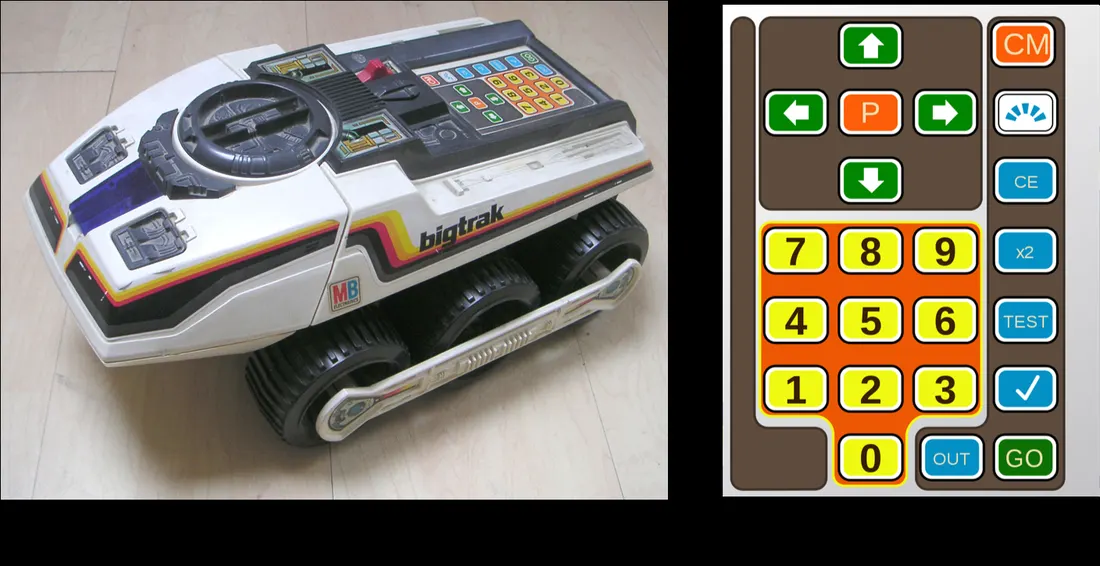
Figure 9.2: (a) Programmable truck BigTrak. (b) Keypad for programming. The keypad shown differs from the one used in the
experiment by having a X2 key instead of a RPT key (both figures from WikiMedia Commons, licensed under the terms of the CC-BY-SA-2.0).
a certain assumption such as R=7 is not only correct in a concrete case but is also consistent with all other available data.
opposite direction of influence: If no hypothesis is made about observations on the object of investigation (search in the hypothesis space), it is possible to use operators (search in the experiment space). Hypotheses can then be derived by observing the results of these experiments.
Simon and Lea (1974) emphasize that their approach is useful not only for cryptarithmetic problems but also for the description of concept acquisition, sequence learning, or the recognition of grammars. The “General Problem Solver” (GPS) is accompanied by a “General Rule Inducer” (GRI) which supports exactly these processes concerning the generation and testing of possible solutions.
For an illustration of their approach, they choose a programmable toy truck “BigTrak” (see Figure 9.2), whose moving behavior can be predetermined by certain keys (e.g., two steps forward, honking, two steps to the right). The keys on the car are divided into 11 instruction keys (e.g. GO, CLS, HOLD) and 10 number keys (0-9). The subject’s task is to find out the meaning of the unexplained RPT key (solution: RPTx repeats the last x instructions). The search for the meaning of this function key leads to the formation of hypotheses and the execution of experiments (see Shrager & Klahr, 1986).
Klahr and Dunbar (1988) further extended the dual space model. They have developed their SDDS model (“Scientific Discovery as Dual Search”) to explain scientific discoveries. In this model, they differentiate between the experiment space (which is similar to the instance space), and the hypothesisspace (similar to the rule space). In the hypothesis space, hypotheses are generated, modified and rejected, e.g. via connections between input and output variables. In the experimental space, on the other hand, experiments of the type in which the hypotheses generated can be tested or how the operators are to be applied are planned. For this purpose, both problem spaces (as in Simon & Lea, 1974) must interact: activities in the hypothesis space activate operations in the experiment space. There is also the
A total of 20 participants in this experiment learned to program BigTrak within 20 minutes. They had to think aloud while working on the problem. Then they had to explore the RPT key, which had not been used before and had not been explained either. Of the many results of this investigation, only one is described here, which refers to a typology of the participants. According to the authors, 7 participants can be called “theorists”, the remaining
Psychology of Human Thought • Chapter 9 • 161
Funke Problem Solving
13 participants were labelled as “experimentalists”. On average, theorists needed 24.5 minutes to solve the problem and performed 18.3 experiments (12.3 with specific hypotheses), whereas the experimentalists needed only 11.4 minutes to solve the problem and performed 9.3 experiments (8.6 with specific hypotheses). While the theorists searched in the hypothesis space, the experimentalists concentrated on the experiment space and attempted to derive generalizations from their experiments.
an incomplete model of the task (Burns & Vollmeyer, 1996). Even the specification of false hypotheses (Vollmeyer, Burns, & Holyoak, 1996) leads to improved performance in complex problems, which can be interpreted indirectly as an indication of an intensified search in the hypothesis space (see also Burns & Vollmeyer, 2002).
Definition of a problem: According to information processing theories, a problem is defined as a barrier between a given and a goal state, requiring input from a bridging operator, which cannot be taken from the library of already known operators but has to be constructed on the fly. Problem solving is seen as a search for a solution within the problem space.
With the dual space model, the results can be explained in terms of strategies, semantic embedding (cover story), goal specificity, hypothesis testing, and knowledge acquisition. The model also points to the issue that many studies with interactive tasks like BigTrak did not distinguish between an exploration phase and an application phase (an unknown system is explored in the exploration phase; in the application phase, explicitly specified goals have to be reached), i.e. the test persons knew the target values or the goal state of their system (specific target) from the outset. Thus, the task could also be solved in such a way that persons with a means-end analysis try to reach the goal (search in the instance space) without formulating hypotheses. They do not acquire knowledge about the system, but learn how to reach the goal (implicit knowledge; see Berry & Broadbent, 1988). For example, Geddes and Stevenson (1997) have explained the dissociation of knowledge and goal attainment. If, on the other hand, explicit knowledge is acquired, hypothesis generation and testing are present (search in the rule space). The search within the rule space can be demanded by the fact that a systematic strategy should be used and no target values are given. A semantic embedding of a problem (instead of a mere abstract description) as well as the specification of a hypothesis have the consequence that more hypotheses are tested and thus the search in the rule space is also required.
9.4 Methods for Assessing andMeasuring Problem Solving
Because problem solving occurs in the head of a person, it is not easy to assess the process of problem solving itself. Different proposals have been made to solve this problem (see also Chapter 3, “Methods”). On the one side, there is access via self-report (e.g., introspection and think-aloud; see below), on the other side, access via behavioral data (e.g., behavior traces and log-files; see below). Last but not least, physiological data (e.g., eye movements and brain-imaging techniques) have been proposed.
9.4.1 Self-Reports
Introspection is the observation of one’s own mental process. It was used in the 19th century by “armchair” psychologists who would rely on their own inner experience instead of empirical obeservations. Introspection is deemed unsuitable in modern research because there is no possibility to prove accuracy of the given report.
With the help of the dual space model, the results of the BigTrak experiment and of similar interactive tasks can be interpreted easily, and it becomes apparent why something was learned in some tasks and not in others. Nevertheless, there are findings that make an extension of the model necessary. One such finding is, for example, that sometimes a specific goal leads to better performance if the subjects have
Thinking aloud is the continuous verbalization of thought processes during problem solving and can be used as a valid data source under certain conditions (Ericsson, 2003). The spontaneous utterances accompanying the act of thinking represent objective expressive behavior that is used for assessment (Jäkel & Schreiber, 2013).
162 • Psychology of Human Thought • Chapter 9
Behavioral Data Funke
Ericsson and Simon (1983) regard thinking aloud methods as unproblematic if the actual thought content is only verbalized and described, because this thinking aloud only slows down the thinking process but does not disturb it. Explaining or describing one’s thoughts carefully, however, disturbs the process of thinking and changes the procedure of the participant (see Ericsson, 2006). Güss (2018) recommends this method especially for testing theories cross-culturally.
tween the system variables is understood and how well they deal with the dynamics of the system.
Log-file analyses look at the step-by-step activities during interactions with computer-presented problem-solving tasks. Such tasks have been used for the first time in a world-wide assessment of student performance in problem solving within PISA 2012, the “Programme for International Student Assessment” run by the OECD from the year 2012. Zoanetti and Griffin (2017) showed the advantages of going deeper into the specific solution steps that are documented in the log-files instead of looking only at the results of certain tasks. For example, pupils who repeatedly interacted erraneously with the software and who ignored negative feedback could be easily identified. Solution strategies became visible.
Verbal data is valid even if there is no 100% agreement between thoughts and verbalizations. Reasons for this deviation are (a) that not all conscious thoughts are verbalized by a participant and (b) that other cognitive steps run unconsciously due to routine/expertise and therefore cannot be verbalized at all. Additional data sources such as reaction times, error rates, eye movement patterns, or recordings of brain activity can increase validity. It is not the thinking itself that manifests itself as behavior but rather the consequences that accompany it.
9.4.3 Physiological Measures
Eye-movement patterns can be used to derive the processes underlying thinking. Eye movements consist of saccades (fast, short movements of the eyeball to align the fovea with the visual objectives) and fixations (keeping the visual gaze on a single location). It is assumed that a large part of information processing takes place during the fixations.
9.4.2 Behavioral Data
Three behavioral measures will be discussed briefly: sequential problems, computer-simulated problems, and log-file analyses.
Eye-movement measurements are used in addition to reaction-time and decision-time measurements in specific fields of experimental psychology, such as perception psychology. Pupillometric data allow conclusions to be drawn about workingmemory load, concentration, and emotional and motivational components. Beatty (1982) describes several experimental and correlational studies that warrant such statements.
By using sequential problems, one tries to visualize the solution path between the initial and the target situation (and thus the process of the solution) as a series of intermediate states. A good example of a sequential problem is the Tower of Hanoi(see below). Sequential problems “materialize” the solution process by producing a trace through the problem space.
Computer-simulated scenarios allow the investigation of the effects of connectedness and dynamics in complex situations by creating realistic simulation environments. Connectedness (i.e., the relationships between variables in a system) forces us to create causal models. The dynamics of a system force us to anticipate the course of development over time and to act with foresight. The interaction of human participants with such scenarios shows their strategic approaches and their reaction to certain scenarios. One can measure how well the connectedness be-
Also, brain-imaging methods can be used to depict physiological changes during thinking. Imaging methods such as functional magnetic resonance imaging (fMRI) are of particular importance for the investigation of problem solving. The aim of such a method is to measure haemodynamic changes of the brain (i.e., changes in the blood flow within the brain due to cerebral activity) as a marker for neuronal activation within certain brain structures.
The fMRI is a spatially high-resolution method, meaning that it allows for a very precise allocation
Psychology of Human Thought • Chapter 9 • 163
Funke Problem Solving
of regions in the brain. It is based on the fact that an increase in neuronal activation leads to an increase in oxygen demand, which in turn leads to an increased supply of oxygen-rich blood. This increase in oxygen can be made visible by means of a magnetic field. Changes in neuronal activity thus become accessible. The application of neuroimaging techniques to research questions in the field of problem solving is still rare (Anderson et al., 2008)
simple tasks include (a) classic mental exercises (such as insight problems), (b) cryptarithmetic problems (where letters represent numbers), and (c) sequential problems like moving disks.
9.5.1.1 Insight Problem Solving
In the early days of problem-solving research, brain teasers and insight problems were the preferred research material. Classic insight problems were presented, for example, by Duncker (1935) as part of his book Psychology of Productive Thinking. He examined the problem-solving process more closely, especially with regard to two problems:
9.5 Paradigms and IllustratingExperiments
For illustrative purposes, the following section presents some of the frequently used tasks in problem solving research. I will start with examples for simple tasks, then round off with complex ones.
(1) The radiation problem: “Looking for a method to free a person from an inoperable gastric tumor with the help of rays which, with sufficient intensity, destroy organic tissue while avoiding co-destruction of the surrounding healthy body parts” (p. 1). He described this problem as “practical” because the central question is “How can I achieve something?” Figure 9.3 illustrates this problem.
9.5.1 Simple Tasks
Simple task requirements differ from complex ones in the low amount of instruction and knowledge required to process them. With regard to the amount of knowledge required for understanding the problem situation, one could also speak of semantically impoverished problems as opposed to semantically rich problems. In addition, simple tasks usually have short processing times of up to 10 minutes, whereas complex tasks require hours or days. The
(2) The problem of proof: “Seeking a justifica-
tion for the fact that all six-digit numbers of the ‘abc,abc’ type, e.g. 276,276, are divisible by 13” (p. 1). He described this problem as “theoretical” because the guiding question is “How? From what do I see?”
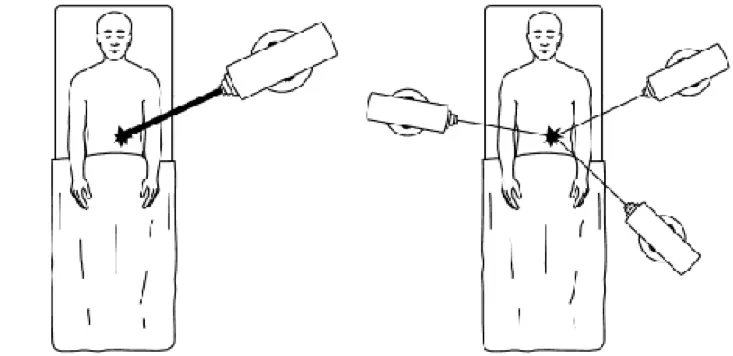
Figure 9.3: Duncker’s Radiation Problem: A patient needs a radiation treatment on a tumor inside the body. Normal radiation will harm
the healthy tissue it reaches on the way in. The solution is to target the tumor with low-level rays coming from different directions that have to converge on the tumor (from http://www.jimdavies.org/research/visual-analogy/proposal/node1.html).
164 • Psychology of Human Thought • Chapter 9
Simple Tasks Funke
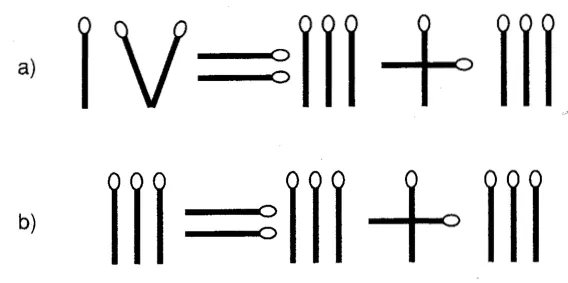
Figure 9.4: Two examples of matchstick arithmetics: (a) 4 = 3 + 3 (solution: 6 = 3 + 3); (b) 3 = 3 + 3 (solution: 3 = 3 = 3; from
Knoblich et al., 1999).
Duncker’s survey method was not selfobservation (introspection), as practiced, for example, by representatives of the historical Würzburg School (Oswald Külpe, Karl Marbe, Otto Selz) but observing somebody “thinking aloud”, a method in which the thinker remains directed at the content of his or her thinking. His analysis of the proposed solutions to the radiation problem shows that the various ideas can be arranged according to their “functional value”. Duncker calls this list “solution
solved by making a “=” out of the “+”. Besides the loosening of boundary conditions, the problem representation can also be changed by the decomposition of chunks (= single elements combined to groups). Thus, “weak” chunks like “IV” are distinguished from “strong” chunks like “X”, whose decomposition into “/” and “\” is more difficult due to the lack of significance of the individual parts.
Based on these two postulated mechanisms for changing the problem representation, Knoblich et al. could make specific predictions about different task difficulties and differential transfer effects for matchstick problems, which were confirmed in the reported experiments. Accompanying eyemovement analyses (Knoblich et al., 2001) also confirmed the following theoretical assumptions: (a) at the “dead end” states, there are fewer eye movements and longer fixation times; (b) as a result of prior arithmetic knowledge, one tends to regard the numerical values and not the operators as the variable quantities.
tree”.
Insight problems using “match-stick arith-metic” were investigated by Knoblich and coworkers (Knoblich, Ohlsson, & Raney, 2001). An insight problem occurs when an obstacle appears after the first exploration (“impasse”, dead end) and the solution appears subjectively impossible (see Metcalfe, 1986). One can get out of these mental dead ends only by changing the representation of the problem. Two examples from the work of Knoblich et al. (1999) will be presented in more detail (see Figure 9.4).
Matchstick arithmetic is an interesting problem type that can be used to investigate elementary thought processes of insight problems. In connection with eye-movement analyses, this simple paradigm allows process theories to be tested that would otherwise hardly be accessible to empirical research. However, it should also be noted that the small amount of knowledge that these problems require to be solved represents an advantage in terms of empirical and systematic analyses. At the same time, simple problems do not represent the complexity of problem-solving processes in everyday situations, let alone in space shuttle catastrophes, since
Problems in the field of match-stick arithmetic consist of false arithmetic expressions, which are composed of Roman numbers (I, II, III etc.), arithmetic operations (+, -) and the equal sign (=). By picking up one of the matches, the wrong one has to be turned into a correct expression. In Figure 9.4a, for example, the IV can be turned into a VI. This is the typical representation in which the numerical values are regarded as variable and the arithmetical operations as constant. If one loosens this boundary condition and allows that also the operators may be seen as variable, the task in Figure 9.4b can be
Psychology of Human Thought • Chapter 9 • 165
Funke Problem Solving
much more world knowledge usually is needed in real-life problem solving.
9.5.1.3 Sequential Problems
Sequential problems are those that require a series of steps to solve them, steps that are reflected in externally visible changes in the state space. Let us start with the “Cannibals and Missionaries” problem (also known as "Orcs and Hobbits"; more generic denomination: river-crossing problems, “move” or “transformation” problems). In this task, represen-
Anagram tasks. Another approach to gaining insight into the underlying processes of problem solving comes from the analysis of solution processes for anagram tasks. Anagrams represent letter sequences that must be changed around to form a word (e.g., HOOLSC -> SCHOOL). In this case, the difficulty can be influenced by the number of letters that have to be changed, the total number of letters given, and word frequency.
tatives of each group—cannibals and missionaries— have to be transported from one side of a river to another. A boat offers space only for a limited number of people. The major rule for solving the problem is that on neither of the banks nor on the boat can the number of cannibals exceed the number of missionaries because otherwise cannibals would do what their name suggests. To avoid such a catastrophe, a careful maneuver is demanded. According to the model developed by Jeffries, Polson, Razran and Atwood (1977), subjects working on this task consider only single-step move sequences. These moves are selected according to two simple rules: (a) search for better states (in terms of less distance to the goal state), (b) avoid states that have been previously visited.
Metcalfe and Wiebe (1987) have shown that anagram solutions rely on sudden insight processes and not on a general, sequential approximation to the answer. They showed that by capturing “hot-cold judgments” (an indication collected every 10 to 15 seconds of how close a problem solver feels to the solution) one cann accesss the process of gaining insight. While these judgments gradually increased as equations were solved, they remained consistently low for anagrams and only rose steeply shortly before the solution was found (see Chapter 6, “Metacognition”, for further research with anagram tasks).
9.5.1.2 Cryptarithmetic Problems
Another prominent example of a sequential problem is called the “Tower of Hanoi” and will be presented here in more detail because it is widely used. The problem consists essentially in moving a given set of differently sized, concentric disks, which are arranged on a starting rod, to a target rod using an auxiliary rod. Two rules have to be followed: (1) Only one disc may be moved at a time, (2) never place a larger disc on top of a smaller disc. Figure 9.6 illustrates the problem by showing the entire instance space, that is, all possible positions for the (simple) case of three discs on the three rods.
Cryptarithmetic problems require the decoding of letters into numbers using arithmetic procedures. Figure 9.5 illustrates an example of such puzzles.
Cryptarithmetic problems are not used so often nowadays because of their simplicity and uniformity of required processes: it is a relatively simple constraint satisfaction task. The total number of possible states is reduced by the constraint of a unique digit for a unique letter in a decimal representation. To make the task easier, more lettters could be disclosed at the outset.—The last prominent publication with that type of problem dates back more than 25 years (Clearwater, Huberman, & Hogg, 1991).
The instance space shown in Figure 9.6 explains the attractiveness of the problem for thought re-
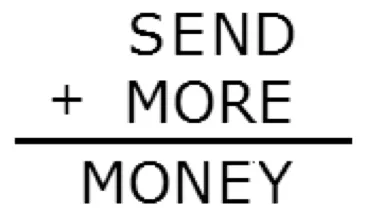
Figure 9.5: Example of a cryptarithmetic problem: each letter corresponds to one of the figures 0 to 9 (hint: E=5, Y=2). The numbers
in each line should produce a correct addition.
166 • Psychology of Human Thought • Chapter 9
Complex Problems Funke
search: Every single move of the problem solver can be represented as a step through this instance space. At the same time, each intermediate state during the solution process can be evaluated in terms of how far away it is from the required target state. In addition, it is possible to show which path is the fastest to the goal for any intermediate state. The process of problem solving can be described as a trajectory (a temporal sequence of states) in this space (for an in-depth analysis of the Tower of Hanoi, see Kotovsky, Hayes, & Simon, 1985). For the problem solver, this type of problem is easy to recognize, to define, and to represent. That is much more difficult in the case of complex tasks.
portant for the problem-solving process, (4) dynam-ics, in the sense of the possible change of a given situation over time, and (5) polytely (from the Greek word ‘polytelos’, meaning many goals), in the sense of there being many goals and objectives involved that are possible and could be pursued. All five features will be explained in briefly.
Complexity. Complexity in the sense of the number of variables involved plays an important role insofar as human information processing only has a limited capacity. As a consequence, the problem solver must take measures to reduce complexity, such as simplifications. He must also be able to deal with the fact that the simplified models can be inaccurate and even wrong in individual cases. For example, to model the complex relationships between world population, energy demand, and resource use, Meadows and colleagues (Meadows, Meadows, Randers, & Behrens, 1972) created a world model on a computer that has reduced the complexity of this huge problem to around 100 variables. Even if a large part of the detailed calculations of this model
9.5.2 Complex Problems
A complex problem shows the following features: (1) complexity in the sense that many variables are involved, (2) connectivity, reflecting the fact that relations exist between variables, (3) intransparency, referring to missing or inaccessible information im-
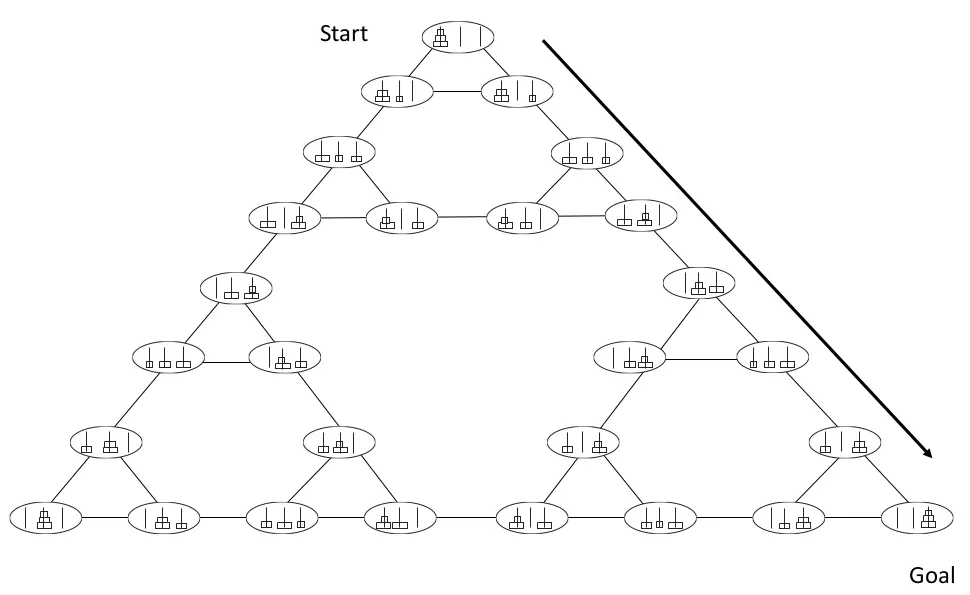
Figure 9.6: The instance space for a Tower of Hanoi with three disks. On top, all three disks are on the left rod (=start); at the bottom
right all three disks are on the right peg (=goal). The shortest path between start and goal is to follow the edge from top to right within seven steps.
Psychology of Human Thought • Chapter 9 • 167
Funke Problem Solving
are inaccurate from today’s point of view, the consequences and warnings derived from it were correct.
ductivity (good for the profit), but at the same time such salaries are costly (bad for the profit). Therefore, an optimal balance for this factor needs to be found, which can be very difficult.
Connectivity. With increasing intervariable dependency and connectivity, the effects of interventions in such a network are difficult to predict. As a consequence, the problem solver must map the dependencies into a model that forms the basis of his or her decisions. An example: Interventions in an ecosystem can have side effects that were not expected. One could think of bees dying because of intensified use of pesticides.
With these descriptions for complex problems in mind, let us look at two of the most prominent examples for this type of task, namely, the political scenario “Lohhausen” and the business scenario “Tailorshop”.
Intransparency. Intransparency is the lack of information about the problem situation; it makes a complex problem a decision-making situation under uncertainty. As a consequence, the problem solver must collect information that is missing. The problem solver needs to accept that her decisions may not include all relevant facts. For example, in a hospital emergency admission, not all desirable and necessary information about a seriously injured accident victim is available to the physician. Nevertheless, action must be taken and with minimal initial information a situation picture must be produced, which always is supplemented later by further facts, piece by piece.
9.5.2.1 Lohhausen
The political scenario “Lohhausen”, with around 2,000 variables, is one of the most complex scenarios in terms of the number of variables. “Lohhausen” is a small computer-simulated town. In the study with this scenario, 48 student participants were acting as a mayor for a simulation period of 10 years and were to lead the community as effectively as possible (Dörner, Kreuzig, Reither, & Stäudel, 1983). According to the description given by Dörner (1981, p. 165), the small town has about 3,500 inhabitants and its main income comes from a clock factory belonging to the town. In addition to the town administration, there are medical practices, retail shops, a bank, schools, kindergartens, etc. In the simulation, not only economic relations were mapped but also social, demographic, and psychological variables (e.g., satisfaction of the inhabitants). Participants were able to interact with the system in a variety of ways: They could influence the production and sales policy of the municipal factory, they could change tax rates, create work plans for teachers, set up and lease doctor’s surgeries, build housing, provide recreational facilities, etc.
Dynamics. Dynamics of a system refer to the changes of a given state over time. As a consequence, the problem solver must consider possible changes of the given situation and make prognoses about future developments. Potentially resulting time pressure has to be endured. For example, anyone speculating on the stock market usually makes assumptions about future market developments, but occasionally has to realize that the dynamics of the market cannot always be accurately predicted. Another example: In the event of a forest fire, a sudden change in wind direction can considerably disrupt the planning of the fire brigade and even endanger its activities.
Data analysis was essentially based on the comparison of the 12 best with the 12 worst acting participants with regard to important measures of success such as population of the town, number of unemployed people, condition of the local watch factory, immigration rate, satisfaction of the inhabitants, or capital of the municipality as well as judgments of the experimenter about the test-taker (e.g., “participant makes an intelligent impression”; subjects did not know these criteria before they started with the simulation).
Polytely. Polytely concerns the number and type of goals involved that need to be considered. As a consequence, the problem solver must set priorities and thus solve value conflicts. For example, company leaders usually strive for the highest possible profit. One major factor influencing this goal is the salary of the employers: paying employees high salaries should lead to more job satisfaction and pro-
168 • Psychology of Human Thought • Chapter 9
Comparing European and American Approaches to Complex Problems Funke
One of the most important (and surprising) results of this study: intelligence (measured with a conventional intelligence test) was not a predictor of performance in the scenario! This finding questioned the classical measurement of intelligence as one that is only assesses analytical intelligence but neglects “operative intelligence” (Dörner, 1986), which had
tems”) instead of a broader view that sees, for example, also advantages of migrants (increased diversity, increased work force, etc.). Political reasoning is sometimes driven by such causal-chain simplifications.
Superiority of the current motive means that humans are driven by their current motives and do not look much into the future. The problems of sustainability fall into this category: We do not want to forgo today’s luxury in order to keep our planet in a good shape for the next generation. Such long-term problems suffer from this error tendency.
not yet been measured by conventional IQ tests. This apparent shortcoming of intelligence tests has subsequently led to a sharp controversy about the benefits of IQ tests. As a result of this debate, the value of the intelligence component “information processing capability” now appears undisputed (see Wüstenberg, Greiff, & Funke, 2012; Kretzschmar, Neubert, Wüstenberg, & Greiff, 2016; for a meta-analysis: Stadler, Becker, Gödker, Leutner, & Greiff, 2015).
9.5.2.2 Tailorshop
The business scenario “Tailorshop” presents a profitbased enterprise in which fabrics are made into shirts by workers using production machines. The shirts are then sold on the market. The system consists of a total of 24 variables, 11 of which can be directly influenced by the respondents’ actions (for a more detailed description, see Danner et al., 2011, or Funke, 2010). The system’s core variable is the “capital” (balance sheet value), which is connected
With regard to the successful control of the Lohhausen community, none of the expected predictors like motivation, test creativity, gender, age, subject of study, or previous education of the participants was important. Successful “mayors” were characterized by strengths in other fields: self-confidence, extraversion, the striving for meaningful information search (“controlled divergent exploration”) or switching between fluctuating and focused thinking proved to be advantageous.
to 15 of the 24 variables. The task of the problem solver consists in managing the “Tailorshop” over a correspondingly extended simulation period in such a way that a sustainable profit is generated. Without intervention in the system, the “Tailorshop” would soon have to file for bankruptcy, as the running costs (storage costs, wage costs, rent, etc.) quickly lead to negative figures. This can be avoided by purchasing raw materials, maintaining the machines, and paying the workers a reasonable wage. In addition, the shirt price must be made competitive. Figure 9.7 shows the variables of the Tailorshop and their connections.
Three primary errors in handling the complex system, which occurred with most participants, were highlighted: (1) the lack of consideration of temporal sequences and difficulties in predicting exponential processes; (2) thinking in causal chains instead of causal networks; (3) the superiority of the current motive.
Difficulties in predicting exponential processesoccur because of a natural tendency to linearize our predictions. Exponential growth can be visualized by the idea of doubling the grain of rice on a chessboard square by square, starting slowly with one grain on the first square, two grains on the second square, 4 on the third, over 1 million by the 21st square, over a trillion by the 41st square and ending up with a number starting with 1.8 and 19 zeros following by the last 64th square.
9.5.3 Comparing European andAmerican Approaches toComplex Problems
According to Sternberg (1995), a special feature of European research in dealing with complex problems compared with American research is that in European research (as in other studies of European origin), novices are used as participants who had
Thinking in causal chains instead of causal net-works is demonstrated by the human tendency to search for simple cause-effect connections (e.g., “migrants increase the expenses of social security sys-
Psychology of Human Thought • Chapter 9 • 169
Funke Problem Solving
ng
manuf
acturi
u
m
an
r
eso
u
r
c
h
e
workers
50/100 machines
material
s
50/100
wages
++
++
++
satisfaction
+
possible production
social expenses
-
shirts stock actual production
+
+
machine capacity
-
-+
+
+
vans
+
shirts sales
maintenance
advertisement shirt price
-
management
++
+
t
e
rial
s
m
a
demand
site
maximizeoverall balance
di
s
trib
ma
rketi
n
g
ut
ion &
g
oal
s
Figure 9.7: Diagrammatic representation of the variables from the “Tailorshop” simulation (sorted by categories; from Engelhart, 2014,
p. 30).
to take on leadership tasks with their everyday routines and without any training or preparation. In the American tradition, research concentrates more on experts in their respective fields. So, the two different approaches can be seen as complementary ways of researching into the psychology of human thought.
(Halpern, 2013) becomes important in times of fake news and indoctrination.
Are there any open questions? First, there is still no comprehensive theory of problem solving that applies to the different types of problem. Second, the best way for assessing problem solving remains unclear. The validity of different measurement proposals is under scrutiny (Dörner & Funke, 2017). Third, besides individual problem solving, the focus will be on collaborative problem solving (i.e., two or more persons working together on a problem; see, e.g., Care & Griffin, 2017) because our modern times require people to work together. It has yet to be shown what the best mixture of collaborative and individual problem solving would be.
9.6 Conclusions
Problem solving can be seen as one the key competencies in the 21st century (Care, Griffin, & Wilson, 2018; Fiore et al., 2018). The argument here is that the labor market is changing more rapidly than ever. The grandfather who trained to be a shoemaker could do this for the rest of his life. Today’s workforce has to learn and to re-learn new tools dayby-day. This is why problem solving is becoming more and more important, not only in the workplace. But it may be that problem solving is part of an even more complex competency, namely systems compe-tency (Funke, Fischer, & Holt, 2018), the ability to handle complex systems. To control such systems and to keep them stable requires more than problem solving. And because systems competency needs information and reliable knowledge, critical thinking
Acknowledgement
The author wants to thank Elena Graf, Dr. Daniel Holt, Laura Krieglstein, and Dr. Katrin Schulze for their insightful comments on a draft version of this chapter. Also, thanks to my co-editor Bob Sternberg for his comments on my chapter. The work underlying the present article was supported by a grant provided by the Deutsche Forschungsgemeinschaft to the author (Fu 173/13 and Fu 173/14).
170 • Psychology of Human Thought • Chapter 9
Conclusions Funke
Summary
1. The term problem solving describes the process to overcome barriers between a given and a goal state.
2. Complex problems differ from simple problems by the degree of background knowledge needed for the solution process, the sheer number of processes to run, and the time needed for completion.
3. In addition, complex problems are characterized by complexity (many variables), connectivity (relations between variables), intransparency (missing information), dynamics (changes over time), and polytely (multiple goals).
4. Problem solving as a process occurs in different idealized phases: target elaboration, hypothesis formation, planning and decision making, monitoring, and evaluation.
5. Important theories of problem solving come from the Gestaltists, from action theory, and from information processing theories.
6. Methods for assessment rely on self-reports, behavioral data, and physiological measures.

Review Questions
1. Explain what problem solving is and how to position it in the list of all other cognitive functions.
2. Why are goals important for problem solving?
3. What methods seem appropriate for measuring problem-solving activities?
4. Why is there no single correct sequence of solutions steps?
5. What is an important assumption of an information-processing theory of problem solving?
Hot Topic
In my own research, I have tried to develop new instruments for measuring problem-solving competencies. Inspired by research about complex problems done by Dietrich Dörner in the mid-1970s, I started with an adaptation of his simulation scenario Tailorshop, then decided to develop more formal-based scenarios (MicroDYN, MicroFIN). I will present both instruments shortly.

Tailorshop is a microworld where subjects have to manage a small business simulation for a simulated time period of, e.g., 12 months. They can buy machines, raw material, set the wages for their employees, hire and fire workers, care for maintenance and for attractive sales conditions.
Joachim Funke
Psychology of Human Thought • Chapter 9 • 171
Funke Problem Solving
In this situation, subjects have to deal with complexity, intransparency, dynamics, and conflicting goals—most of these features are characteristic for complex problems.
The development of MicroDYN and MicroFIN was driven by the requirement to construct “batteries” of test items for the purpose of psychometric assessment: what was needed were easy,
medium, and difficult items that could be compared directly. Based on formal systems, such batteries were constructed for the world-wide PISA 2012 assessment of problem solving (see Csapó & Funke, 2017). In the end, questions of validity remain most important: if we want to contribute to an understanding of problem solving “in the wild”, we have to explain how managers, politicians, and other leaders make decisions and to predict errors as well as “wise” decisions in the long run (see Dörner & Funke, 2017).
What we need in the 21st century more than ever is systems competency (which is more than problem solving; see Funke, Fischer, & Holt, 2018). To understand how people represent complex systems, how they predict the future states of such systems, and how difficult it might be to make goal-directed interventions without producing unwanted side-effects: these are goals for my future research.
References
Csapó, B. & Funke, J. (Eds.) (2017). The nature of problem solving. Using research to inspire 21st century
learning. Paris: OECD Publishing. doi:10.1787/9789264273955-en
Dörner, D., & Funke, J. (2017). Complex problem solving: What it is and what it is not. Frontiers in Psychology,
8(1153). doi:10.3389/fpsyg.2017.01153
Funke, J., Fischer, A., & Holt, D.V. (2018). Competencies for complexity: Problem solving in the twenty-first
century. In E. Care, P. Griffin, & M. Wilson (Eds.), Assessment and teaching of 21st century skills. Researchand application (pp. 41–53). Cham: Springer. doi:10.1007/978-3-319-65368-6_3
References
Anderson, J. R., Carter, C. S., Fincham, J. M., Qin, Y., Ravizza, S. M., & Rosenberg-Lee, M. (2008). Using fMRI to test models of complex cognition. Cognitive Science, 32, 1323–1348. doi:10.1080/03640210802451588
Burns, B. D., & Vollmeyer, R. (1996). Goals and problem
solving: Learning as search of three spaces. In G. W. Cotrell (Ed.), Proceedings of the Eighteenth AnnualConference of the Cognitive Science Society (pp. 23– 24). Hillsdale, NJ: Lawrence Erlbaum Associates.
Bales, R. F., & Strodtbeck, F. L. (1951). Phases in group
Burns, B. D., & Vollmeyer, R. (2002). Goal specificity ef-
problem-solving. Journal of Abnormal and SocialPsychology, 46, 485–495. doi:10.1037/h0059886
fects on hypothesis testing in problem solving. Quar-terly Journal of Experimental Psychology A, 55(1), 241–261. doi:10.1080/0272498014300026
Beatty, J. (1982). Task-evoked pupillary responses, processing load, and the structure of processing resources. Psychological Bulletin, 91, 276–292. doi:10.1037//0033-2909.91.2.276
Care, E., & Griffin, P. (2017). Assessment of collaborative
problem-solving processes. In B. Csapó & J. Funke (Eds.), The nature of problem solving: Using researchto inspire 21st century learning (pp. 227–243). Paris: OECD Publishing. doi:10.1787/9789264273955-16en
Berry, D. C., & Broadbent, D. E. (1988). Interactive tasks
and the implicit-explicit distinction. British Journalof Psychology, 79, 251–272.
172 • Psychology of Human Thought • Chapter 9
References Funke
Care, E., Griffin, P., & Wilson, M. /Eds.) (2018). Assess-
ing: The European perspective (pp. 65–99). Hillsdale, NJ: Lawrence Erlbaum Associates.
ment and teaching of 21st century skills. Researchand applications. Cham: Springer. doi:10.1007/978- 3-319-65368-6
Duncker, K. (1935). Zur Psychologie des produktiven
Denkens [On the psychology of productive thinking]. Berlin: Julius Springer.
Chi, M. T. H., Glaser, R., & Rees, E. (1982). Expertise in
problem solving. In R. J. Sternberg (Ed.), Advancesin the psychology of human intelligence. Volume 1(pp. 7–75). Hillsdale, NJ: Lawrence Erlbaum Associates.
Engelhart, M. (2014). Optimization-based analysis and
training of human decision making. Unpublished doctoral dissertation. Ruprecht-Karls-Universität Heidelberg, Heidelberg, Germany.
Clausewitz, C. von (1832). Vom Kriege [On war]. Berlin:
Ericsson, K. A. (2006). Protocol analysis and expert thought: Concurrent verbalizations of thinking during experts’ performance on representative task. In K. A. Ericsson, N. Charness, P. Feltovich, & R. R. Hoffman (Eds.), Cambridge hand-book of expertise and expert performance (pp. 223– 242). Cambridge, UK: Cambridge University Press. doi:10.1017/cbo9780511816796.013
Dämmler.
Clearwater, S. H., Huberman, B. A., & Hogg, T.
(1991). Cooperative solution of constraint satisfaction problems. Science, 254(5035), 1181–1183. doi:10.1126/science.254.5035.1181
Cranach, M. von, & Tschan, F. (1997). Handlungspsy-
chologie [Pschology of action]. In J. Straub, W. Kempf, & H. Werbik (Eds.), Psychologie.EineEinführung. Grundlagen, Methoden, Perspektiven(pp. 124–158). München: Deutscher Taschenbuch Verlag.
Ericsson, K. A., & Simon, H. A. (1983). Proto-col analysis: Verbal reports as data. Cambridge, MA: Bradford. Retrieved from http:/ / ezproxy.l ibrary.unlv.edu/login?url=http://search.ebscohost.co m/login.aspx?direct=true&db=psyh&AN=1985-973 37-000&site=ehost-live
Danner, D., Hagemann, D., Holt, D. V., Hager, M.,
Schankin, A., Wüstenberg, S., & Funke, J. (2011). Measuring performance in a complex problem solving task: Reliability and validity of the Tailorshop simulation. Journal of Individual Differences, 32, 225–233. doi:10.1027/1614-0001/a000055
Ericsson, K. A. (2003). Valid and non-reactive verbaliza-
tion of thoughts during performance of tasks. Journalof Consciousness Studies, 10(9), 1–18.
Fischer, A., Greiff, S., & Funke, J. (2012). The process
Dewey, J. (1910). How we think. London: D.C. Heath &
of solving complex problems. Journal of ProblemSolving, 4(1), 19–42. doi:10.7771/1932-6246.1118
Company. Retrieved from http://www.gutenberg.org /ebooks/37423
Fiore, S. M., Graesser, A., & Greiff, S. (2018). Col-
Dörner, D. (1981). Über die Schwierigkeiten menschlichen Umgangs mit Komplexität [Omn the difficulties of people dealing with complexity]. Psychol-ogische Rundschau, 32, 163–179.
laborative problem-solving education for the twentyfirst-century workforce. Nature Human Behaviour, 2, 367-–369. doi:10.1038/s41562-018-0363-y
Funke, J. (2010). Complex problem solving: A case for
Dörner, D. (1986). Diagnostik der operativen Intelligenz
complex cognition? Cognitive Processing, 11(2), 133– 142. doi:10.1007/s10339-009-0345-0
[Diagnostics of operative intelligence]. Diagnostica, 32(4), 290–308.
Funke, J., Fischer, A., & Holt, D. V. (2018). Competencies
Dörner, D., & Funke, J. (2017). Complex problem solving:
for complexity: Problem solving in the twenty-first century. In E. Care, P. Griffin, & M. Wilson (Eds.), Assessment and teaching of 21st century skills. Re-
What it is and what it is not. Frontiers in Psychology, 8(1153), 1–11. doi:10.3389/fpsyg.2017.01153
search and applications (pp. 41–53). Cham: Springer. doi:10.1007/978-3-319-65368-6_3
Dörner, D., Kreuzig, H. W., Reither, F., & Stäudel, T.
(1983). Lohhausen. Vom Umgang mit Unbestimmtheitund Komplexität [Lohhausen: On dealing with inde-terminacy and complexity]. Bern: Huber.
Funke, J., & Glodowski, A.-S. (1990). Planen und Prob-
lemlösen: Überlegungen zur neuropsychologischen Diagnostik von Basiskompetenzen beim Planen [Planning and problem solving: Some considerations on the diagnosis of elementary planning competencies]. Zeitschrift für Neuropsychologie, 1, 139–148.
Dörner, D., & Wearing, A. J. (1995). Complex problem
solving: Toward a (computersimulated) theory. In P. A. Frensch & J. Funke (Eds.), Complex problem solv-
Psychology of Human Thought • Chapter 9 • 173
Funke Problem Solving
Gardner, H. (1985). The mind’s new science. A history of
Kretzschmar, A., Neubert, J. C., Wüstenberg, S., & Greiff,
the cognitive revolution. New York: Basic Books.
S. (2016). Construct validity of complex problem solving: A comprehensive view on different facets of intelligence and school grades. Intelligence, 54, 55–69. doi:10.1016/j.intell.2015.11.004
Geddes, B. W., & Stevenson, R. J. (1997). Explicit learning of a dynamic system with a non-salient pattern. Quarterly Journal of Experimental PsychologyA, 50(4), 742–765. doi:10.1080/027249897391874
Krueger, C. W. (1992). Software reuse. ACM Computing
Surveys, 24, 131–183. doi:10.1145/130844.130856
Graumann, C. F. (1980). Verhalten und Handeln. Prob-
leme einer Unterscheidung [Behaving and acting. Problems with their differentiation]. In W. Schluchter (Ed.), Verhalten, Handeln und System.TalcottParsons’ Beitrag zur Entwicklung der Sozialwis-senschaften (pp. 16–31). Frankfurt: Suhrkamp.
Lindblom, C. E. (1959). The science of “muddling through.” Public Administration Review, 19(2), 79– 88. doi:10.2307/973677
Lindblom, C. E. (1979). Still muddling, not yet through. Public Administration Review, 39, 517–526. doi:10.2307/976178
Güss, C. D. (2018). What is going through your mind?
Thinking aloud as a method in cross-cultural psychology. Frontiers in Psychology, 9(1292), 1–11. doi:10.3389/fpsyg.2018.01292
Lipshitz, R., & Bar-Ilan, O. (1996). How problems are
solved: Reconsidering the phase theorem. Organi-zational Behavior and Human Decision Processes, 65(1), 48–60. doi:10.1006/obhd.1996.0004
Halpern, D. F. (2013). Thought and knowledge: An in-
troduction to critical thinking (5th ed.). New York: Psychology Press. doi:10.4324/9781315885278
Luchins, A. S., & Luchins, E. H. (1950). New experimen-
tal attempts at preventing mechanization in problem solving. Journal of General Psychology, 42, 279–297.
Hayes, J. R., & Simon, H. A. (1976). The understanding
process: Problem isomorphs. Cognitive Psychology,8, 165–190. doi:10.1016/0010-0285(76)90022-0
Meadows, D. H., Meadows, D. L., Randers, J., & Behrens,
W. W. (1972). The limits to growth. New York: Universe Books. doi:10.9774/gleaf.978-1-907643-44-6_8
Jäkel, F., & Schreiber, C. (2013). Introspection in prob-
lem solving. Journal of Problem Solving, 6(1), 20–33. doi:10.7771/1932-6246.1131
Metcalfe, J. (1986). Feeling of knowing in memory and
problem solving. Journal of Experimental Psychol-ogy: Learning, Memory, and Cognition, 12, 288–294. doi:10.1037//0278-7393.12.2.288
Jeffries, R., Polson, P. G., Razran, L., Atwood, M.
E. (1977). A process model for Missionaries- Cannibals and other river-crossing problems. Cog-nitive Psychology, 440, 412–440. doi:10.1016/0010- 0285(77)90015-9
Metcalfe, J., & Wiebe, D. (1987). Intuition in insight and
noninsight problem solving. Memory & Cognition, 15, 238–246. doi:10.3758/BF03197722
Klahr, D., & Dunbar, K. (1988). Dual space search during
Newell, A., & Simon, H. A. (1972). Human problem
scientific reasoning. Cognitive Science, 12(1), 1–48. doi.10.1207/s15516709cog1201_1
solving. Englewood Cliffs, NJ: Prentice-Hall.
Pretz, J. E., Naples, A. J., & Sternberg, R. J. (2003). Recognizing, defining, and representing problems. In J. E. Davidson & R. J. Sternberg (Eds.), The psychology of problem solving (pp. 3– 30). Cambridge: Cambridge University Press. doi:10.1017/cbo9780511615771.002
Knoblich, G., Ohlsson, S., Haider, H., & Rhenius, D.
(1999). Constraint relaxation and chunk decomposition in insight problem solving. Journal of Ex-perimental Psychology:Learning, Memory, andCognition, 25(6), 1534–1555. doi:10.1037//0278- 7393.25.6.1534
Shannon, C. E., & Weaver, W. (1949). The mathematical
Knoblich, G., Ohlsson, S., & Raney, G. E. (2001).
theory of communication. Urbana, IL: University of Illinois Press.
An eye movement study of insight problem solving. Memory and Cognition, 29, 1000–1009. doi:10.3758/bf03195762
Shrager, J., & Klahr, D. (1986). Instructionless learning
about a complex device: The paradigm and observations. International Journal of Man-Machine Studies, 25(2), 153–189. doi:10.1016/s0020-7373(86)80075-x
Kotovsky, K., Hayes, J. R., & Simon, H. A. (1985).
Why are some problems hard? Evidence from Tower of Hanoi. Cognitive Psychology, 17, 248–294. doi:10.1016/0010-0285(85)90009-x
Simon, H. A. (1947). Administrative behavior. New York:
Macmillan.
174 • Psychology of Human Thought • Chapter 9
References Funke
Simon, H. A., & Lea, G. (1974). Problem solving and
Weber, M. (1913). Ueber einige Kategorien der verstehen-
rule induction: A unified view. In L. W. Gregg (Ed.), Knowledge and cognition (pp. 105–127). Hillsdale, NJ: Lawrence Erlbaum Associates.
den Soziologie [About some categories of an understanding sociology]. Logos. Internationale Zeitschriftfür Philosophie der Kultur, 4, 253–294.
Stadler, M., Becker, N., Gödker, M., Leutner, D., &
Werbik, H. (1978). Handlungstheorien [Action theories].
Greiff, S. (2015). Complex problem solving and intelligence: A meta-analysis. Intelligence, 53, 92–101. doi:10.1016/j.intell.2015.09.005
Stuttgart: Kohlhammer.
Wertheimer, M. (2010). A gestalt perspective on the psy-
chology of thinking. In B. M. Glatzeder, V. Goel, & A. von Müller (Eds.), Towards a theory of thinking.Building blocks for a conceptual framework (pp. 49– 58). Berlin: Springer.
Sternberg, R. J. (1995). Expertise in complex problem
solving: A comparison of alternative conceptions. In P. A. Frensch & J. Funke (Eds.), Complex problemsolving: The European perspective (pp. 295–321). Hillsdale, NJ: Erlbaum. doi:10.4324/9781315806723
Witte, E. H. (1972). Field research on complex decision
making processes: The phase theorem. InternationalStudies of Management and Organization, 2, 156–182. doi:10.1080/00208825.1972.11656117
Vollmeyer, R., Burns, B. D., & Holyoak, K. J. (1996).
The impact of goal specificity on strategy use and the acquisition of problem structure. Cognitive Science, 20(1), 75–100. doi:10.1207/s15516709cog2001_3
Wüstenberg, S., Greiff, S., & Funke, J. (2012). Complex
problem solving — More than reasoning? Intelli-gence, 40(1), 1–14. doi:10.1016/j.intell.2011.11.003
von Wright, G. H. (1974). Erklären und Verstehen [Ex-
plaining and understanding]. Frankfurt: Fischer Athenäum.
Zoanetti, N., & Griffin, P. (2017). Log-file data as indicators for problem-solving processes. In B. Csapó & J. Funke (Eds.), The nature of problemsolving:Using research to inspire 21st centurylearning (pp. 177–191). Paris: OECD Publishing. doi:10.1787/9789264273955-13-en
Watson, J. B. (1913). Psychology as the behaviorist views it. Psychological Review, 20, 158–177. doi:10.1037/h0074428
Psychology of Human Thought • Chapter 9 • 175
Funke Glossary
Glossary
behavioral data Behavior traces, in terms of se-
problem solving Activity to reach a certain goal
quential problems or computer-simulated scenarios, and log-files of human-computer interactions that allow access to processes related to thinking. 162
despite barriers on the way between initial state and goal state. 155
problem space The internal representation of the
task environment—the space contains tools, barriers, solution will be sought and potentially found. 159
collaborative problem solving Problem-solving
activities in a group of persons (two or more) working together on a problem. 170
complex problem A problem situation that re-
self-report The observation of one’s own mental
quires a higher amount of world knowledge and is characterized by complexity, connectivity, intransparency, dynamics, and polytely. 167
processes: introspection and thinking aloud. 162
simple task A problem situation that require little
amount of previous knowledge. 164
ill-defined problem Problems with unclear goals
where success cannot easily be identified. 156
task environment The externally given descrip-
introspection Observation of one’s own mental
tion of a problem situation, the structure of the problem and its elements, including all possible states on the way from initial to goal state. 159
process. 162
match-stick arithmetic False arithmetic expres-
sions composed of Roman numbers, arithmetic operations, and the equal sign, that have to be turned into correct ones. 165
thinking aloud The continuous verbalization of
thought processes during problem solving. 162
phase theorem A description of the processes ac-
tually taking place in problem solving as well as a prescription for how to solve problems. 156
Tower of Hanoi A typical simple problem situa-
tion that requires repeated application of disk movements. 163, 166
physiological data Eye-movement data and brain-
imaging data allow access to physiologcal processes that accompany thinking processes. 162
well-defined problem Problems with clear goal
descriptions where success can be measured easily. 156
176 • Psychology of Human Thought • Chapter 9