 Starvard
The Psychology of Human Thought · Chapter 10 of 19
Chapter 10: Decision Making
by Julia Nolte, David Garavito & Valerie Reyna
Choice is ubiquitous, from small decisions such as whether to bring an umbrella to life-changing choices such as whether to get married. Making good decisions is a lifelong challenge. Psychologists have long been fascinated by the mechanisms that underlie human decision making. Why do different people make different decisions when offered the same choices? What are common decision making errors? Which choice option is the “best” and why? These questions are addressed in this chapter.
term bounded rationality to describe this limited rationality and described human beings as satisficers, who choose the first available option that satisfies a given threshold, rather than optimizers, who choose the option that is the best of the set (Payne, Bettman, & Johnson, 1988).
Descriptive models describe real-life behavior in which decision makers fall short of maximizing. Descriptive models characterize how decision makers actually make choices and explain why they do so. These models do not prescribe how decision makers ought to behave if they want to accomplish specific decision goals.
We first outline models and theories of decision making, defining key concepts and terms. We then describe the psychological processes of decision makers and how these approaches can sometimes lead to systematic biases and fallacies. We touch on the related subject of judgment because of the close relationship with decision making in the literature.
Prescriptive models attempt to bridge the gap between normative and descriptive models. These approaches recommend which steps to take in order to achieve certain normative goals, as for example, guidelines or decision aids in real-world contexts. These include Bransford and Stein’s (1984) IDEAL framework, Sternberg’s (1986) problemsolving model, the GOFER model of decision making (Mann, Harmoni, & Power, 1991), and Guo’s (2008) DECIDE model of decision making.
10.1 Types of Models of DecisionMaking
Early theories of decision making were often normative in nature. Normative models characterize optimal or ideal decision making, for example, choosing options consistently that yield greater utility or overall usefulness of goods (von Neumann & Morgenstern, 1944). Often, this boils down to choosing so as to maximize money. Psychologists, beginning with Simon (1956), pointed out that humans rarely choose optimally because their information processing capacities are bounded; hence, he introduced the
10.2 Foundational Concepts
One of the foundational concepts that underlies models of decision making is expected value (EV; Knutson, Taylor, Kaufman, Peterson, & Glover, 2005). EV is calculated by multiplying the objective probability of the occurence of an event by the magnitude
https://doi.org/10.17885/heiup.470.c6673 Psychology of Human Thought • Chapter 10 • 177
Nolte, Garavito & Reyna Decision Making
of the possible outcome (e.g., winning $10,000). Probability is expressed as a number ranging from 0 (impossible to occur) to 1 (definite to occur). Thus, the EV of gaining $10,000 with a 0.50 probability would be $5,000 because $10,000 x 0.50 = $5,000.
choose the risky option B, and risk-neutral or riskindifferent individuals would be expected to choose one of the two options at random. As such, it is impossible to classify risky or risk-free options as better than the respective alternative—which one is preferred will depend on the specific choice at hand, as well as the subjective perspective of the decision maker.
From a mathematical perspective, the option with the higher objective EV is the “better“ or more desirable choice option. However, options that have the same EV are not equally attractive to many decision makers. Consider a choice between gaining $5,000 for sure (option A: $5,000 x 1.00 probability = $5,000) versus a 0.50 probability of gaining $10,000 versus a 0.50 probability of gaining $0 (option B: $10,000 x 0.50 + $0 x 0.50 = $5,000). Although both options offer the same EV, economists would describe option B as riskier than option A because its outcome is more variable and therefore more uncertain (Fox & Tannenbaum, 2011). By contrast, some psychologists define risk more broadly, encompassing behaviors such as drug abuse with potentially negative outcomes (e.g., death due to drug overdose). Uncertainty differs from ambiguity, which arises when an option has unknown probabilities. For example, if option B instead consisted of an unknown chance of gaining $10,000 (otherwise gaining $0), the level of uncertainty associated with this choice option would be ambiguous.
10.3 Theoretical Frameworks
10.3.1 Expected Utility Theory
One theory that accounts for subjective effects such as the phenomenon of risk-aversion is expected util-ity theory (EUT), which describes a classic normative model of decision making. Unlike EV, EUT represents outcomes non-linearly via a negatively accelerated function of objective magnitude (von Neumann & Morgenstern, 1944). Using this function, if the objective magnitude of a reward was continuously increasing at a set rate, the subjective magnitude of the same reward would increase at an increasingly slower rate, hence “negatively accelerated.” In other words, particularly at large magnitudes, the subjective value of a reward will be less than its objective value. When EV is equal, objective outcomes are larger in the gamble, and so the value of risky options is discounted more steeply than the value of risk-free options.
Characteristics of a choice option—such as its EV or its levels of risk and uncertainty—are important determinants of the choices a person will make. However, decisions are also influenced by the individual characteristics and preferences of the decision maker, such as their tendendies to avoid or embrace ambiguity and risk.
For instance, option B may only be worth $9,950 to a decision maker. This subjective value is then multiplied by the objective probability of the expected outcome to derive a choice option’s expected utility. Comparable to options with high EV, options with high expected utility are expected to be preferred over options with low expected utility. A negatively accelerated utility function for outcomes also explains why many decision makers will choose option A with the certain outcome over option B with the more uncertain or risky outcome. However, in most studies measuring risk preferences, decision makers learn about probabilities and outcomes through written (or spoken) description rather than through experience. Learning about outcomes and their probabilities by experiencing them encourages risk-taking. When decision makers rely on feed-
Although there are exceptions where decision makers are ambiguity-indifferent or ambiguityseeking (e.g., cancer patients with an unfavorable prognosis; Innes & Payne, 2009), most individuals demonstrate ambiguity aversion (Camerer & Weber, 1992). This means that most people will favor choice options that are unambiguous over options that are ambiguous. Similarly, most decision makers are risk-averse: When choosing between the riskfree option A and the risky option B we described above, most people will choose A. Nevertheless, this does not mean that option B is never favored. In fact, risk-seeking individuals would be expected to
178 • Psychology of Human Thought • Chapter 10
Subjective Expected Utility Theory Nolte, Garavito & Reyna
back, instead of verbal descriptions, to learn about outcomes, they can become risk-neutral or even riskseeking in the gains domain (and risk-averse for losses; Barron & Erev, 2003; see also Weber, Shafir, & Blais, 2004).
that is, choosing a sure option over a gamble). To illustrate this effect, remember the two choice options we introduced earlier: A, gaining $5,000 for sure, and B, a 0.50 probability of gaining $10,000 versus a 0.50 probability of gaining $0. As we discussed, many decision makers prove risk-averse when confronted with these choices, and will therefore select the first option (A).
10.3.2 Subjective Expected UtilityTheory
Now, assume that instead of being faced with the possibility of winning money (that is, a “gain“ frame), decision makers are given $10,000 and told they might lose money (“loss“ frame). Specifically, decision makers can either lose $5,000 for sure or take the risk of a 0.50 probability of losing all $10,000 versus a 0.50 probability of losing $0. In this context, many decision makers are risk-seeking. This means they prefer the risky option B to the sure loss of $5,000 in option A. Accordingly, many decision makers reverse their preferences from riskseeking to risk-avoidance depending on the reference point they are given.
In 1954, the statistician L. J. Savage further refined the idea of subjectivity by introducting subjectiveexpected utility theory (SEU). SEU accounts for a subjective perception of probabilities through a nonlinear transformation of objective probabilities. (This work was one of the major influences on prospect theory, described below, which also assumes nonlinear perceptions of probabilties.) Accordingly, SEU posits that a choice option’s subjective value is multiplied by its subjective probability to estimate its subjective expected utility. Options with higher subjective expected utility are hypothesized to be favored over options with lower utility.
By showing that decision makers prefer different choice options depending on the way choices are being presented to them, PT challenges the traditional economic belief that a person’s risk preferences are consistent. A psychological approach would be to say that risk preference is not a fixed disposition (Becker, 1976). However, decision science is concerned with the fact that framing effects violate the invariance assumption of EUT, thereby challenging a fundamental assumption that human beings are rational (i.e., have coherent preferences).
10.3.3 Prospect Theory
In 1979, psychologists Kahneman and Tversky proposed an alternative to both EUT and SEU called prospect theory (PT; Figure 10.1). PT not only accounts for subjectivity in perceived outcomes and probabilities but also proposes the notion of relative change (i.e., from a specific reference point or status quo; Kahneman & Tversky, 1979). According to PT, outcomes, even when they are objectively equivalent, are subjectively perceived as either upward (“gains”) or downward (“losses”) adjustments away from a reference point (Tversky & Kahneman, 1986). As a result, PT can explain crucial decision making phenomena such as the framing effect or loss aversion.
10.3.3.2 Reference Point
Like EU and SEU theory, PT hypothesizes that decision makers become less sensitive to changes in gains or losses the farther these values move away from the reference point. For example, the difference between gaining either $5,000 or $10,000 is believed to feel more significant to the decision maker than the difference between $105,000 or $110,000. This is true even though in both cases, the two choice options differ by an absolute value of $5,000. This is because $105,000 and $110,000 are much farther away from zero than both $5,000 and $10,000 are.
10.3.3.1 Framing Effect
The framing effect describes a shift in risk preferences that arises when the same information is either framed as a “loss“ (which typically leads to risktaking, that is, choosing a risky gamble over a sure option) or a “gain“ (which leads to risk-avoidance,
Psychology of Human Thought • Chapter 10 • 179
Nolte, Garavito & Reyna Decision Making
10.3.3.3 Loss Aversion
pate more common events, such as experiencing a car crash.
PT further holds that decision makers not only perceive changes differently when they move away from the reference point, but also depending on their direction compared to the reference point (that is, based on whether changes represent gains or losses). The concept of loss aversion follows from the observation that to decision makers, losses “feel“ worse than gains of the same magnitude “feel“ good (Tversky & Kahneman, 1992). Consequently, decision makers are believed to be more motivated to avoid a loss of a certain value than they are to obtain a gain of objectively equivalent value. PT’s framework incorporates loss aversion by modeling a steeper loss function than gain function in its valuation of outcomes, yielding a distorted S-shape, with a flatter top and a longer bottom.
In sum, theories of decision making such as EUT, SEUT, and PT predict that decision makers rarely make decisions grounded in the objective characteristics of the choice options they are considering. Instead, decision makers seem to base their choices on subjective perceptions of objective information and personal preferences relating to risks, rewards, and losses. However, predictions made by EUT, SEUT, and PT are not always good descriptions of actual decision making, even at the group level (e.g., Reyna, Chick, Corbin, & Hsia, 2014); we return to this topic below when we discuss an alternative to these theories, fuzzy-trace theory.
10.4 Dual Process Theories of DecisionMaking
10.3.3.4 Probability Weighting Function
10.4.1 System 1 and System 2
In addition, PT proposes a probability weighting function. According to the probability weighting function, decision makers do not perceive differences in probabilities realistically either. Instead, they underestimate moderate to high probabilities and overestimate small probabilities. As a result, decision makers may wrongfully anticipate the occurence of very unlikely events, such as winning the lottery or dying in a plane crash, but fail to antici-
More recently, decision making researchers including Nobel Laureate Daniel Kahneman have proposed so-called dual process theories of judgmentand decision making. This type of theory contrasts intuitive, impulsive decision making (also called “System 1“ reasoning) with rational and logical deliberation (“System 2“ reasoning; Kahneman, 2003, 2011; Stanovich & West, 2008; see
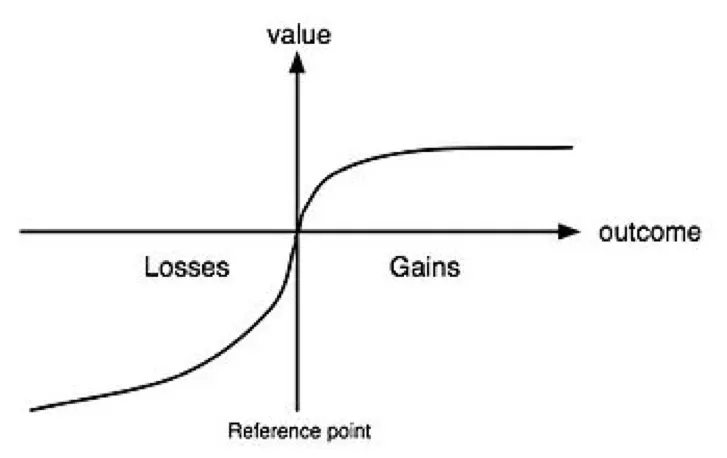
Figure 10.1: The value function that passes through the reference point is s-shaped and asymmetrical. The value function is steeper for
losses than gains indicating that losses outweigh gains. ©Marc Oliver Rieger, CC BY-SA 3.0, https://en.wikipedia.org/
180 • Psychology of Human Thought • Chapter 10
Developmental Dual Process Theories Nolte, Garavito & Reyna
also “Type 1” and “Type 2” processes in Evans & Stanovich, 2013).
wards while other brain regions are more sensitive to the delay of future rewards. This can affect the perceived value of immediate and delayed choice options and may lead decision makers to perceive delayed rewards as less desirable than immediate rewards.
Dual process theories generally characterize fast, automatic “System 1” reasoning as the major source of decision making biases (Kahneman, 2003, 2011; but see Duke, Goldsmith, & Amir, 2018, for contradictory evidence). According to EUT and PT, biases such as the framing effect can lead to seemingly irrational judgments of reality or decision making that is not always advantageous. To reiterate, the framing effect occurs when people‘s subjective perception of different choice options varies depending on how the options are portrayed or phrased, even when, objectively, the choice options are equivalent. We return to the framing effect later in this chapter to discuss when such technically irrational biases can actually turn out to be smart (Reyna, 2018).
10.4.2 Developmental Dual ProcessTheories
“System 1” reasoning is traditionally assumed to be
phylogenetically and ontogenetically less advanced than “System 2” reasoning, which increases with maturation (Steinberg, 2008). Thus, dual process theories cannot explain why, rather than becoming less pronounced, the strength of the framing effect has been shown to increase with age and experience (Reyna & Ellis, 1994; Reyna & Farley, 2006; Reyna et al., 2011, 2014). In the context of standard dual process theories, this finding is out of place, as mature decision makers are expected to become less susceptible to reasoning biases that have been explained in terms of “System 1“ processing, not more. For that and many other reasons, more recently developed theories aim at rethinking some of the core assumptions of standard dual process theories.
10.4.1.1 Temporal Discounting
Dual process theories have also been applied to tem-poral discounting. Temporal discounting is the tendency to assign a smaller subjective value to a delayed reward compared to an immediate reward (Kirby, 2009; McClure, Laibson, Loewenstein, & Cohen, 2004; but see Kable & Glimcher, 2007). Discounting distant outcomes can lead decision makers to choose smaller, immediate rewards over greater, delayed rewards, and therefore decrease the magnitude of their overall gains. Depending on their patterns of discounting in time preferences, their choices can also violate consistency.
10.4.3 Fuzzy-Trace Theory
One such theory is fuzzy-trace theory (FTT). Put forward by psychologists Reyna and colleagues (e.g., Reyna, 2012), FTT is a modern dual process theory that distinguishes between developmentally advanced intuition and mere impulsivity, which is believed to be developmentally inferior (Reyna, Weldon, & McCormick, 2015). FTT posits that a person encodes information simultaneously into verbatim representations, which are composed of surfacelevel details, and gist representations, which capture bottom-line meaning. Although roughly categorized as a dual process theory, FTT technically assumes that information is being processed and represented on a continuum between precise, verbatim details on the one end and vague, abstract gists on the other. Verbatim details include concrete numbers, exact wording, and other surface-level information (e.g., “Treatment A has a 30% risk of experiencing side
In psychological research, higher rates of temporal discounting have been linked to impulsivity and unhealthy risk-taking such as drug and alcohol abuse (Bickel, 2012; Bickel et al., 2012; Story, Vlaev, Seymour, Darzi, & Dolan, 2014). Accordingly, some researchers have drawn connections between impulsive “System 1“ reasoning and higher rates of temporal discounting (that is, higher rates of making suboptimal choices). For example, McClure and colleagues (2004) suggest that distinct neural systems activate when people make impulsive versus patient (willingness to wait for larger rewards) choices in temporal discounting tasks. Alternatively, according to Ballard and Knutson (2009), some brain regions are more sensitive to the magnitude of future re-
Psychology of Human Thought • Chapter 10 • 181
Nolte, Garavito & Reyna Decision Making
effects.“). Conversely, gist describes the fuzzy meaning underlying such details (e.g., “Treatment A is risky“).
with age (Romer, Reyna, & Satterthwaite, 2017). As a consequence, adults are predicted to rely more strongly on fuzzy, gist-based processing (as opposed to verbatim processing) than adolescents.
10.4.3.1 Hierarchy of Representations
10.4.3.3 Risk-Taking and Risk Avoidance
The theory posits that the gist of information is encoded at varying levels of abstraction to form a hierarchy of representations, and evidence supports this prediction: The simplest level of gist representation is grounded in categorical yes-or-no distinctions, such as whether or not a choice option entails any level of risk. Imagine deciding between treatment A with a 10% risk of side effects and treatment B with a 0% risk of side effects. Here, a categorical gist representation could be “Treatment A is risky. Treatment B is not risky“. More refined representations require ordinal less-or-more distinctions. If treatment A comes with a 10% risk and treatment B with a 5% risk, the corresponding representation might take the shape of “Treatment A has a higher risk than Treatment B“. Finally, the most precise representations of information call for exact details, such “Treatment A has a 10% risk of reducing life expectancy by 1 year while treatment B has a 5% risk of reducing life expectancy by 2 years“. Which representation will be relied on is ultimately determined by the specificity of the choice at hand, with a preference for the least-detailed representation that allows for a decision (dubbed the “fuzzy-processing preference”; Corbin, Reyna, Weldon, & Brainerd, 2015; Reyna & Brainerd, 2008; Reyna & Lloyd, 2006).
Reducing choice options to their bottom-line gist enables decision makers to categorically reject catastrophic risks, without trading off risk for the reward a risky choice option offers. Gist-reliance is often negatively associated with unhealthy risk-taking, whereas verbatim-based processing and impulsivity are often positively related to risk-taking (along with reward sensitivity and impulsivity, explaining unique variance in why adolescents are more riskprone; Mills et al., 2008; Reyna & Farley, 2006; Reyna & Mills, 2014; Reyna et al., 2015; Wilhelms, Reyna, Brust-Renck, Weldon, & Corbin, 2015). Verbatim-based reasoning leads decision makers to weigh risks against benefits, which can facilitate risk-taking if the risks associated with a choice option are perceived as low and benefits are perceived as sufficiently high. For example, the risk of contracting HIV from unprotected sex is low, so decision makers relying on verbatim representations, when weighing the risk of contracting HIV against the benefits from unprotected sex, will consider taking this risk because the benefits outweigh the risks (Wilhelms et al., 2015). Decision makers relying on gist representations, such as that it only takes once to get HIV, would not take the risk of contracting HIV, a catastrophically bad outcome (i.e., no risk of contracting HIV is better than some risk of contracting HIV). Evidence supports these theoretical tenets.
10.4.3.2 Developmental Trajectories
According to FTT, decision makers shift from verbatim to gist-based processing as they develop (Mills, Reyna, & Estrada, 2008; Reyna, 2012; Reyna & Brainerd, 2011; Reyna & Lloyd, 2006). In the context of FTT, gist-based processing serves intuition, here defined as an advanced ability to extract meaning and recognize patterns (Reyna, 2012). Since intuition is acquired through age, experience, and expertise, intuitive decision making is believed to be different from impulsive decision making, which peaks in adolescence and becomes less common
10.4.3.4 Standard and Reverse Framing
When comparing choice options whose risks and benefits differ considerably in size, this can lead children—whose processing veers closer to verbatim-based processing than gist-based processing—to process risks more objectively, and thus to not show irrational framing biases. Some young people, especially those who are sensitive to rewards (e.g., adolescents), may exhibit reverse
182 • Psychology of Human Thought • Chapter 10
Heuristics and Biases Nolte, Garavito & Reyna
framing when rewards are large, preferring gambles for gains and sure losses over risky losses (Reyna et al., 2011; Reyna & Farley, 2006). In reverse framing, a person tends to make the opposite choices that one would make in the typical framing effect (that is, choosing the risky gamble in the “gain“ frame and the sure option in the “loss“ frame). This effect, however, does not carry over into adulthood: Adults, with their greater tendency to rely on the simple gist of choices (such as “losing something for sure“ versus “losing something or losing nothing“ if presented with a “loss“ frame), tend to produce the standard framing effect (Chick & Reyna, 2012; Reyna et al., 2011). Young children do not show framing effects (Reyna & Ellis, 1994). Standard framing first emerges when differences in outcomes are small. When differences are substantial, older children and adolescents display reverse framing by favoring larger but risky rewards over smaller but safe rewards. A preference for reverse framing becomes stronger as adolescents’ reward sensitivity develops. The increasing tendency to rely on gist develops with adulthood, in which most decision makers demonstrate standard framing.
ture decision makers on certain types of decision tasks. Research grounded in FTT suggests that developmental reversals are the result of an increase in gist-based reasoning with age and experience, which makes mature decision makers more susceptible to reasoning biases that originate from gist-based reasoning than children and adolescents are (Reyna & Brainerd, 2011; Weldon, Corbin, & Reyna, 2013).
10.5 Heuristics and Biases
10.5.1 Bounded Rationality
Bounded rationality assumes that decision makers are often unable to deliberate each decision slowly and carefully (Simon, 1957; 1991). In other words, decision makers will not always be able to rely on “System 2” processing as it is described through
standard dual process theories, even if they are mature and experienced in making decisions. Instead, finite cognitive resources, time constraints, and incomplete information can drive decision makers to fall back on so-called heuristic processing, which is associated with “System 1” processing.
Heuristics are “recipes” or rules-of-thumb that serve as fast and efficient mental shortcuts to simplify many of the decisions and judgments we need to make every day (Gigerenzer & Gaissmaier, 2011). The use of heuristics is assumed to be adaptive and can be highly successful, but heuristics also give rise to biases similar to the reasoning errors we have already introduced in this chapter. When psychologists Amos Tversky and Daniel Kahneman introduced the heuristics-and-biases research program in the 1970s (e.g., 1974), multiple heuristics and biases were identified. Here, we describe some of the most well-known heuristics and biases. Although Gigerenzer and Gaissmaier (2011) emphasize the adaptive nature of heuristics and biases, Tversky and Kahneman also argued in favor of overall adaptiveness (and similarly relied heavily on Simon), but designed tests that revealed human limitations and fallacies. One difference in these approaches is definitional, describing heuristics as processing only part of information in a simpleminded way (Gigerenzer & Gaissmaier) as opposed to substituting one kind of judgment (that comes more readily
10.4.3.5 Developmental Reversal
As initially predicted by FTT, the standard framing effect increases with age and experience (e.g., Kim, Goldstein, Hasher, & Zacks, 2006; Reyna et al., 2014), which is at odds with assumptions of standard dual process theories. Greater development, according to these theories, leads to greater reliance on the slow, labored “System 2“ reasoning, leading to fewer biases, like the framing effect, in judgments and decisions, in contrast to what literature has shown (Wilhelms & Reyna, 2013; but see Peters et al., 2006). FTT conceptualizes the increase in the framing effect with age, and other developmental biases that disagree with the predictions put forward by standard dual process theories (such as an increase in the production of false memories), as a developmental reversal (Brainerd, Reyna, & Ceci, 2008; De Neys & Vanderputte, 2011; Reyna & Ellis, 1994; Reyna et al., 2011). Per FTT, developmental reversals occur when less mature decision makers, such as children and adolescents, “outperform” ma-
Psychology of Human Thought • Chapter 10 • 183
Nolte, Garavito & Reyna Decision Making
to mind, e.g., similarity) for another judgment (e.g., probability; Kahneman, 2003) or processing meaningful gist rather than superficial details (Reyna, 2012). Although some scholars have challenged traditional norms of rationality, assertions about alternatives such as ecological rationality (the degree to which a heuristic is adapted to the structure of the environment) are difficult to test scientifically.
10.5.1.2 Recognition Heuristic
In a similar vein, decision makers employ the recog-nition heuristic to make judgments about pairs of objects or events they have limited knowledge about. Students from Germany and the U.S. were tasked to compare pairs of American or German cities with regard to the size of their populations (Gigerenzer & Goldstein, 1996; Goldstein & Gigerenzer, 2002). Since Americans lacked detailed knowledge about German cities and vice versa, participants simply relied on whether or not they recognized the name of foreign cities (a less-is-more effect). If they recognized only one of the two cities in a pair, they inferred that this city had a bigger population, substituting familiarity for knowledge.
10.5.1.1 Availability Heuristic
To judge the relative probability or frequency of an event, the availability heuristic relies on the ease with which people recall examples associated with different choice options or events. For instance, when asked whether there are more words in the English language that have R as their first or as their third letter, most people—incorrectly—choose the former (Tversky & Kahneman, 1973). This occurs because words that start with a certain letter are more readily available for us to recall than other types of words. In everyday life, decision makers often rely on salient information in their environment (such as information publicized in the news) to evaluate how likely they are to contract certain diseases or to experience specific events, such as a shark attack (e.g., Read, 1995). Because rare and unexpected events are more likely to be publicized than expected events, people will sometimes overestimate the likelihood of uncommon events and underestimate the likelihood of more common events.
10.5.1.3 Affect Heuristic
People can rely on a different heuristic when evaluating which of two choice options is the riskier one: When comparing risks, the affect heuristic implies that dread increases perceived risk, even when objective probabilities do not warrant this inference (Slovic, 1987). This can skew individuals’ understanding of risk-benefit tradeoffs: Although in real life, risks and benefits can be positively correlated (meaning high risks come with high rewards), relying on the affect heuristic has been linked to the perception of an inverse relationship between risks and benefits. Objects or activities that elicit positive affect are typically believed to be high in benefits and low in risks, whereas the opposite is true for objects or activities that evoke negative feelings such as dread (Finucane, Alhakami, Slovic, & Johnson, 2000; Slovic, 1987).
More generally, it is crucial to read original articles (rather than only secondhand summaries of them) to fully understand the arguments and counterarguments in the decision making literature. For example, Gigerenzer and Gaissmaier (2011) say that “Neither version of the availability heuristic could
10.5.1.4 Confirmation Bias
Another bias that affects decision makers’s ability to reason objectively is confirmation bias. This bias describes people’s tendency to selectively seek, attend to, or recall evidence that sides with one’s initial opinion (Plous, 1993). Similarly, people have been found to be biased in their interpretation of information lacking clear meaning, construing whichever meaning best fits their personal attitudes. In a seminal experiment, proponents and opponents
predict participants’ frequency estimates. Instead, estimated frequencies were best predicted by actual frequencies” (p. 458), but the second sentence of Tversky and Kahneman’s (1973) article on the availability heuristic makes a similar point (p. 207): “In general, availability is correlated with ecological frequency, but it is also affected by other factors.“
184 • Psychology of Human Thought • Chapter 10
Bounded Rationality Nolte, Garavito & Reyna
of the death penalty read two scientific studies examining whether or not the death penalty deterred murder (Lord, Ross, & Lepper, 1979). While one study found that murder rates decreased in those U.S. states that had introduced the death penalty, the other study found no effect of the death penalty. Unbeknownst to the participants, both studies were entirely fictional. In line with a confirmation bias, participants thought that the study that supported their personal stance on death penalty was more probative than the study that contradicted their beliefs, of which they were markedly more critical.
willing to spend to acquire the mug when they did not own it (Kahneman, Knetsch, & Thaler, 1990).
10.5.1.7 Sunk-cost Fallacy
Similar to the attachment people feel towards their belongings or property, people also grow attached to past investments. As a result, decision makers often continue to invest time, money, or effort into previously made commitments, even when these commitments fail to pay off. This bias, labeled sunk-costfallacy, arises because people dislike incurring the loss of resources they have already invested into an endeavor (Arkes & Blumer, 1985). To provide an example, imagine that you have made a nonrefundable downpayment on a nice watch that you plan on gifting to your father. After making the downpayment, you come across a different watch that you like better. But since you do not want to waste the money you have already invested, you purchase the watch you saw first instead of the watch you prefer. This fallacy is typically explained in terms of loss aversion (which we introduced earlier in this chapter), as it aligns with the assumption that decision makers are more motivated to avoid losses (e.g., losing the money invested in the first watch) than to acquire gains (e.g., buying the nicer watch, Tversky & Kahneman, 1986).
10.5.1.5 Hindsight Bias
Also referred to as the “I-knew-it-all-along” effect, hindsight bias is observed when, after an event occurs, decision makers overestimate how predictable the outcome was in the first place (Fischhoff, 2007). In one of the first studies designed to test the hindsight bias, decision scientists Fischhoff and Beyth (1975) tasked decision makers to evaluate the probability of several possible outcomes associated with President Nixon’s then-upcoming visit to China and Russia. Following Nixon’s return to the U.S., participants overestimated the probabilities they had assigned to those outcomes that ended up occurring, exaggerating how foreseeable these events had factually been.
10.5.1.8 Status Quo Bias
10.5.1.6 Endowment Effect
But even if no prior investments are involved, many people perceive any change away from an existing choice to another choice option as a loss of sorts: The status quo bias (also known as the default effect) treats default settings or previous choices as reference points that are typically preferred over alternative choice options (Samuelson, & Zeckhauser, 1988). For instance, countries that have implemented an opt-out policy for organ donation report much higher consent rates to organ donations than countries in which willing potential donors have to manually opt in (Johnson & Goldstein, 2003). According to Daniel Kahneman and Amos Tversky (1982), this could be because individuals regret their choices more strongly when they suffer negative consequences as a result of a new action than when
Some phenomena have not been labeled biases, even though they produce biased judgments and decisions. For example, the endowment effect leads individuals to overestimate the objective value of objects they own, simply because they own them (Kahneman, Knetsch, & Thaler, 1991). This means that people are more partial to the same object if it is in their own possession than when it is in somebody else’s possession. In transactions, the endowment effect manifests as an unwillingness to trade objects one owns (Knetsch, 1989), or to demand an exaggerated price in exchange for parting with them. In a famous demonstration of this effect, decision makers who were given a mug charged approximately twice as much money to part with it than they were
Psychology of Human Thought • Chapter 10 • 185
Nolte, Garavito & Reyna Decision Making
they experience negative consequences as a result of inertia. PT suggests that the status quo acts as a reference point for all subsequent decisions, and that the prospect of potential losses associated with leaving the reference point outweigh the prospect of potential gains (because losses loom larger than gains).
makers agree that his personality best outfits him to work as a librarian. However, this response neglects to take the underlying base rate into account. In the experiment, this base rate had been presented to favor farmers (also see representativeness heuristic, Kahneman & Tversky, 1973).
10.5.1.11 Conjunction Fallacy
10.5.1.9 Anchoring Effect
When passing judgment, people are similarly prone to committing what is commonly referred to as a conjunction fallacy: the incorrect assumption that a combination of two or more conditions is more likely to occur than one of these conditions by itself. The most well-known example in this context is that of the fictional “Linda”, who is “31 years old, single, outspoken, and very bright. She majored in philosophy. As a student, she was deeply concerned with issues of discrimination and social justice, and also participated in anti-nuclear demonstrations“ (Tversky & Kahneman, 1983, p. 297).
The anchoring effect, another bias, is evident when individuals base their decisions around an initial “anchor value“ they encounter, even when this value is unrelated to the question at hand (Tversky & Kahneman, 1974). Once an anchor is in place, subsequent decisions are made by deviating away from this value, which leads to substantial biases in the estimation of prices and other numbers. For example, Ariely, Loewenstein, and Prelec (2003) asked MIT students to write down the last two digits of their social security number and then prompted them to bid for objects such as chocolate or computer equipment. Individuals with higher numbers made notably higher bids than those with lower numbers, suggesting that people anchored their judgments on their social security numbers—despite the fact that these numbers held no relevant information about the value of the auction items. While any salient number can serve as an anchor, anchors do not have to be random or meaningless: often, anchors are highly relevant to the choice context, such as existing baseline values.
Given this information, is it more likely that Linda is a bank teller or that Linda is a bank teller who is active in the feminist movement? Since the latter is more aligned with Linda’s personality, the majority of people side with the second rather than the first option. This type of reasoning, however, is erroneous, as the probability of a single event (i.e., Linda being a bank teller) must necessarily be higher than or the same as the probability of two joint events that are a subset of the more inclusive event (i.e., Linda being a bank teller and an activist). This fallacy is often explained through the use of the represen-tativeness heuristic (Kahneman & Tversky, 1972). This heuristic draws comparisons between specific cases (e.g., Linda’s characteristics) and a standard or parent population (e.g., feminists), sometimes resulting in the incorrect conclusion that just because something is more representative, it is also more likely to be probable.
10.5.1.10 Base-rate Fallacy
Anchor values are not the only way seemingly irrelevant information can bias our judgments. Individuals also engage in what is known as the base-ratefallacy, a reasoning error that ignores generic, statistical information in favor of specific, qualitative information (Tversky & Kahneman, 1985). Consider the case of a person named Steve (Kahneman, 2011), who is known to be shy, withdrawn, helpful, and tidy, with great attention to detail and a love for structure but little interest in engaging with people or the real world. When asked whether Steve is more likely to be a farmer or a librarian, many decision
Finally, decisions and judgments are often aided by social factors. Attribution bias is the common tendency to generate different explanations for one’s own behavior as opposed to other people’s behavior (Ross, 1977): When people evaluate their own actions (such as cutting in line while waiting in a queue), they often attribute them to external or con-
186 • Psychology of Human Thought • Chapter 10
Decision Strategies Nolte, Garavito & Reyna
textual factors (e.g., being late for work). However, when interpreting other individuals’ actions, people often believe that behavior is driven by internal factors that are characteristic of the person (such as cutting in line due to rudeness)—possibly because they are unaware of the external factors that affect other people’s lives. Aside from such internal and situational factors, judgments and choices will often be governed by social norms. Norms act as implicit or explicit guidelines to inform individuals whether to make a certain decision or not based on what other people around them do or expect them to do.
proach: A positive value in one choice attribute cannot make up for a negative value in another attribute. In practice, this means that some non-compensatory strategies dismiss any choice option that performs poorly on essential choice attributes.
Some of the most commonly studied strategies (e.g., Mata & Nunes, 2010; Svenson & Maule, 1993; Wichary & Smolen, 2016) include non-compensatory, satisficing strategies, such as elimination-by-aspects (EBA; Tversky, 1972) and the take-the-best strategy (TTB) (Hogarth, 1990; von Winterfeldt & Edwards, 1986). EBA requires decision makers to determine which choice attribute is the most important to them and to exclude all choice options from consideration that do not achieve a high enough value on this attribute. This process is then repeated for the second most important attribute (and so forth) until only one choice option prevails (Tversky, 1972). In contrast, TTB simply chooses that option which outperforms other options on a single choice attribute that is deemed “important enough” to enable a decision (or corre-
In this context, psychologists typically differentiate between injunctive and descriptive norms that influence decision making (Cialdini, Reno, & Kallgren, 1990). Injunctive norms outline which behaviors are socially desirable or acceptable, such as tipping a waitress, stopping at a red traffic light, or abstaining from underage drinking. Descriptive norms are perceptions of other people’s actual behavior. Consider, for example, an adolescent who is attending a party at a friend’s house. This adolescent may decide to embrace underage drinking because she knows or believes that other guests are illegally consuming alcohol as well—even if injunctive norms (such as the law, or her parents’ rules) prohibit it. As a result, injunctive and descriptive norms will not always overlap, even though in many cases, they do.
lated with the outcome; Gigerenzer & Goldstein, 1996). How decision makers know which attributes outperform others is an open question.
Compensatory, optimizing take a different approach than non-compensatory, satisficing strategies do. For example, the weighted additive rule(WADD) weighs the attributes associated with each option by their importance (or other means) and then adds up the different attributes to decide which option is the most favorable. Tallying (TALLY) is a special case of the WADD rule in which pros and cons are just added up without assigning them different weights (EW, equal weighting). EW selects the choice option with the highest sum of all attribute values, treating all attributes as equally important. Unlike EW, WADD assigns different importance to different choice attributes. To choose the choice option with the highest sum of attribute values, WADD first multiplies the value of each piece of information with the importance of the relevant choice attribute and then calculates the sum of these products, as in EV and EUT.
10.6 Decision Strategies
As discussed, cognitive, social and situational factors lead decision makers to base their decisions on seemingly irrelevant cues or skew the accuracy of their judgments. In the following part of our chapter, we review which strategies individuals employ to engage with and integrate evidence when sufficient information is available to them. These kind of decision strategies are typically categorized in two ways. The literature distinguishes between compensatoryand non-compensatory strategies (Hogarth, 1990; von Winterfeldt & Edwards, 1986). Compensatory strategies allow trade-offs between positive and negative values on different choice attributes whereas non-compensatory strategies take the opposite ap-
Psychology of Human Thought • Chapter 10 • 187
Nolte, Garavito & Reyna Decision Making
10.6.1 Satisficing versus Optimizing
together with the models and theories we outlined at the beginning of this chapter, knowing which strategies people employ and which biases they produce now gives us the means to describe, explain, and predict how decision makers will choose between choice options when facing certain types of decisions.
Since using non-compensatory or satisficing decision strategies requires less cognitive effort than using compensatory or optimizing strategies, satisficing becomes more common with age (e.g., Bruine de Bruin, Parker, & Strough, 2016). Although this suggests that older adults could be more prone to making uninformed choices, simulations demonstrate that employing more demanding strategies only leads to small gains in decision quality when compared to non-compensatory or satisficing strategies (Mata & Nunes, 2010). Put differently, some scholars interpret these null effects (no difference between strategies detected for these decisions) to mean that even resource-efficient choice strategies such as TTB and EBA can allow decision makers to make rather advantageous choices. However, research shows that people generally do not optimize in the strict sense of thoroughly processing all available information, but they do seem to process both outcome and probability information along with other simpler representations of that information, as predicted by FTT (see Reyna, 2012).
The theories we have reviewed expect decision makers to favor safe and unambiguous choice options, to pursue options with higher EVs, to adopt simplified choice strategies, or to emphasize gistbased processing when possible. A fundamental finding is that decision makers shift their choice preferences in accordance with the standard fram-ing effect. However, many individuals are not “average” decision makers: which choice options or strategies people consider desirable will depend on their risk and reward preferences, their subjective appraisal of objective choice characteristics such as magnitude and probability, their cognitive resources and processing style, and their susceptibility to both standard and reverse framing. Importantly, these determinants can evolve across the lifespan and in response to situational demands and constraints, suggesting that the same individual may well employ different strategies or come to a different decision when facing the same choice twice. In sum, decision making is a complex synthesis between the choice at hand, the decision makers’ individual make up, and the context in which the decision is made, including time constraints and whether there is information available that can help people to come to a decision.
10.7 Conclusion
At the beginning of this chapter, we set out to answer key questions about human decision making: Why are certain choice options favored over others, why do people make different choices when offered equivalent options, and which types of errors commonly occur when people make decisions? Taken
Summary
1. Normative, descriptive, and prescriptive models distinguish how decision makers make choices (descriptive) and how they should ideally behave (normative) to reach certain decision goals. Normative models propose that decision makers are rational, trying to optimize outcomes. In contrast, descriptive models hold that decision makers often violate assumptions of rationality. Prescriptive models make recommendations on how to achieve certain decision goals.
2. According to various theories of subjectivity, decision makers decide between different choice options by subjectively evaluating objective information about choice outcomes and the probability with which these outcomes occur. Whereas expected utility theory only
188 • Psychology of Human Thought • Chapter 10
Conclusion Nolte, Garavito & Reyna
considers subjective evaluations of choice outcomes, subjective expected utility theory also accounts for subjective evaluations of probabilities. Prospect theory combines both of these assumptions with additional hypotheses about reference points, sensitivity to changes from that reference point, and the influence of gains versus losses.
3. Dual process theories of decision making predict that decision makers evaluate choice options using one of two information-processing mechanisms: fast and impulsive “System 1” processing or slow and careful “System 2” processing. Standard dual process theories propose that decision makers default to “System 1” processing, which gives rise to various decision biases such as the framing effect or temporal discounting. Conversely, “System 2” processing is thought to increase with advanced reasoning and with maturity from childhood to adulthood.
4. Fuzzy-trace theory builds on previous theories of decision making, but also is the source of predictions that falsify those theories. The theory introduces novel assumptions about mental representations of choices: surface level verbatim representations and bottom-line, gist representations. FTT further deviates from standard dual process theories by differentiating between impulsiveness, which peaks in adolescence and leads to unhealthy risk-taking, and intuition based on reliance on gist representations, which is developmentally advanced and generally encourages healthy decision making (e.g., avoidance of HIV risk). According to FTT, mature decision makers rely more strongly on simple meaning (or gist) whereas younger decision makers resort to verbatim processing of rote information. As predicted, this theory can explain an increase in certain biases (e.g., the framing effect) with age, dubbing this general phenomenon of increasing gist-based biases as developmental reversal.
5. Bounded rationality assumes that decision makers are constrained in their ability to reason, especially under time pressure, when information is limited, or cognitive resources are low. Kahneman/Tversky, Gigerenzer and others have assumed that decision making exhibits cognitive economy, relying on fast-and-frugal mental shortcuts called heuristics (Nisbett & Ross, 1980). However, research since the 1990s has called these assumptions (that capacity limitations cause decision biases) into question (Reyna, 2012; Stanovich & West, 2008).
6. Under cognitive, time, or information constraints, decision makers are expected to fall back on heuristics—decision rules that help us make good decisions fast but that can also lead to reasoning biases that skew judgments or lead to suboptimal decisions. Well-known examples include the representativeness, recognition, and affect heuristic. Research suggests that these heuristics are due to intuitive processes.
7. When information is available, decision makers can employ thorough or frugal choice strategies to navigate the information, but that might not identify the most beneficial choice option as traditionally assumed. Satisficing and non-compensatory strategies were thought to operate under time constraints or limited cognitive resources, considering only some of the information available, but more recent research suggests that simpler gist processing is used even when people have information and time. Optimizing and compensatory strategies represent time- and resource-intensive choice strategies that consider much of the available information before allowing for a choice, but they do not necessarily yield superior choices.
Psychology of Human Thought • Chapter 10 • 189
Nolte, Garavito & Reyna Decision Making

Review Questions
1. Define what a “heuristic” is and under which circumstances decision makers may use heuristics. Describe at least two examples of heuristics.
2. Explain the difference between the standard framing effect and the reverse framing effect. Which types of decision makers are likely to engage in standard or reverse framing, and why?
3. Describe the difference between normative, prescriptive, and descriptive models of decision making.
4. What are the differences between fuzzy-trace theory and standard dual process theories of decision making?
5. Summarize how to calculate the expected value (EV) of a choice option. If two options have the same EV, how might decision makers decide between them?
Hot Topic
Julia Nolte, M.Sc., is a Ph.D. student at Cornell University’s Department of Human Development. Her research interests span risk perception, decision making, lifespan development, and health. At the moment, Julia is working on tailoring health and risk information to the preferences and needs of different age and patient groups. One line of this research addresses how healthy adults and arthritis patients make healthcare choices when provided with varying information formats (i.e., written information, icon arrays, metaphors). As part of this research, Julia evaluates whether decision makers’ reactions to different presentation formats depend on interindividual differences in numeracy and educational attainment. Another line of Julia’s research investigates to which extent younger and older adults’ information seeking depends on the type of information provided. Specifically, Julia researches the influence of quantitative (verbatim) and qualitative (gist) information on information acquisition.

Julia Nolte
David Garavito is a JD/PhD candidate and researcher at Cornell University who, using fuzzy-trace theory (FTT), examines developmental trends in memory and decision making. A large portion of his research focuses on cognitive theory and neuroscience, with his main research focus on the perception of decisions involving brain injuries in sports, as well as the short and long-term effects of concussions and sub-concussive head injuries on decision making and memory. Using both temporal discounting and framing tasks, David examines concussion-induced deviations from developmental trends in decision making and memory and how they may serve as a warning sign for development of possible neurodegenerative diseases later in life. Additionally, David uses structural and functional fMRI data to test theoretical predictions relating neural development, functional activation, and decision making. David seeks to empirically test the predictions of the various dual process theories, with a specific focus on FTT.

David Garavito
190 • Psychology of Human Thought • Chapter 10
Conclusion Nolte, Garavito & Reyna
Valerie Reyna is the Lois and Melvin Tukman Professor of Human Development, Director of the Human Neuroscience Institute, Director of the Cornell University Magnetic Resonance Imaging Facility, and Co-Director of the Center for Behavioral Economics and Decision Research. She has been elected to the National Academy of Medicine, Society of Experimental Psychologists, and President of the Society for Judgment and Decision Making. Her research integrates brain and behavioral approaches to understand and improve judgment, decision making, and memory across the lifespan. Her recent work has focused on the neuroscience of risky decision-making and its implications for health and well-being, especially in adolescents; applications of artificial intelligence to understanding cancer genetics; and medical and legal decision making (e.g., jury awards, medication decisions, and adolescent crime).

Valerie Reyna
Latest Research Highlights
Differences between description and experience, such as greater risk aversion when gains aredescribed verbally rather than experienced. For example, suppose that the rate of car thefts is about 1 in 10 in a city (9,989 for every 100,000 people); many people would buy insurance in this situation to protect against the risk of car theft. However, suppose you left your car unlocked for months and never experienced car theft or any other problem with your car. Not experiencing the statistically rare outcome of car theft (or experiencing it rarely) tends to lower the perception of risk, compared to describing the risk verbally.
Developmental reversals, a growing list of heuristics and biases that emerge with development fromchildhood to adulthood, contrary to traditional cognitive theories. For example, given a choice between winning two prizes for sure versus spinning a spinner to win four prizes or nothing, most adults choose the sure thing. However, when given four prizes and offered a choice between losing two prizes for sure or spinning a spinner to lose four prizes or nothing, most adults choose the risky option. Adults avoid the sure loss even when the total number of prizes is a net gain. This bias is not present in children; they pick the risky option about 70% of the time for both gains and losses, responding to the objective outcomes when they are explained simply and displayed clearly. FTT explains framing effects in terms of the qualitative gist of the options (get something or take a chance on getting nothing), as opposed to objective (verbatim) tradeoffs between risk and reward.
Dual-process models and their counterarguments, including differentiating different kinds of dualprocesses. For example, people with higher processing capacity who think carefully will sometimes censor their responses to gains and losses, making their choices more consistent, when they are presented with both gains and loss versions of the same decision. Dual-process theories suggest that this censoring is an example of deliberative System 2 thinking inhibiting intuitive System 1 thinking.
References
Cozmuta, R., Wilhelms, E. A., Cornell, D., Nolte, J., Reyna, V. F., & Fraenkel, L.
(2018). The influence of explanatory images on risk perceptions and treatment preference. Arthritis Careand Research, 70(11), 1707–1711. doi:10.1002/acr.23517
Garavito, D. M. N., Weldon, R. B., & Reyna, V. F. (2017). Fuzzy-trace theory: Judgments, decisions, and
neuro-economics. In A. Lewis (Ed.), The Cambridge Handbook of Psychology and Economic Behavior(pp. 713–740). Cambridge University Press. doi:10.1017/9781316676349.026
Psychology of Human Thought • Chapter 10 • 191
Nolte, Garavito & Reyna Decision Making
References
Arkes, H. R., & Blumer, C. (1985). The psychology
Camerer, C., & Weber, M. (1992). Recent developments
of sunk costs. Organizational Behavior and HumanDecision Processes, 35, 124–140. doi:10.1016/0749- 5978(85)90049-4
in modeling preferences: Uncertainty and ambiguity. Journal of Risk and Uncertainty, 5, 325–370. doi:10.1007/BF00122575
Ariely, D., Loewenstein, G., & Prelec, D. (2003). "Coher-
Chick, C. F., & Reyna, V. F. (2012). A fuzzy-trace the-
ent arbitrariness": Stable demand curves without stable preferences. The Quarterly Journal of Economics, 118(1), 73–105. doi:10.1162/00335530360535153
ory of adolescent risk-taking: Beyond self-control and sensation seeking. In V. F. Reyna, S. Chapman, M. Dougherty, & J. Confrey (Eds.), The AdolescentBrain: Learning, Reasoning, and Decision Making(pp. 379–428). Washington, DC: American Psychological Association. doi:10.1037/13493-013
Ballard, K., & Knutson, B. (2009). Dissociable neural
representations of future reward magnitude and delay during temporal discounting. Neuroimage, 45, 143–150. doi:10.1016/j.neuroimage.2008.11.004
Cialdini, R. B., Reno, R. R., & Kallgren, C. A. (1990).
Barron, G., & Erev I. (2003). Small feedback-based deci-
A focus theory of normative conduct: Recycling the concept of norms to reduce littering in public places. Journal of Personality and Social Psychology, 58, 1015–1026. doi:10.1037/0022-3514.58.6.1015
sions and their limited correspondence to descriptionbased decisions. Journal of Behavioral Decision Mak-ing, 16, 215–233. doi:10.1002/bdm.443
Corbin, J. C., Reyna, V. F., Weldon, R. B., & Brainerd, C. J.
Becker, G. (1976). The Economic Approach To Human
(2015). How reasoning, judgment, and decision making are colored by gist-based intuition: A fuzzy-trace theory approach. Journal of Applied Research in Mem-ory and Cognition, 4, 344–355. doi:10.1037/0033- 2909.134.3.343
Behavior. Chicago, IL: University of Chicago Press.
Bickel, W. K. (2012). The emerging new science of psychopathology. Addiction, 107(10), 1738–1739. doi:10.1111/j.1360-0443.2012.03968
Bickel, W. K., Jarmolowicz, D. P., Mueller, E. T., Franck,
De Neys, W., & Vanderputte, K. (2011). When less is
C. T., Carrin, C., & Gatchalian, K. M. (2012). Altruism in time: Social temporal discounting differentiates smokers from problem drinkers. Psychopharmacol-ogy (Berlin), 224, 109–120. doi:10.1007/s00213-012- 2745-6
not always more: Stereotype knowledge and reasoning development. Developmental Psychology, 47(2), 432–441. doi:10.1037/a0021313
Dewey, J. (1910). How We Think. New York, NY: Heath.
doi:10.1037/10903-000
Bickel, W. K., Jarmolowicz, D. P., Mueller, E. T., &
Duke, K. E., Goldsmith, K. & Amir, O. (2018). Is the
Gatchalian, K. M. (2011). The behavioral economics and neuroeconomics of reinforcer pathologies: Implications for etiology and treatment of addiction. Current Psychiatry Reports, 13(5), 406–415. doi:10.1007/s11920-011-0215-1
preference for certainty always so certain? Journal ofthe Association for Consumer Research, 3(1), 63–80. doi:10.1086/695776
Evans, J. S. B. T., & Stanovich, K. E. (2013). Dual-
process theories of higher cognition: advancing the debate. Perspectives on Psychological Science, 8(3), 223–241. doi:10.1177/1745691612460685
Brainerd, C. J., Reyna, V. F., & Ceci, S. J. (2008). Devel-
opmental reversals in false memory: A review of data and theory. Psychological Bulletin, 134(3), 343–382. doi:10.1037/0033-2909.134.3.343
Finucane, M. L., Alhakami, A. Slovic, P. & Johnson,
Bransford, J., & Stein, B. (1984). The IDEAL Problem
S. M. (2000). The affect heuristic in judgment of risks and benefits. Journal of Behavioral De-cision Making, 13(1), 1–17. doi:10.1002/(SICI)1099- 0771(200001/03)13:1<1::AID-BDM333>3.0.CO;2- S
Solver: A guide for Improving Thinking, Learning,and Creativity. New York, NY: W. H. Freeman.
Bruine de Bruin, W., Parker, A. M., & Strough, J. (2016).
Choosing to be happy? Age differences in "maximizing" decision strategies and experienced emotional well-being. Psychol Aging, 31(3), 295–300. doi:10.1037/pag0000073
Fischhoff, B. (2007). An early history of hindsight re-
search. Social Cognition, 25, 10–13. Retrieved 05/09/2018, from https://www.cmu.edu/epp/peopl
192 • Psychology of Human Thought • Chapter 10
References Nolte, Garavito & Reyna
e/faculty/research/Fischhoff-Hindsight-Early-Histor y.pdf
Kahneman, D., Knetsch, J. L., & Thaler, R. (1991).
Anomalies: The endowment effect, loss aversion, and status quo bias. Journal of Economic Perspectives, 5(1), 193–206. doi:10.1257/jep.5.1.193
Fischhoff, B., & Beyth, R. (1975). ’I knew it would hap-
pen’: Remembered probabilities of once-future things. Organizational Behaviour and Human Performance, 13, 1–16. doi:10.1016/0030-5073(75)90002-1
Kahneman, D., & Tversky, A. (1972). Subjective prob-
ability: A judgment of representativeness. Cogni-tive Psychology, 3(3), 430–454. doi:10.1016/0010- 0285(72)90016-3
Fox, C. R., & Tannenbaum, D. (2011). The elusive search
for stable risk preferences. Frontiers in Psychology, 2, 298. doi:10.3389/fpsyg.2011.00298
Kahneman, D., & Tversky, A. (1979). Prospect theory:
An analysis of decision under risk. Econometrica, 47, 263–291. doi:10.2307/1914185
Gigerenzer, G., & Gaissmaier, W. (2011). Heuristic deci-
sion making. Annual Review of Psychology, 62, 451– 482. doi:10.1146/annurev-psych-120709-145346
Kahneman, D., & Tversky, A. (1982). The psychology
of preference. Scientific American, 246, 160–173. doi:10.1038/scientificamerican0182-160
Gigerenzer, G., & Goldstein, D. G. (1996). Reasoning the fast and frugal way: Models of bounded rationality. Psychological Review, 103, 650–669. doi:10.1037/0033-295X.103.4.650
Kim, S., Goldstein, D., Hasher, L., & Zacks, R. T. (2006).
Framing effects in younger and older adults. J Geron-tol B Psychol Sci Soc Sci, 60(4), P215–P218. PMCID: PMC1751470. doi:10.1093/geronb/60.4.p215
Goldstein, D. G., & Gigerenzer, G. (2002). Models of
ecological rationality: The recognition heuristic. Psy-chological Review, 109(1), 75–90. doi:10.1037//0033- 295x.109.1.75
Knetsch, J. L. (1989). The endowment effect and evi-
dence of nonreversible indifference curves. The Amer-ican Economic Review, 79, 1277–1284. Retrieved 05/01/2018, from http://www.jstor.org/stable/18314 54
Guo, K. L. (2008). DECIDE: a decision-making model
for more effective decision making by health care managers. Health Care Manag, 27(2), 118–127. doi:10.1097/01.HCM.0000285046.27290.90
Kirby, K. N. (2009). One-year temporal stability of delay-
discount rates. Psychonomic Bulletin & Review, 16, 457–462. doi:10.3758/PBR.16.3.457
Hogarth, R. M. (1990). Insights in Decision Making.
Chicago, IL: University of Chicago Press.
Knutson, B., Taylor, J., Kaufman, M., Peterson, R., &
Innes, S., & Payne, S. (2009). Advanced cancer patients’ prognostic information preferences: A review. Palliative Medicine, 23(1), 29–39. doi:10.1177/ 0269216308098799
Glover, G. (2005). Distributed neural representation of expected value. Journal of Neuroscience, 25, 4806– 4812. doi:10.1523/JNEUROSCI.0642-05.2005
Lord, C. G.; Ross, L., & Lepper, M. R. (1979). Biased
Johnson, E. J., & Goldstein. D. (2003). Do defaults save lives? Science, 302, 1338–1339. doi:10.1126/science.1091721
assimilation and attitude polarization: The effects of prior theories on subsequently considered evidence. Journal of Personality and Social Psychology, 37(11), 2098–2209. doi:10.1037/0022-3514.37.11.2098
Kable, J. W., & Glimcher, P. W. (2007). The neural correlates of subjective value during intertemporal choice. Nat Neurosci, 10(12), 1625–1633. doi:10.1038/nn2007
Mann, L., Harmoni, R., & Power, C. (1991). The GOFER
course in decision making. In J. Baron & R. V. Brown (Eds.), Teaching Decision Making To Adolescents(pp. 61–78). Hillsdale, NJ: Lawrence Erlbaum Associates.
Kahneman, D. (2003). A perspective on judgment and choice: Mapping bounded rationality. Ameri-can Psycholigist, 58, 697–720. doi:10.1037/0003- 066X.58.9.697
Mata, R., & Nunes, L. (2010). When less is enough: Cog-
nitive aging, information search, and decision quality in consumer choice. Psychol Aging, 25(2), 289–298. doi:10.1037/a0017927
Kahneman, D. (2011). Thinking, Fast and Slow. New
York, NY: Farrar, Straus and Giroux.
Kahneman, D., Knetsch, J. L., & Thaler, R. (1990). Exper-
McClure, S. M., Laibson, D. I., Loewenstein, G., & Co-
imental tests of the endowment effect and the coase theorem. Journal of Political Economy, 98(6), 1325– 1348. doi:10.1086/261737
hen, J. D. (2004). Separate neural systems value immediate and delayed monetary rewards. Science, 306, 503–507. doi:10.1126/science.1100907
Psychology of Human Thought • Chapter 10 • 193
Nolte, Garavito & Reyna Decision Making
Miller, G. A. (1956). The magical number seven, plus or
ases than college students. Psychological Science, 25(1), 76–84. doi:10.1177/0956797613497022
minus two: Some limits on our capacity for processing information. Psychological Review, 63(2), 81–97. doi:10.1037/h0043158
Reyna, V. F., & Ellis, S. C. (1994). Fuzzy-trace the-
ory and framing effects in children’s risky decision making. Psychological Science, 5, 275–279. doi:10.1111/j.1467-9280.1994.tb00625.x
Mills, B., Reyna, V. F., & Estrada, S. (2008). Explaining
contradictory relations between risk perception and risk taking. Psychological Science, 19(5), 429–433. doi:10.1111/j.1467-9280.2008.02104.x
Reyna, V. F., Estrada, S. M., DeMarinis, J. A., Myers,
R. M., Stanisz, J. M., & Mills, B. A. (2011). Neurobiological and memory models of risky decision making in adolescents versus young adults. Journalof Experimental Psychology: Learning, Memory, andCognition, 37(5), 1125–1142. doi:10.1037/a0023943
Nisbett, R. E., & Ross, L. (1980). Human Inference:
Strategies and Shortcomings of Social Judgment. Englewood Cliffs, NJ: Prentice-Hall, Inc.
Payne, J. W., Bettman, J. R., & Johnson, E. J. (1988).
Adaptive strategy selection in decision making. Jour-nal of Experimental Psychology: Learning, Mem-ory, and Cognition, 92, 382–402. doi:10.1037/0278- 7393.14.3.534
Reyna, V. F., & Farley, F. (2006). Risk and rationality in
adolescent decision making. Psychological Sciencein the Public Interest, 7(1), 1–44. doi:10.1111/j.1529- 1006.2006.00026.x
Peters, E., Västfjäll, D., Slovic, P., Mertz, C. K., Maz-
Reyna, V. F., & Lloyd, F. J. (2006). Physician decision
zocco, K., & Dickert, S. (2006). Numeracy and decision making. Psychological Science, 17(5), 407–413. doi:10.1111/j.1467-9280.2006.01720.x
making and cardiac risk: Effects of knowledge, risk perception, risk tolerance, and fuzzy processing. Jour-nal of Experimental Psychology: Applied, 12(3), 179– 195. doi:10.1037/1076-898X.12.3.179
Plous, S. (1993). The Psychology of Judgment and Deci-
sion Making. New York, NY, England: Mcgraw-Hill Book Company.
Reyna, V. F., & Mills, B. A. (2014). Theoretically mo-
tivated interventions for reducing sexual risk taking in adolescence: A randomized controlled experiment applying fuzzy-trace theory. Journal of Ex-perimental Psychology: General, 143(4), 1627–1648. doi:10.1037/a0036717
Read, J. D. (1995). The availability heuristic in person identification: The sometimes misleading consequences of enhanced contextual information. Applied Cognitive Psychology, 9(2), 91–121. doi:10.1002/acp.2350090202
Reyna, V. F., Weldon, R. B., & McCormick, M. J.
(2015). Educating intuition: Reducing risky decisions using fuzzy-trace theory. Current Direc-tions in Psychological Science, 24(5), 392–398. doi:10.1177/0963721415588081
Reyna, V. F. (2012). A new intuitionism: Meaning, mem-
ory, and development in fuzzy-trace theory. Judg-ment and Decision Making, 7(3), 332–359. PMCID: PMC4268540.
Reyna, V. F. (2018). When irrational biases are smart: a
Romer, D., Reyna, V. F., & Satterthwaite, T. D. (2017).
Beyond stereotypes of adolescent risk taking: Placing the adolescent brain in developmental context. Developmental Cognitive Neuroscience, 27,19–34. doi:10.1016/j.dcn.2017.07.007
fuzzy-trace theory of complex decision making. Jour-nal of Intelligence, 6(2), 29. doi:10.3390/jintelligence 6020029
Reyna, V. F., & Brainerd, C. J. (2008). Numeracy, ratio
Ross, L. (1977). The intuitive psychologist and his short-
bias, and denominator neglect in judgments of risk and probability. Learning and Individual Differences, 18(1), 89–107. doi:10.1016/j.lindif.2007.03.011
comings: Distortions in the attribution process. In L. Berkowitz (Ed.), Advances in Experimental SocialPsychology (pp. 173–220). New York, NY: Academic Press. doi:10.1016/s0065-2601(08)60357-3
Reyna, V. F., & Brainerd, C. J. (2011). Dual processes in
decision making and developmental neuroscience: A fuzzy-trace model. Developmental Review, 31, 180– 206. doi:10.1016/j.dr.2011.07.004
Samuelson, W., & Zeckhauser, R. J. (1988). Status quo bias in decision making. Journal of Risk andUncertainty, 1, 7–59. Retrieved 05/01/2018, from http://www.jstor.org/stable/41760530
Reyna, V. F., Chick, C. F., Corbin, J. C., & Hsia, A. N.
(2014). Developmental reversals in risky decision making: Intelligence agents show larger decision bi-
Savage, L. J. (1954). The Foundations of Statistics. New
York, NY: Wiley.
194 • Psychology of Human Thought • Chapter 10
References Nolte, Garavito & Reyna
Simon, H. A. (1956). Rational choice and the structure of
probability judgment. Psychological Review, 90(4), 293–315. doi:10.1037/0033-295X.90.4.293
the environment. Psychological Review, 63(2), 129– 138. doi:10.1037/h0042769
Tversky, A., & Kahneman, D. (1985). Evidential impact
Simon, H. A. (1957). Models of Man: Social and Rational
of base rates. In D. Kahneman, P. Slovic & A. Tversky (Eds.), Judgment Under Uncertainty: Heuristics andBiases (pp. 153–160). New York, NY: Cambridge University Press. doi:10.1017/cbo9780511809477.011
Mathematical Essays on Rational Human Behavior ina Social Setting. Hoboken, NJ: John Wiley & Sons, Inc.
Simon, H. A. (1960). The New Science of Management
Tversky, A., & Kahneman, D. (1986). Rational choice
Decision. New York, NY: Harper & Brothers Publishers. doi:10.1037/13978-000
and the framing of decisions. The Journal of Business, 59(4), 251–278. doi:10.1037/0033-295X.90.4.293
Simon, H. A. (1991). Bounded rationality and organiza-
Tversky, A., & Kahneman, D. (1992). Advances in prospect theory: Cumulative representation of uncertainty. Journal of Risk and Uncertainty, 5(4), 297–323. Retrieved 05/01/2018, from http://www.jstor.org/sta ble/41755005
tional learning. Organization Science, 2(1), 125–134. doi:10.1287/orsc.2.1.125
Slovic, P. (1987). Perception of risk. Science, 236, 280–
285. doi:10.1126/science.3563507
von Neumann, J., & Morgenstern, O. (1944). Theory
Stanovich, K. E., & West, R. F. (2008). On the relative
independence of thinking biases and cognitive ability. Journal of Personality and Social Psychology, 94(4), 672–695. doi:10.1037/0022-3514.94.4.672
of Games and Economic Behavior. Princeton, NJ: Princeton University Press.
von Winterfeldt, D., & Edwards, W. (1986). Decision
Steinberg, L. (2008). A social neuroscience perspective
Analysis and Behavioral Research. Cambridge: Cam-
bridge University Press
on adolescent risk taking. Dev Rev, 28(1), 78–106. doi:10.1016/j.dr.2007.08.002
Weber E. U., Shafir S., & Blais A. R. (2004). Predict-
ing risk sensitivity in humans and lower animals: risk as variance or coefficient of variation. Psycho-logical Review, 111, 430–445. doi:10.1037/0033- 295X.111.2.430
Sternberg, J. R. (1986). Intelligence Applied: Understand-
ing and Increasing Your Intellectual Skills. New York, NY: Harcourt Brace Jovanovich.
Story, G. W., Vlaev, I., Seymour, B., Darzi, A., & Dolan,
Weldon, R. B., Corbin, J. C., & Reyna, V. F. (2013).
R. J. (2014). Does temporal discounting explain unhealthy behavior? A systematic review and reinforcement learning perspective. Front Behav Neurosci,12(8), 76. doi:10.3389/fnbeh.2014.00076
Gist processing in judgment and decision making: Developmental reversals predicted by fuzzy-trace theory. In H. Markovits (Ed.), The Developmen-tal Psychology of Reasoning and Decision-Making(pp. 36–62). New York, NY: Psychology Press. doi:10.4324/9781315856568
Svenson, O., & Maule, A. J. (1993). Time Pressure and
Stress in Human Judgment and Decision Making. New York, NY: Plenum Press. doi:10.1007/978-1-4757-
Wichary, S., & Smolen, T. (2016). Neural underpinnings of decision strategy selection: a review and a theoretical model. Front Neurosci, 10, 500. doi:10.3389/fnins.2016.00500
6846-6
Tversky, A. (1972). Elimination by aspects: A theory
of choice. Psychological Review, 79(4), 281–299. doi:10.1037/h0032955
Wilhelms, E. A., & Reyna, V. F. (2013). Fuzzy trace
Tversky, A., & Kahneman, D. (1973). Availability: A
theory and medical decisions by minors: Differences in reasoning between adolescents and adults. Journal of Medicine and Philosophy, 38, 268–282. doi:10.1093/jmp/jht018
heuristic for judging frequency and probability. Cog-nitive Psychology, 5, 207–232. doi:10.1016/0010- 0285(73)90033-9
Tversky, A., & Kahneman, D. (1974). Judgment under
Wilhelms, E. A., Reyna, V. F., Brust-Renck, P. G.,
uncertainty: Heuristics and biases. Science (New Se-ries), 185, 1124–1131. Retrieved 05/01/2018, from http://www.jstor.org/stable/1738360.
Weldon, R. B., & Corbin, J. C. (2015). Gist representations and communications of risks about HIV-AIDS: A fuzzy-trace theory approach. Cur-rent HIV Research, 13(5), 399–407. doi:10.2174/ 1570162X13666150511142748
Tversky, A., & Kahneman, D. (1983). Extensional ver-
sus intuitive reasoning: The conjunction fallacy in
Psychology of Human Thought • Chapter 10 • 195
Nolte, Garavito & Reyna Glossary
Glossary
affect heuristic Infers unknown properties of a
conjunction fallacy The incorrect assumption
choice option (such as its relative level of risk) from the emotional response the choice option elicits. 184, 189
that a set of specific conditions is more likely to occur than one general condition. 186
descriptive decision models Frameworks that seek to describe the state things are in and explain how that state came about. 177, 188
ambiguity The degree to which a decision maker
does not know the properties of a decision. 178
descriptive norms Norms formulated based on
anchoring effect Evident when individuals base
how other people behave, or one’s perception of how they behave. 187
their judgments or decisions on an initial “anchor value“ they encounter, even when this value is irrelevant to the task at hand. 186
developmental reversal A developmental effect
that goes against most assumptions about cognitive development (i.e., cognitive heuristics and biases becoming stronger throughout the lifespan). 183, 189
attribution bias The tendency to explain one’s
own behavior through external factors while explaining other people’s behavior through internal factors. 186
dual process theories of decision making
availability heuristic Judgments or decisions based on the ease with which people recall examples associated with different choice options. 184
Theories that explain decision-making as a conflict between rational and logical deliberation (i.e., System 1) and impulsive intuition (i.e., System 2). 180, 189
base-rate fallacy A reasoning error that ignores
elimination-by-aspects (EBA) strategy First
generic, statistical information in favor of specific, qualitative information. 186
determines which choice attribute is the most important and then excludes all choice options from consideration that do not achieve a high enough value on this attribute. 187
bias A cognitive error that skews judgments or
leads to suboptimal decision making. 189
endowment effect Leads decision makers to
bounded rationality The notion that finite cogni-
overestimate the objective value of objects they own, simply because they own them. 185
tive resources, time constraints, and incomplete information limit decision makers’ ability to make careful, deliberate decisions. 183, 189
equal weights (EW) strategy Selects choice option with the highest sum of all attribute values, treating all choice attributes as equally important. 187
compensatory choice strategies Allow favorable choice attributes to compensate for unfavorable choice attributes. 187, 189
expected utility (EU) theory An economic the-
ory that posits that decision makers scale down the objective magnitude of an outcome (e.g., due to risk aversion) before multiplying magnitude and probability to determine the expected utility of a decision. 178, 188
confirmation bias The tendency to selectively
seek, attend to, or recall evidence that sides with one’s initial opinion. 184
196 • Psychology of Human Thought • Chapter 10
Glossary Nolte, Garavito & Reyna
expected value (EV) An economic principle that
prescriptive decision models Pragmatic frame-
uses the product of probability and outcome to discern a decision’s likely value. 177, 188
works that seek to both explain how behavior should occur in reality, given that normative assumptions are often violated, and prescribe steps in order to achieve many normative goals. 177, 188
framing effect A phenomenon that occurs when
decision makers, choosing between a safe option and an equivalent gamble, choose the gamble when choices are framed as loss and the safe option when choices are framed as a gain. 179, 188, 189
prospect theory (PT) A theory of behavioral
economics that accepts expected utility theory and subjective expected utility theory’s subjective perception of outcomes and probabilities but further posits that decision makers are influenced by relative change from a reference point. 179, 189
fuzzy-trace theory (FTT) A dual process theory
of decision making that distinguishes between verbatim representations of information (encoding details and surface features of information) and gist representations (encoding the bottom-line meaning of information). Unlike traditional dual process theories, FTT distinguishes gist-based intuition, which is developmentally advanced, from mere impulsivity. 181, 189
recognition heuristic Judgments or decisions based on which of two or more choice options is the more recognizable. 184, 189
representativeness heuristic Draws comparisons between specific cases and a standard or parent population, sometimes resulting in the incorrect conclusion that just because something is more representative, it is also more likely to be true. 186, 189
heuristic A fast and frugal rule-of-thumb that can
lead to biases in judgment and decision making. 183, 189
reverse framing A phenomenon, witnessed most
often in adolescents, in which a person tends to make the opposite choices than those seen in the typical framing effect (i.e., choosing the gamble in the gain frame and the sure option in the loss frame). 182, 188
hindsight bias When, after the fact, decision mak-
ers overestimate the predactibility of a factually unforeseeable event. 185
risk A concept measured in economics terms as
injunctive norms Outline which behaviors are so-
“increased variance of outcomes” but given
cially desirable or acceptable. 187
broader meaning in social scientific research, often incorporating anti-social and unhealthy behaviors (e.g., drug and alcohol abuse). 178
loss aversion Decision makers are often more
strongly motivated to avoid losses than to obtain equivalent gains, as losses feel ca. twice as painful as equivalent gains feel good. 179, 180
satisficing When decision makers strive to make
“good enough” rather than ideal decisions on
the basis of limited information or under time pressure. 189
normative decision models Frameworks that seek to define optimal decision making or choices that result in the most efficient allocation of resources. 177, 188
status quo bias Treats default settings or previ-
ous choices as reference points that are typically preferred over alternative choice options. 185
Psychology of Human Thought • Chapter 10 • 197
Nolte, Garavito & Reyna Glossary
subjective expected utility (SEU) theory An
tallying (TALLY) strategy a special case of the
economic theory that incorporates subjective perception of probability in addition to expected utility theory’s (EUT) negativelyaccerating function of objective magnitude. Accordingly, this theory posits that decisionmakers will rely on the product of subjective magnitude and subjective probability of an outcome (i.e., the subjective expected utility) to make a decision. 179, 189
weighted additive (WADD) rule in which pros and cons are just added up (see EW, equal weighting). 187
temporal discounting The tendency of a person
to assign smaller subjective values to a delayed rewards compared to immediate rewards. 181, 189
sunk-cost fallacy Continued investment into an
uncertainty The amount of variance in the possi-
endeavor even if the endeavor proves unsuccessful, resulting from people’s unwillingness to waste or abandon previously made investments. 185
ble outcomes of a particular decision. 178
weighted additive (WADD) rule Multiplies
the value of each piece of information with the perceived importance of the relevant choice attribute before comparing choice options based on the sum of these value X relevance products. 187
take-the-best (TTB) strategy Chooses the first option that outperforms another option on any choice attribute deemed “sufficient enough” to enable a decision. 187
198 • Psychology of Human Thought • Chapter 10