 Starvard
The Psychology of Human Thought · Chapter 11 of 19
Chapter 11: Nature of Language
by Lisa von Stockhausen & Joachim Funke
Imagine you meet a friend after the summer and start a conversation about your holidays. In a fluent and easy exchange you get a lively idea of your friend’s experience, what the places she went to looked like and even how the people were. Your friend in turn shares your embarrassment about a mishap you had at the airport when you mistook another passenger’s suitcase for yours. This situation reveals a lot about the nature of language: the common ease and fluency when we use it, the context of conversing with others as its most natural and frequent use, the vividness and detail with which we can express and also understand things that are no longer present.
The faculty of language evolved not only in response to biological but also to cultural demands and is continuously adapted and changed through cultural transmission. This results in a great diversity of forms and structures so that the notion of universal features shared by all languages (so called languageuniversals) nowadays is highly controversial (Evans & Levinson, 2009; Hauser, Chomsky & Fitch, 2002; Levinson & Evans, 2010). Giving the sentence “The farmer kills the duckling” as an insightful example, Edward Sapir (1921, p. 65-96) shows how conceptual information is coded in the grammar of the English language: The noun “farmer” signifies a doer, the verb “kills” marks something being done. The categories subject and object tell us who initiates and who receives an action. The grammatical category of number indicates how many of a kind were involved. The category of tense tells us when the event happened, etc. Sapir identified thirteen of these grammatical-conceptual units in this sentence. In certain other languages, this information may be coded differently or not at all, whereas still other languages may grammatically code aspects that are missing in English (e.g., was the action observed or only received by hearsay?, see Chapter 12, “Language and Thought”).
More formally, language can be described as a system of symbols by means of which human beings express an infinite variety of content, given finite resources. Its enormous expressive power is based on three basic features: First, meaningful elements are created from a set of units which themselves are not meaningful (the so-called duality of patterning; the phoneme s, e.g., is not meaningful by itself but together with the phonemes k and y it may form the meaningful unit sky). Second, an infinite set of sentences can be created from a finite set of rules (productivity or generativity of language). Finally, there is the feature of displacement, meaning that we can express anything irrespective of it being present in the current moment (Fitch, 2010; Hockett, 1959). Language is not bound to one modality but can be spoken, written, or signed.
While languages differ widely regarding forms and structures, at their core, they all enable a detailed and abstract representation and description of the world that is independent of the current context. Against this background, in the present chapter,
https://doi.org/10.17885/heiup.470.c6674 Psychology of Human Thought • Chapter 11 • 199
von Stockhausen & Funke Nature of Language
11.1 Language Acquisition
we discuss the nature of language as a means which allows for representation and communication, which in turn lie at the core of the human faculty of thinking and problem solving.
How do people acquire language? If you had been born and grown up in China, would you be able to speak Chinese? The answer to this question is obviously “yes”. According to the hypothesis of Noam Chomsky, an American linguist, people are born with a universal grammar, a “language acquisition device” (LAD; see, e.g., Chomsky, 2011). Most importantly, learning a first language is possible without much instruction (implicit learning, grammar learning). Arthur Reber is an American researcher who first analyzed this process of implicit learning by means of artificial grammars (see Textbox 11.1 below and Reber, 1967, 1989).
First, we lay grounds in sections on how languages are usually learned (language acquisition; implict grammar leaning) and how we deal with more than one language (Bi-/Multilingualism). We then turn to research on language as a tool for representation and communication (Language as em-bodied simulation; Alignment in dialogue). We close with a look at studies that show the role of language in shaping our views of the social world.
Textbox 11.1: Implicit learning with artificial grammars
People learn the (inherently complicated) grammar of their first language L1 without explicit instruction. How is this possible? To experimentally research the processes behind grammar learning, Arthur Reber had the idea to use artificial grammars. Grammars are sets of rules, in the case of language, for example, rules for correct positions of words in sentences. A correct sentence can be understood as a series of transitions between different types of words. Instead of words, Reber decided to set up a simple grammar that constitutes transitions between letters. See, for example, the following graph with six knots (S0 to S5). The labelled arrows indicate the transitions between knots which are allowed according to the grammar. All transitions here are unidirectional, the arrows’ labels are the letters A to H, respectively:
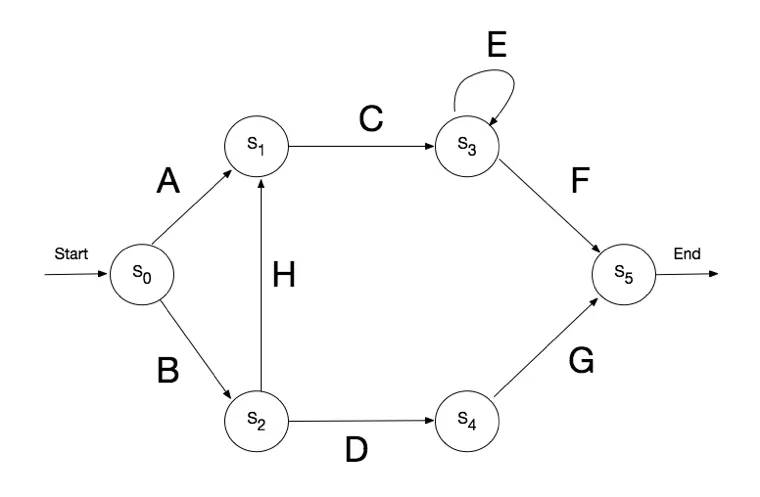
Figure 11.1: Artificial grammar with six knots, S0 to S5, and eight unidirectional transitions between them shown as labelled
arrows; the labels are the letters A to H, respectively. The graph is similar to the one used by Reber (1967).
200 • Psychology of Human Thought • Chapter 11
Bi- and Multilingualism von Stockhausen & Funke
Imagine you start working with the graph at S0, where you can choose either the way up to S1, thereby producing an „A“, or the way down to S2, producing a „B“. We choose S1, move on to S3 (we have no other choice), producing a „C“. Then at S3, we could either stay there and produce a single „E“ (or a series of them), or move on to S5, producing an „F“ and reaching the end. We have produced a trail of letters: ACEF. This is a letter sequence that is compatible with the shown grammar. Other acceptable letter sequences could be BDG, BHCEEF, ACEEEEF. A sequence like ABCD would be equally incompatible with this grammar as would be GDB, as according to the shown grammar, there is no arrow back from G to D or from D to B. Reber found that participants, when presented with sequences of letters without being told about underlying rules, could differentiate compatible from incompatible sequences far beyond random despite their inability to explain the reasons (i.e., they were not aware of the hidden structure of the grammar). Reber concluded that participants had learned about correct and incorrect sequences in an implicit way: they could not explicitly give reasons for their grammaticality judgements but showed with their above-random decisions that they had learned the rules of transitions.
The Leipzig-based anthropologist Michael Tomasello developed another idea concerning language acquisition. He argues for a Usage-Based Theory (UBT; Tomasello, 2003) without innate grammar detection. Instead, more general cognitive “modules” come into play. Children use their innate faculty to categorize, to use analogies, and to understand action intentions. Through listening in social interactions, within a context of joint attention where the child and adult(s) coordinate their attention toward each other and toward a third object, children extract grammatical categories and rules. They first produce simple constructions (e.g., Thereis x, I x this) which they apply by analogy to new situations. Further on in the acquisition process they then combine the constructions to more complex utterances (There is the X that mummy Yed). The UBT offers a challenging alternative to the idea of innate grammar learning.
There have been a lot of experiments to train chimpanzees. The most prominent case of alleged language acquisition in chimpanzees is reported by Gardner and Gardner (1969). They trained an infant female chimpanzee named "Washoe" to use the gestural language of the deaf, American Sign Language (ASL). After 22 months of training, Washoe could use 30 signs appropriately and spontaneously. Transfer to new referents as well as combinations and recombinations of signs have been observed. From other studies it is known that nonhuman primates can indeed learn to manipulate symbols to gain certain rewards (Snowdon, 1990). But in the end, there not only remains a quantitative difference between chimps and humans but also qualitative differences. An example is the level of meta-language (i.e., speaking about speaking) or figurative language including the understanding of irony which have not been found in animals at all.
Typically developing individuals acquire a language by passing through a sequence of stages. In a rough sketch, it starts with the first sounds, followed by babbling, then the first words (“milk”), then a two-word stage (“sit chair”) up to full use of language. Acquisition of syntactic rules and a growing size of vocabulary is part of this sequence. An important fact is that there are sensitive periods for the different stages.
11.2 Bi- and Multilingualism
Is there a price to pay if a child grows up, for example, with parents who speak two different languages, or if a child grows up in Germany (learning German as their first language, L1) and then, say at the age of 3, moves to the US to learn English as a second language, L2? The case of bilingualism(two languages) or multilingualism (more than two
An interesting question concerns the ability of primates such as chimpanzees to learn a language.
Psychology of Human Thought • Chapter 11 • 201
von Stockhausen & Funke Nature of Language
languages) is an interesting and rather common phenomenon.
language. Thus, language comprehension basically is simulating the reality that is being described linguistically (Zwaan & Madden, 2005). This contrasts with the traditional view of language comprehension as the process of manipulating abstract symbols and creating amodal representations, and only then to interact with other cognitive systems (Weiskopf, 2010). Empirical evidence supporting the embodied language view stems from experiments that show effects of linguistically described reality on people’s behavior and on neuronal responses which cannot easily be reconciled with the idea of amodal and abstract representations (Buccino, Colage, Gobbi, & Bonaccorso, 2016). To give an example of the effect of appearance (cf. Stanfield & Zwaan, 2001), a description of a nail that is pounded into a wall implies a different orientation of the nail than one of a nail pounded into a floor. After reading respective descriptions of objects, participants had to determine if a presented picture showed an object mentioned in the previous sentence. Response times were shorter when the verbal description matched the appearance of the object in the picture, suggesting that the appearance of an object in a described context is part of the mental representation of the sentence, even when it is in no way relevant to solving the task. Besides their appearance, objects are also characterized by their pragmatic features that determine how and for what purpose we deal with these objects. Studies on the role of these pragmatic features, also called af-fordances of objects, in comprehension showed that participants processed information faster or found it more sensible when it matched affordances of aforementioned objects (e.g., filling a sweater with leaves (afforded) versus water (not afforded) to substitute for a pillow; Glenberg & Robertson, 2000).
The Critical Age Hypothesis states that during the first years of life, a person would learn any language as L1, given that enough verbal stimulation is present. After that critical period, learning another language requires much more attention and explicit instructions. This points to different mechanisms of acquisition and learning behind L1 and L2 respectively. The hypothesis, including critical remarks, is described in more detail by Vanhove (2013).
In the beginning of bilingualism research, the assumption was that a bilingual person might have disadvantages due to the increased load of keeping two language systems separate. In later research, however, it was hypothesized that bilinguals might have advantages through better trained executivefunctions (EF) (e.g., Bialystok, Craik, Klein, & Viswanathan, 2004). These EF are part of selfregulation and thought control. Traditionally, they comprise three control functions: updating of information, shifting/switching of attention, and inhibitory control of distractions. By now, several studies have challenged the hypothesis of cognitive benefits through bilingualism. Paap et al. (2015, 2017), for example, tested the hypothesis that bilinguals might have advantages in EF and found no evidence for such positive effects. However, the debate is ongoing and recent publications again argue for cognitive benefits of multilingualism (cf. Quinteros Baumgart & Billick, 2018).
11.3 Language as EmbodiedSimulation
It is commonly agreed that language recruits neurological structures that have been around for a longer time than language itself (Zuidema, 2013). The theoretical approach of language as embodied simula-tion draws upon this idea: it assumes that language processing is principally grounded in sensorimotor experience and shares representational formats with non-linguistic processes, such as perceiving and acting (see Chapter 5, “Knowledge Representation and Acquisition”). Such experiences leave traces in our minds that become reactivated in comprehending
Effects of action compatibility can be observed when an experimental task comprises movements toward or away from the body that are compatible or not with a linguistically described movement. Action compatibility effects even occur for abstract movements such as radioing a message or telling a story (Glenberg & Kaschak, 2002). Further studies support the notion that not only simple and concrete objects are subject of simulation. Objects that are part of negated sentences appear to be simulated,
202 • Psychology of Human Thought • Chapter 11
Alignment in Dialogue von Stockhausen & Funke
too (e.g., There was no eagle in the nest/sky; Kaup et al., 2007), as are contents of figurative language and abstract concepts (e.g., the balance of justice, cf. Gibbs & Perlman, 2010).
Traditionally, language production and comprehension have often been studied separately and mostly out of social or even out of larger linguistic context. Representations underlying production and comprehension were not considered to be necessarily linked and the separate stages of planning an utterance—from preverbal concepts via syntactic, lexical and phonological encoding to phonetic realization (cf. Levelt, 1989)—were supposed to be irrelevant to the listener. The listener would in turn create their representation of the utterance in stages—from decoding sounds through to a conceptual understanding—which used to be considered irrelevant to the speaker. An interesting question is that of how can a dialogue, with its constant changes of roles in real time, its overlapping complex processes of interpreting and planning, be so easy and effortless, even for young children?
Recent discussions of the approach of embodied language focus less on the question of whether representations are in principle either grounded in sensory experience or symbolic but rather on the degree to which language users simulate the content of linguistic input during comprehension. This seems to depend on their expertise regarding the content, their linguistic skill, and the content itself, as, for example, the description of a cooking show is easier to simulate than the content of a legal document (Zwaan, 2014, 2016). Neurophysiological data tentatively but not yet conclusively support the notion of language processing as simulation (e.g., Buccino et al., 2016; Mollo, Pulvermüller & Hauk, 2016).
This approach highlights the possible role of language in problem solving. Capturing a problem space in language does not necessarily translate it into an abstract amodal code but may rather help to properly represent perceptual aspects of the situation, spatial relations, temporal or spatial dynamics, or a perceiver’s perspective by simulating what is being described in an experience-based manner. In this sense, solving problems that comprise sensorimotor aspects should benefit from experience-based simulation through language.
Pickering and Garrod (2004) proposed an interactive alignment model of dialogue stating that interlocutors adjust and align their representations on all linguistic levels: on the level of the situation model representing the described content in context, on the level of syntax and the lexicon, through to the level of articulation and speech rate. According to this approach, comprehension and production draw upon the same representations and are based on closely intertwined processes, not only intra- but also interindividually. Each linguistic level in a speaker’s utterance influences the respective level of the listener in comprehension and in turn the planning of following utterances. A word that has been comprehended is more likely to be produced; repeating a word or using semantically similar words enhances the alignment of syntax, and so forth (see Figure 11.2; cf. Garrod & Pickering, 2009). When, in a dialogue, the listener becomes the speaker, the process continues with changed roles. The ease with which this constant role change takes place and with which interlocutors, for example, complete each other’s utterances is enabled by highly automatized priming processes, with each level on the production side priming the respective level of the hearer on the comprehension side. The result is a high level of repetition and a high level of imitation in dialogue (Pickering & Garrod, 2004).
11.4 Alignment in Dialogue
Dialogue represents the most natural use of language and is closest to the conditions of its early stages in evolution (as opposed to monologue, as well as reading and writing; written language was invented only about 7000 years ago; Zuidema, 2013). In terms of problem solving, dialogue is a powerful form of action that enables the exchange of ideas, joint planning, and transfer of experience and expertise independent of context (see Chapter 5, “Knowledge Representation and Acquisition”). From a psycholinguistic point of view, dialogue is characterized by a constant exchange between interlocutors, requiring listeners to be prepared to speak, and speakers to listen throughout the process.
Psychology of Human Thought • Chapter 11 • 203
von Stockhausen & Funke Nature of Language
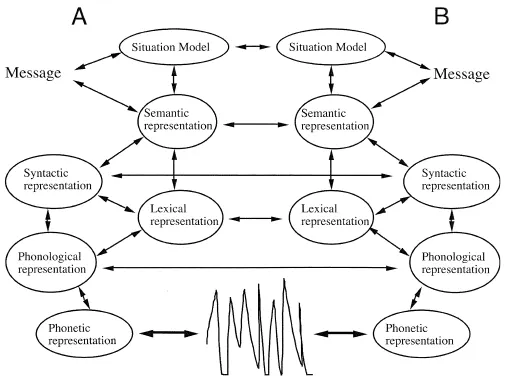
Figure 11.2: The figure shows the different levels of linguistic representation involved in language comprehension and in language
production and the relatedness between the levels within and between two interlocutors A and B in dialogue, according to the interactive alignment model (Fig. 2 from Pickering & Garrod, 2004; reproduced by permission of Cambridge University Press).
The approach of interactive alignment locates and studies language in the context of its function as an action (Garrod & Pickering, 2009; Pickering & Garrod, 2013). It thereby places language in line with other strategies of coordinating one’s behavior with others, based on perception-action links (Garrod & Pickering, 2004). Perceiving a facial expression or body posture often results in (overt or covert) imitation (Dijksterhuis & Bargh, 2001). In a similar way, comprehending language (i.e. perceiving) goes along with emulating the interlocutor’s action of language production - this in turn facilitates one’s own production (Pickering & Garrod, 2013). As Dijksterhuis and Bargh (2001, p. 3) put it “In sum, perception is for doing”.
nodes, and gates, to reach a goal. Coordination was required since, for a player, only his or her own position in the maze was visible and movements of one player could change the configuration of gates in the partner’s maze. Thus, players were motivated to work out each other’s position in dialogue and to coordinate their movements toward the goal. Dialogues showed that, without explicit negotiation, partners quickly converged on specific representations of the maze and respective ways of describing it (e.g., by moving along a path, by referring to a line intersection or describing a subsection of the maze figuratively). These patterns of description changed between games, suggesting that they emerged locally in a specific dialogue through alignment. In an experimental demonstration of alignment of syntax, Branigan, Pickering, and Cleland (2000) developed a “confederate scripting technique”, with two persons participating in a dialogue about pictures describing actions involving
Alignment in dialogue has been studied in diverse paradigms. Garrod and Anderson (1987) presented participants with a maze game in which dyads of players who were seated in separate rooms had to find their ways through a maze, made up of paths,
204 • Psychology of Human Thought • Chapter 11
The Role of Language in Representing and Constructing Social Reality von Stockhausen & Funke
an agent, a patient, and a beneficiary. One participant was a confederate who described the depicted scene with systematically varying syntactic structure (The A gives/hands/offers/... the B to the Cor The A gives/hands/offers/... the C the B). The study shows that participants adjusted their syntax to the confederate’s, for example, tending to use a prepositional phrase when the confederate had just used one. The effect was stronger when confederate and participant used the same verb but also occurred between descriptions with different verbs.
The interactive-alignment model of human dialogue underlines the deeply social function of language, which means efficiently communicating and coordinating with our fellow human beings. In the final part of the chapter, we further broaden our perspective on the social nature of language and present evidence for its influential role in shaping our understanding of social reality.
11.5 The Role of Language inRepresenting and ConstructingSocial Reality
The universal quality and robustness of alignment has been underlined by studies showing effects across modality (people align their speech styles to words that they listen to or lip read; Miller, Sanchez, Rosenblum, 2010) as well as across languages (as shown in code switching by Kootstra, van Hell & Dijkstra, 2010, and in dialogues of bilingual speakers with differing L1 and a shared L2; Trofimovich & Kennedy, 2014).
Because language use is both ubiquitous and automatized, the influence of language on representing and constructing social reality is both powerful and subtle (see Chapter 12, “Language and Thought”). Several linguistic biases have been identified in the literature. Semin and Fiedler (1988) proposed the Lin-guistic Category Model stating that different kinds of descriptions of persons and their behaviors vary in terms of abstractness. This, in turn, affects how informative a description about a person is and how temporally stable a described quality is perceived to be. For example, descriptive action verbs refer to a particular activity in a specific situation (e.g., kiss, talk, stare) and do not reveal lasting features of a person. Interpretive action verbs (such as help,inhibit, imitate) still refer to observable actions that, however, belong to a more general class of behaviors and require interpretation. Still more abstract is a description with state verbs referring to mental or emotional states with no clear beginning and end (hate, like, notice). Finally, descriptions based on adjectives (e.g., honest, reliable, creative) abstract characteristics from observable behavior and a concrete context and assign dispositional qualities that are rather stable over time.
As mentioned earlier, alignment is assumed to happen implicitly and automatically. This contrasts with other views on dialogue. Coordination in dialogue, for example, was supposed to go back to the common ground (Clark, 1996), shared knowledge based on communal experience (such as culture, language, ethnicity) and personal experience. Common ground in the traditional view has to be established and updated in working memory to make a dialogue aligned. In the interactive alignment framework, however, common ground is created bottom up through what is shared between interlocutors. Well-aligned interlocutors do not have to infer meaning because they both sample from very similar representations, including situation models. Only in case of apparent misalignment may common ground be established as an explicit strategy. It is part of a repair process, not of the regular process of alignment (Pickering & Garrod, 2004).
Relying on this model, studies on Linguistic In-tergroup Bias showed that descriptions of persons and their behaviors differ in their level of abstractness, depending upon the person belonging to an observer’s ingroup or outgroup and on the behavior being desirable or not (Maass, Salvi, Arcuri & Semin, 1989). Favorable behaviors by outgroup members are described in a more concrete way (e.g.,
The fact that linguistic behavior is deeply embedded in a larger social and behavioral context is underlined by findings that show the influence of non-linguistic factors (e.g., gender or quality of a relationship) on the degree of conversational convergence (Gambi & Pickering, 2013; Pardo, Gibbons, Suppes, & Krauss, 2012).
Psychology of Human Thought • Chapter 11 • 205
von Stockhausen & Funke Nature of Language
X helped somebody as opposed to X acted in analtruistic way), implying that this behavior might not be stable over time. In contrast, undesirable behaviors of outgroup members are described in rather abstract ways (e.g., X is being aggressive as opposed to X hit somebody), inviting one to generalize from the situation and thus suggesting stability over time. Descriptions of ingroup behavior follow the opposite pattern, with desirable behavior being described more abstractly and unfavorable behavior more concretely. This implies stability of the desirable and dependence on the situational context of the undesirable behavior.
not smart is less offensive than saying he or she is stupid; cf. Beukeboom, 2014). However, on a daily basis of communication and based on highly automatized processes of stereotype activation in language use, these biases work implicitly beyond people’s awareness.
The previous research shows that expectations based on social stereotypes are expressed linguistically in subtle ways. The following studies further underline how deeply interwoven processing language is with our ideas about (social) reality. Using eye-tracking methodology during reading and therefore assessing the process of understanding on a moment-to-moment basis, these experiments show that violations of our expectations concerning social reality slow down fundamental aspects of language comprehension, such as interpreting pronouns or assigning thematic roles.
Further research suggests that the dimension of abstractness versus concreteness underlying person descriptions may reflect observers’ expectations, called the Linguistic Expectancy Bias (Wigboldus, Semin & Spears, 2000). Behaviors that are expected on the basis of stereotypes about social groups are described on a more abstract level (Alice is emo-tional) and lead to inferences regarding a person’s disposition whereas behaviors that violate stereotypes and are therefore unexpected are described in concrete terms (Paul brushes tears from his eyes). Such behavior is rather attributed to the situational context and not to a person’s disposition. Besides the level of abstraction, the use of negation may also indicate if a behavior is expected or not. Beukeboom, Finkenauer, and Wigboldus (2010) showed that participants used more negations to describe a behavior that violated stereotypical expectations (e.g., Mary is not bad at math rather than Mary isgood at math). Furthermore, they interpreted negations as indicating that a described behavior deviated from the speaker’s expectancies (i.e., the speaker did not expect Mary to be good at math), attributed them more strongly to situational than dispositional factors and evaluated negated descriptions as more neutral than affirmative descriptions (i.e., being notbad at math is not as good as being good at math; the analogue applies to negative attributes: beingnot kind is less unkind than being unkind).
In a study by Reali, Esaulova, and von Stockhausen (2015), participants read descriptions of typical activities of a person being in a specific profession. The person was denoted by initials only, so that gender was not indicated. The professional role could either be typically male, typically female, or neutral. A typically male description read, for example, M.F. repairs and produces furniture, workswith wood. Each description was followed by a target sentence that contained a personal pronoun referring to the described person, such as Usuallyhe/she has a sufficient income. When the pronoun was not congruent with the gender stereotype of the described role (such as carpenter + she, florist + he), participants had greater difficulties to resolve
the pronoun as reflected in longer fixation times. It is worth noting that neither was gender explicitly indicated in the descriptions nor did they contain role nouns that directly denote the profession. Thus, the gender-related expectations could only be based on the gender typicality of the described behavior. Effects were independent of participants’ individual gender attitudes.
Esaulova, Reali, and von Stockhausen (2017) showed effects of expectations regarding gender typical roles and behavior on comprehending thematic structures. Take as an example the two sentences The flight attendant who observed many tourists
Aspects of interpersonal context have been shown to affect these biases and that in principle they can be used strategically, such as when the communicative goal is to convince an interlocutor or to mitigate a negative description (e.g., stating that someone is
is attentive and The flight attendant whom many
206 • Psychology of Human Thought • Chapter 11
The Role of Language in Representing and Constructing Social Reality von Stockhausen & Funke
tourists observed is attentive. These sentences differ regarding the thematic roles of the protagonists that relate to the performed action. In the first sentence, the flight attendant takes the agent role (i.e., initiates or causes the action), the tourists take the patient role (i.e., receive the action). In the second sentence, roles are swapped with the flight attendant now receiving the action and the tourists causing it (taking the agent role). In the English translation of the materials, thematic roles are clearly indicated by the relative pronoun who/whom. However, in the original (in German), both versions were identical until the end of the relative clause was reached and the verb form indicated who did the observing (singular form in case of the flight attendant, plural form in case of the tourists). That is, only after reading both nouns were participants able to solve the ambiguity regarding thematic roles. By then they were expected to have built up expectations regarding agent and patient depending on the role nouns’ gender typicality (flight attendant is a typically female role, tourist is neutral) and depending on grammatical gender (masculine or feminine). Eye movements showed that participants took longer to resolve the relative clause and found it more difficult to assign the agent role to a role noun in feminine rather than masculine grammatical gender and to typically female as opposed to neutral role nouns. Feminine grammatical gender (which usually indicates female biological gender) and female gender typicality better qualified a noun for the thematic role of patient
than agent, reflecting the strong link between masculinity and agency in gender stereotypes (Koenig, Mitchell, Eagly, & Ristikari, 2011).
The reported effects in eye movements occurred within the very first stages of understanding, based on highly automatized processes and not being strategically controlled (for replications see Esaulova, & von Stockhausen, 2015; Reali, Esaulova, Öttl, & von Stockhausen, 2015).
To summarize, there are implicit biases in language production and comprehension that express social stereotypes and, in both listeners and speakers, lead to stereotype congruent inferences (Beukeboom, 2014). It is in that sense that language does not only reflect but also shapes and maintains social reality. The underlying mechanisms are deeply embedded in lexical, semantic, and syntactic features of language and our use of them: the verbs we use for a description, our use of negation, interpreting pronouns and relative clauses, our assignment of thematic roles. In this way, we are dealing with an essential aspect of the nature of language, that of representing and expressing our sense of reality.
Acknowledgements
The authors would like to thank Dr. Yulia Esaulova for her insightful comments on a draft version of this chapter and Katharina Conrad for copy editing the manuscript.
Psychology of Human Thought • Chapter 11 • 207
von Stockhausen & Funke Nature of Language
Summary
1. The term language covers a number of cognitive processes that enable humans to represent and communicate information efficiently and independently of context. Examples include the simulation of perceptual experience in language, the alignment of interlocutors in dialogue and the representation of social reality in language structure.
2. Language is acquired in the first years of life without explicit instruction through implicit strategies. In later years, language acquisition requires active attention.
3. Language has its roots in perception and is a tool for action. According to the approach of language as embodied simulation, language comprehension basically is simulating what is being described.
4. The most natural use of language is in dialogue. The interactive alignment model accounts for the typical fluency and ease in dialogue by assuming that interlocutors automatically align on all levels of linguistic representation.
5. Our views of social reality are reflected in language use, for example, in how abstractly or concretely we describe a person’s behavior, in patterns of negation, or in thematic structures. Production and interpretation of these language-based social cues occurs automatically.
6. Through representation and communication, language carries our experiences and ideas into problem solving, reasoning, decision making, goal setting and planning.

Review Questions
1. What makes human language different from animal communication?
2. In what way can language be considered a tool for action?
3. How does the close relation between perceptual experience and language contribute to planning and problem solving?
4. What cognitive mechanisms are considered to make common dialogue so fluent and easy?
5. Where do expectations about social groups surface in language use?
208 • Psychology of Human Thought • Chapter 11
References von Stockhausen & Funke
Hot Topic
My research program addresses the question of how linguistic structures and cognitive processes reflect social reality. Specifically, in my lab we study automatic processes underlying the representation of gender in language. In our experiments, participants are confronted with linguistic input that may conflict with their expectations concerning social reality, such as men working in typically female occupations or taking passive (patient) thematic roles.

Using methods of measurement with high temporal resolution (such as eye-tracking), we could show that violating expectations regarding social categories slows down language comprehension in its earliest stages, indicating the highly automatized ways in which social cognition is embedded in language.
Another area of my research are cognitive mechanisms underlying mindfulness. The focus here lies on the question of and how guiding one’s attention (to the present moment and without judgment) can be trained, how this affects our basic faculty of attention regulation and in turn processes of self-regulation.
Lisa von Stockhausen
References
Esaulova, Y., Reali, C., & von Stockhausen, L. (2017). Prominence of gender cues in the assignment of
thematic roles in German. Applied Psycholinguistics, 38, 1133–1172. doi:10.1017/S014271641700008X
Garnham, A., Oakhill, J., von Stockhausen, L. & Sczesny, S. (2016). Editorial: Language, Cognition, and
Gender. Frontiers in Psychology, 7, 772. doi:10.3389/fpsyg.2016.00772
Wimmer, L., Bellingrath, S. & von Stockhausen, L. (2016). Cognitive effects of mindfulness training: Results
of a pilot study based on a theory driven approach. Frontiers in Psychology (Section ConsciousnessResearch), 7, 1037. doi:10.3389/fpsyg.2016.01037
References
Beukeboom, C. J. (2014). Mechanisms of linguistic bias: How words reflect and maintain stereotypic expectancies. In J. Laszlo, J. Forgas, & O. Vincze (Eds.), Social cognition and communication(pp. 313–330). New York, NY: Psychology Press. doi:10.4324/9780203744628
Branigan, H. P., Pickering, M., & Cleland, A. A. (2000).
Syntactic co-ordination in dialogue. Cognition, 75, B13–25. doi:10.1016/S0010-0277(99)00081-5
Buccino, G., Colage, I., Gobbi, N., & Bonaccorso,
G. (2016). Grounding meaning in experience: A broad perspective on embodied language. Neu-roscience and Biobehavioral Reviews, 69, 69–78. doi:10.1016/j.neubiorev.2016.07.033
Beukeboom, C. J., Finkenauer, C., & Wigboldus, D.
H. J. (2010). The negation bias: When negations signal stereotypic expectancies. Journal ofPersonality and Social Psychology, 99, 978–992. doi:10.1037/a0020861
Chomsky, N. (2011). Language and other cognitive systems. What is special about language? Lan-guage Learning and Development, 7(4), 263–278. doi:10.1080/15475441.2011.584041
Bialystok, E., Craik, F. I. M., Klein, R., & Viswanathan,
M. (2004). Bilingualism, aging, and cognitive control: Evidence from the Simon task. Psychology and Aging, 19, 290–303. doi:10.1037/0882-7974.19.2.290
Clark, H. H. (1996). Using language. Cambridge: Cam-
bridge University Press.
Psychology of Human Thought • Chapter 11 • 209
von Stockhausen & Funke Nature of Language
Dijksterhuis, A., & Bargh, J. A. (2001). The perception-
Hauser, M. D., Chomsky, N., & Fitch, W. T. (2002).
The faculty of language: What it is, who has it, and how did it evolve? Science, 298, 1569–1579. doi:10.1126/science.298.5598.1569
behavior expressway: Automatic effects of social perception on social behavior. In M. P. Zanna (Ed.), Advances in experimental social psychology, Vol. 33, (pp. 1–40). San Diego, CA, US: Academic Press. doi:10.1016/s0065-2601(01)80003-4
Hockett, C. F. (1959). Animal “languages” and human
language. Human Biology, 31, 32–39.
Esaulova, Y., Reali, C., & von Stockhausen, L. (2017).
Kaup, B., Yaxley, R. H., Madden, C. J., Zwaan, R.
Prominence of gender cues in the assignment of thematic roles in German. Applied Psycholinguistics, 38, 1133–1172. doi:10.1017/S014271641700008X
A., & Lüdtke, J. (2007). Experiential simulations of negated text information. The QuarterlyJournal of Experimental Psychology, 60, 976–990. doi:10.1080/17470210600823512
Esaulova, Y. & von Stockhausen, L. (2015). Crosslinguistic evidence for gender as a prominence feature. Frontiers in Psychology (Section Cognition), 6, 1356.
Koenig, A. M., Mitchell, A. A., Eagly, A. H., & Ristikari,
T. (2011). Are leader stereotypes masculine? A metaanalysis of three research paradigms. PsychologicalBulletin, 137, 616–642. doi:10.1037/a0023557
doi:10.3389/fpsyg.2015.01356
Evans, N. & Levinson, S. C. (2009). The myth of language
universals: Language diversity and its importance for cognitive science. Behavioral and Brain Sciences, 32, 429–492. doi:10.1017/S0140525X0999094X
Kootstra, G. J., van Hell, J. G., & Dijkstra, T.
(2010). Syntactic alignment and shared word order in code-switched sentence production: Evidence from bilingual monologue and dialogue. Journal of Memory and Language, 63, 210–231. doi:10.1016/j.jml.2010.03.006
Fitch, W. T. (2010). The evolution of language. Cam-
bridge: Cambridge University Press.
Gambi, C. & Pickering, M. J. (2013). Predicting and
imitating speech. Frontiers in Psychology, 4, 340. doi:10.3389/fpsyg.2013.00340
Levelt, W. J. M. (1989). Speaking: From intention to
articulation. Cambridge: The MIT Press.
Gardner, A., & Gardner, B. (1969). Teaching sign lan-
Levinson, S. C. & Evans, N. (2010). Time for a sea-
guage to a chimpanzee. Science, 165, 664–672. doi:10.1126/science.165.3894.664
change in linguistics: Response to comments on “The Myth of Language Universals”. Lingua, 120, 2733– 2758. doi:10.1016/j.lingua.2010.08.001
Garrod, S. & Anderson, A. (1987). Saying what you mean
in dialogue: A study in conceptual and semantic coordination. Cognition, 27, 181–218. doi:10.1016/0010- 0277(87)90018-7
Maass, A., Salvi, D., Arcuri, L., & Semin, G. (1989).
Language use in intergroup contexts: The linguistic intergroup bias. Journal of Personality and So-cial Psychology, 57(6), 981–993. doi:10.1037//0022- 3514.57.6.981
Garrod, S. & Pickering, M. J. (2009). Joint action, in-
teractive alignment, and dialogue. Topics in Cog-nitive Science, 1, 292–304. doi:10.1111/j.1756- 8765.2009.01020.x
Miller, R. M., Sanchez, K., & Rosenblum, L. D. (2010).
Alignment to visual speech information. Atten-tion, Perception, & Psychophysics, 72, 1614–1625. doi:10.3758/APP.72.6.1614
Gibbs Jr., R. W. & Perlman, M. (2010). Language understanding is grounded in experiential simulations: a response to Weiskopf. Studies in His-tory and Philosophy of Science, 41, 305–308. doi:10.1016/j.shpsa.2010.07.004
Mollo, G., Pulvermüller, F., & Hauk, O. (2016).
Movement priming of EEG/MEG brain responses for action-words characterizes the link between language and action. Cortex, 74, 262–276. doi:10.1016/j.cortex.2015.10.021
Glenberg, A. M. & Kaschak, M. P. (2002). Grounding
language in action. Psychological Bulletin & Review, 9, 558–565. doi:10.3758/BF03196313
Paap, K. R., Johnson, H. A., & Sawi, O. (2015). Bilin-
gual advantages in executive functioning either do not exist or are restricted to very specific and undetermined circumstances. Cortex, 69, 265–278. doi:10.1016/j.cortex.2015.04.014
Glenberg, A. M. & Robertson, D. A. (2000). Symbol grounding and meaning: A comparison of high-dimensional and embodied theories of meaning. Journal of Memory and Language, 43, 379–401. doi:10.1126/science.298.5598.1569
Paap, K. R., Myuz, H. A., Anders, R. T., Bockelman, M.
F., Mikulinsky, R., & Sawi, O. M. (2017). No com-
210 • Psychology of Human Thought • Chapter 11
References von Stockhausen & Funke
pelling evidence for a bilingual advantage in switching or that frequent language switching reduces switch cost. Journal of Cognitive Psychology, 29(2), 89–112. doi:10.1080/20445911.2016.1248436
Stanfield, R. A. & Zwaan, R. A. (2001). The effect of
implied orientation derived from verbal context on picture recognition. Psychological Science, 12, 153–156. doi:10.1111/1467-9280.00326
Pardo, J. S., Gibbons, R., Suppes, A., & Krauss,
Tomasello, M. (2003). Constructing a language:A usage-based theory of language acquisition.
R. M. (2012). Phonetic convergence in college roommates. Journal of Phonetics, 40, 190–197. doi:10.1016/j.wocn.2011.10.001
Cambridge, MA: Harvard University Press. doi:10.1017/S0272263104363059
Pickering, M. J. & Garrod, S. (2004). Toward a mechanistic psychology of dialogue. Be-havioralandBrainSciences, 27, 169–226. doi:10.1017/S0140525X04000056
Trofimovich, P. & Kennedy, S. (2014). Interactive alignment between bilingual interlocutors: Evidence from two information-exchange tasks. Bilin-gualism: Language and Cognition, 17, 822–836. doi:10.1017/S1366728913000801
Pickering, M. J. & Garrod, S. (2013). An integrated theory of language production and comprehension. Behavioral and Brain Sciences, 36, 329–392. doi:10.1017/S0140525X12001495
Vanhove, J. (2013). The Critical Period Hypothesis in Second Language Acquisition: A statistical critique and a reanalysis. PLoS ONE, 8(7), e69172. doi:10.1371/journal.pone.0069172
Quinteros Baumgart, C. & Billick, S. B. (2018). Positive
cognitive effects of bilingualism and multilingualism on cerebral function: a review. Psychiatric Quarterly, 89, 273–283. doi:10.1007/s11126-017-9532-9
Weiskopf, D. A. (2010). Embodied cognition and linguistic comprehension. Studies in His-tory and Philosophy of Science, 41, 294–304. doi:10.1016/j.shpsa.2010.07.005
Reali C., Esaulova, Y., & von Stockhausen, L. (2015). Isolating stereotypical gender in a grammatical gender language: Evidence from eye movements. Applied Psycholinguistics, 36, 977–1006. doi:10.1017/S0142716414000010
Wigboldus, D. H. J., Semin, G. R., & Spears, R. (2000).
How do we communicate stereotypes? Linguistic biases and inferential consequences. Journalof Personality and Social Psychology, 78, 5–18. doi:10.1177/1368430205053939
Reali, C., Esaulova, Y., Öttl., A., & von Stockhausen,
L. (2015). Role descriptions induce gender mismatch effects in eye movements during reading. Fron-tiers in Psychology (Section Cognition), 6, 1607. doi:10.3389/fpsyg.2015.01607
Zuidema, W. (2013). Language in nature: On the evo-
lutionary roots of a cultural phenomenon. In P.- M. Binder & K. Smith (Eds.), The language phe-nomenon. Human communication from millisecondsto millennia (pp. 163–189). Heidelberg: Springer. doi:10.1007/978-3-642-36086-2_8
Reber, A. S. (1967). Implicit learning of artificial gram-
mars. Journal of Verbal Learning and Verbal Behav-ior, 6, 855–863. doi:10.1016/S0022-5371(67)80149- X
Zwaan, R. A. (2016). Situation models, mental simula-
tions, and abstract concepts in discourse comprehension. Psychonomic Bulletin & Review, 23, 1028–1034. doi:10.3758/s13423-015-0864-x
Reber, A. S. (1989). Implicit learning and tacit knowledge.
Journal of Experimental Psychology: General, 118, 219–235. doi:10.1037/0096-3445.118.3.219
Zwaan, R. A. (2014). Embodiment and language comprehension: reframing the discussion. Trends in Cognitive Sciences, 18, 229–234. doi:10.1016/j.tics.2014.02.008
Sapir, E. (1921). Language: An introduction to the study
of speech. New York, NY: Harcourt, Brace, and Company.
Zwaan, R. A. & Madden, C. J. (2005). Embodied sen-
Semin, G. R. & Fiedler, K. (1988). The cognitive functions of linguistic categories in describing persons: Social cognition and language. Journal ofPersonality and Social Psychology, 54, 558–568. doi:10.1037/0022-3514.54.4.558
tence comprehension. In D. Pecher & R. A. Zwaan (Eds.), Grounding Cognition. The role of percep-tion and action in memory, language, and thinking(pp. 224–245). Cambridge: Cambridge University Press. doi:10.1017/cbo9780511499968.010
Snowdon, C. T. (1990). Language capacities of nonhuman
animals. American Journal of Physical Anthropology, 33(S11), 215–243. doi:10.1002/ajpa.1330330510
Psychology of Human Thought • Chapter 11 • 211
von Stockhausen & Funke Glossary
Glossary
alignment model of dialogue Models dialogue
language A system of communication that is gov-
as a process of adjusting all levels of language processing to one’s partner and thereby drawing on representations shared by both interlocutors. Explains how dialogue is complex (constant change between comprehension and production at high speed) and easy at the same time. 200, 203
erned by a system of rules (a grammar) that allows an infinite number of ideas to be expressed given finite resources. 199
language acquisition Process of learning a (first)
language without instruction. Healthy children in common social conditions acquire language within their first years effortlessly, going through rather defined stages. 200
bi-/multilingualism Definitions differ depending
on research traditions but basically the term denotes the regular use of more than one language by a person. Often one language is more dominant than another depending on its proficiency and share in daily use. 200, 201
language universals For a long time prominent
idea in linguistics that there are features shared by all languages. Nowadays highly controversial. 199
linguistic biases Point to the subtle ways in which
dialogue Language use in a social context with two
language contributes to constructing social reality. Behavior that violates expectations about social groups is described in more concrete ways or by using negations. Typical gender roles are reflected in language semantically and grammatically. 205
interlocutors. Comprises constant changes between comprehension and production. Most natural form of language use. 203
embodied simulation Denotes a theoretical ap-
proach to language processing that conceptualizes the process of understanding as simulating actual sensory experiences. 200, 202
phoneme Smallest sound unit of language that
by itself is not meaningful but differentiates meaning. For example, k and h alone are not meaningful but sky and shy are different meaningful units of language. The smallest non-meaningful unit of written language that differentiates meaning is called grapheme, the smallest signed unit chereme. 199
executive functions Human faculty of executing
several complex cognitive tasks in parallel. Usually broken down into the components of forming and updating a mental set, set shifting (cognitive flexibility) and set maintenance (inhibitory control). 202
implicit learning Process of learning (i.e. poten-
tial of behavioral change) by way of associating co-occurrent information that does not need instruction and often happens unnoticed by the learner. 200
representation Mental process that reflects con-
tents of the mind (from memory, perceptions, etc.) and allows other mental processes to draw upon (repeat, elaborate, etc.). 199
212 • Psychology of Human Thought • Chapter 11