 Starvard
The Psychology of Human Thought · Chapter 14 of 19
Chapter 14: Intelligence
by Oliver Wilhelm & Ulrich Schroeders
Most other chapters in this volume tackle the nature of human thinking from the perspective of cognitive psychology, for example how humans derive deductions. In most of these chapters, human subjects are treated uniformly; that is, an attempt is made to describe and explain the cognitive principles of deductive reasoning that are common to all people. In this chapter, the focus will instead be placed on what makes people different: individual differences between persons. The areas of cognition discussed in most other chapters provide the required background information on what exactly humans engage in while working on an intelligence test. Whereas some measures stress deductive inference, others might provoke complex problem solving behavior. The focus of this chapter is to study why some subjects answer those intelligence items correctly while others get them wrong, and why these differences are meaningful and interesting.
nitive effort. The second section will be very pragmatic, showing how intelligence can be measured, how it can be used for predictive purposes, and whether it can be changed through interventions. We will conclude the chapter by examining important issues for future intelligence research. A very broad and relatively developed field such as intelligence and its assessment cannot be addressed exhaustively in an introductory chapter. We hope that the references provided in this chapter will be helpful for further reading and will enrich one’s understanding of contemporary research in the field.
14.1 Understanding Intelligence
Research on the structure of individual differences in intelligence follows an atypical strategy, relative to most other psychological research. Typically, theories and hypotheses are proposed, followed by the development of adequate means for testing and evaluating; intelligence research instead proceeds in reverse. For instance, in the beginning of intelligence research as an independent field, factor analytic methods were invented and refined, with corresponding theories of intelligence developed afterwards. This approach to intelligence research places the focus on competing explanations of individual differences in a broad variety of intelligence tasks. Unfortunately, we must skip some important early contributions: for example, Galton (1883) developed several simple tests of intellectual function-
In the first section of this chapter, we will approach the concept of intelligence by briefly summarizing the history of relevant psychometric intelligence models. While a historical overview might seem somewhat inappropriate in an introductory chapter, in the case of intelligence research, this perspective provides us with a set of competing accounts essential for understanding intelligence data and intelligence theories. We will then proceed by describing an established taxonomy of intelligence factors and discuss intelligence as an overarching concept for all measures that provoke maximal cog-
https://doi.org/10.17885/heiup.470.c6677 Psychology of Human Thought • Chapter 14 • 255
Wilhelm & Schroeders Intelligence
ing and made early contributions to the heredity of intelligence. Binet deserves credit for compiling one of the original intelligence tests, although his efforts could hardly be considered a clear theoretical contribution on the structure of intelligence. Moreover, Ebbinghaus (1895) developed several intelligence tests that were reused in other fields before making a much later comeback in intelligence research (Ackerman, Beier, & Bowen, 2000).
a completely different topic) with Wilhelm Wundt in Leipzig. In one of these contributions, he laid the foundation for what is known today as classical test theory (Lord & Novick, 1968). In his other contribution, he established the groundwork for the general factor theory. This theory is based on two central assumptions. First, a latent factor (g) accounts for the correlations between all intelligence tasks. Second, besides this general factor, there are test-specific individual differences. Apart from these two components, there is only unsystematic measurement error in intelligence tasks.
14.1.1 The History of IntelligenceModels and the Usual Suspects
The first assumption is an idea prevalent throughout research on individual differences and applies to traits such as extraversion and achievement motivation. The assumption is that there is a stable disposition within persons to act in specific ways. In the case of the g-factor, this disposition is to do well
In the following section, we will present different ways of conceptualizing intelligence (see Figure 14.1). We start with Spearman (1904a, 1904b), who made two seminal methodological contributions in the year he completed his dissertation (on
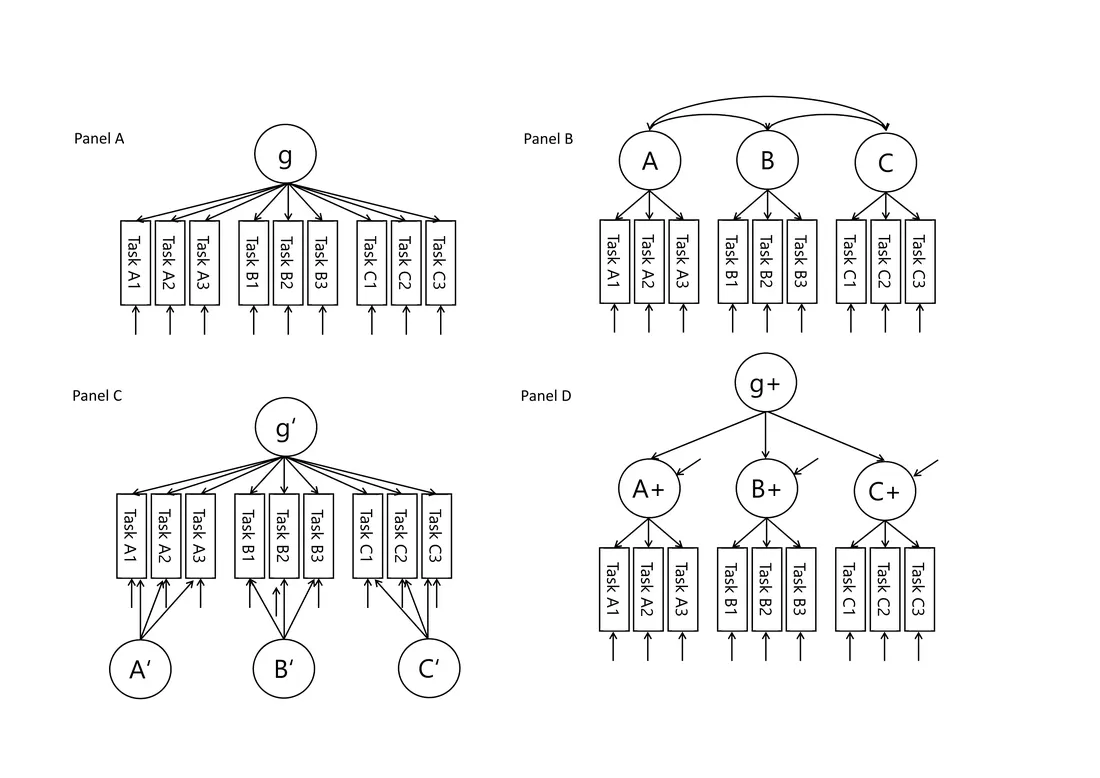
Figure 14.1: Psychometric models of intelligence.
256 • Psychology of Human Thought • Chapter 14
Accepted Views on the Structure of Intelligence Wilhelm & Schroeders
on tasks requiring cognitive effort. This disposition is deemed causal for the correctness or swiftness of responses on each intelligence item. The ideas of a latent trait also apply to most other theories of intelligence structure. Usually, these traits are deemed stable over time, that is, the rank-order of subjects does not change dramatically over time. They are considered broad, in the sense that they do not only apply to a highly-specific test but also to similar examinations. They are expected to be relevant, meaning they predict real-life outcomes that are of individual or societal relevance. In the case of the g-factor, only one such latent variable is specified for the field of intelligence. Spearman’s theory states that the correlation between any two intelligence tasks is because of the g-factor (Figure 14.1, panel A). As a side note, the g-factor theory competed in the early days of intelligence testing with the so-called bond theory (Thomson, 1919). The bond theory stated that the magnitude of the correlation between any two intelligence tasks indicates the proportion of overlapping processes—the higher the correlation, the larger the number of shared processes. Somewhat more cognitively, the componential theory of intelligence proposes that the correlation between two intelligence tasks is a function of shared components and the theory was put to the test for example in the area of analogical problem solving (Sternberg, 1977). This approach has recently gained new attraction (van der Maas et al., 2006). A somewhat related approach pursued with different methods is called facet theory. Here, the overlap of task attributes determines the correlations between intelligence tasks, while the magnitude of correlations is graphically represented by proximity (Guttman & Levy, 1991).
longed this list jointly with his wife three years later (Thurstone & Thurstone, 1941).
Disentangling different contributions to performance on intelligence tasks was also the main purpose of the so-called bifactor approach (Holzinger & Swineford, 1937). Similarly, Schmid and Leiman (1957) proposed rotation techniques to distinguish between independent performance contributions to individual differences in intelligence tasks. Both approaches (Figure 14.1, panel C) are early hierarchical perspectives on intelligence.
Higher-order factor models are another way to conceptualize intelligence because the ubiquitous positive correlation between any two intelligence tasks also leads to correlations between intelligence factors. These factor correlations are the basis for higher-order models of intelligence (Figure 14.1, panel D). In these models, a second-order factor accounts for the correlations between first-order factors, which in turn accounts for the correlations between intelligence tasks (Carroll, 1993).
14.1.2 Accepted Views on the Structureof Intelligence
Among the more contemporary models, Cattell’s theory of fluid and crystallized intelligence (Cattell, 1971; see also Brown, 2016) has become a widely accepted and applied model for the description and testing of intelligence. The gf-gc-theory also heavily stimulated theory building, as can be seen in the investment theory (Cattell, 1971) or the PPIK theory (Intelligence-as-Process, Personality, Interests and Intelligence-as-Knowledge, Ackerman, 1996). Furthermore, the integration of the gf-gc-theory into personality research and its validation and use in aging research has contributed to its popularity. In the current version, the gf-gc theory assumes nine primary factors (McGrew, 2009), of which fluid and crystallized intelligence are central (see Table 14.1).
A major competitor of the g-factor theory arose with the development of multiple factor analysis (Thurstone, 1931). This procedure allowed for the extraction of more than one factor (Figure 14.1, panel B). Combined with the development of factor rotations, the interpretation of intelligence factors was greatly facilitated (Thurstone, 1934). Thurstone subsequently proposed 7 primary mental abilities (Thurstone, 1938). Thurstone initially proposed reasoning, spatial visualization, verbal comprehension, word fluency, number facility, associative memory, and perceptual speed—and he updated and pro-
A closely related milestone in intelligence research is the seminal work of Carroll (1993). The comprehensive synopsis and reanalysis of decades of factor-analytic intelligence research and the theory-guided integration of these findings led to a structural model that, in view of the factors postulated, bears much resemblance to the model of
Psychology of Human Thought • Chapter 14 • 257
Wilhelm & Schroeders Intelligence
Table 14.1: Overview of the central factors of cognitive ability.
LabelDescriptionExample Task
gf Fluid intelligence
Reason, plan, solve abstract and complex problems; basically the ability to maintain, to mentally manipulate, and to store information; strong link with working memory capacity.
Number series
gc Crystallized intelligence
Describes the breadth and depth of cultural knowledge that is passed on to the individual through acculturation (e.g., formal learning). Is often measured with (and reduced to) verbal ability indicators, predominantly vocabulary tasks.
Vocabulary
gsm Short term memory
Retain and maintain a limited amount of information for a short period of time.
Memory span
gv Visual processing
Perceive, manipulate, store, and retrieve visual images such as shapes, forms, colors, etc., and more complex visual stimuli. This also includes spatial orientation, transformation, and moving visual objects.
Spatial relations
ga Auditory processing
Analyze, manipulate, understand, and synthesize sound elements, sound groups, and sound patterns. The key feature is the cognitive control in perception of auditory material (i.e., handle the competition between signal and noise).
Speech sound discrimination
glr Long-term memory and retrieval
Store and consolidate new information in long-term memory. Fluently retrieve stored information (e.g., concepts, ideas, items, names).
Word fluency
gs Processing speed
Perform over-learned or elementary cognitive tasks under time constraints, high efficiency (i.e., attention and focused concentration) is necessary.
Perceptual speed
gt Reaction and decision speed
Quickly make elementary responses (i.e., simple reaction time) or several elementary responses (i.e., complex reaction time) when simple stimuli are presented.
Simple reaction task
Note. Labels in the first column are taken from the CHC model.
Cattell and Horn. Carroll (1993) reanalyzed 461 data sets from factor analytic intelligence research including diverse populations, countries, decades, and a full variety of cognitive tasks developed by that time. To this day, Carroll most likely compiled the most comprehensive overview of cognitive ability measures. His analyses led to a structural model distinguishing three levels of generality (see Figure 14.2).
therefore show positive manifold. This positive manifold is captured with an overarching general intelligence factor at the apex of the higher-order model of intelligence. Such models have become more prevalent and popular recently (e.g., Gustafsson 1999), because they a) explicitly address and capture the substantial positive correlations between intelligence tasks and intelligence factors, and b) deliver the best from the two worlds of group factor theories and a general factor theory. In pragmatic terms, the factors from the middle level of generality are not all of equal importance. Whereas fluid and crystallized intelligence are indispensable in intelli-
At the middle level of generality, eight broad ability factors are distinguished (see Table 14.1). Once again, any two intelligence tasks will always show a positive correlation and these eight factors will
258 • Psychology of Human Thought • Chapter 14
Accepted Views on the Structure of Intelligence Wilhelm & Schroeders
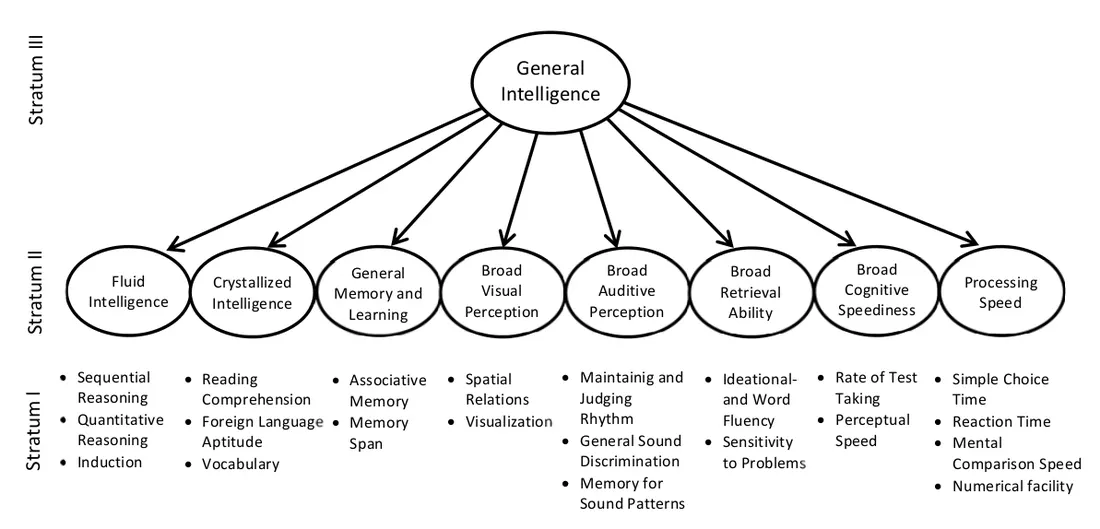
Figure 14.2: A slightly revised version of Carroll’s Three-Stratum Theory.
gence tests, other factors are mostly needed to give a comprehensive picture of an individual’s cognitive abilities. Unsurprisingly, fluid and crystallized intelligence (and mixtures of both factors) are also most predictive for outcomes such as educational achievement or job performance. Please note that fluid intelligence has been found repeatedly to show the strongest relation with the overarching general factor. Therefore, if only a single task can be used to measure intelligence, your choice should be to pick a fluid intelligence task.
that was desperately needed for various Wechslertests in particular.
Despite its unifying character, the CHC model must not be misunderstood as a final model of intelligence structure. There are many open questions, some of which we will discuss in later sections of this chapter. In addition, our presentation of intelligence relies on psychometric, mainly factoranalytical approaches for studying individual differences in cognitive abilities. However, we want to mention that there are several theories of intelligence that cannot be given full consideration in the course of an introductory chapter. A theory that is popular, especially among educators and teachers, is the theory of "Multiple Intelligences" by Gardner (1983, 1991) who advocated against g, proposed distinct forms of intelligence and claimed that students can be categorized in eight different types of learners (i.e., visual-spatial, bodilykinesthetic, musical-rhythmic, interpersonal, intrapersonal, verbal-linguistic, logical-mathematic, naturalistic). However, multiple intelligences appear to be a blend of g, broad ability factors below g, and other non-cognitive factors (Visser, Ashton, & Vernon, 2006) and there is no adequate empirical evi-
At the lowest level of the hierarchy there are many specific intellectual abilities that serve to underline the breadth of factors at the middle level and to illustrate the exhaustiveness of the model. Taken together, the work of Cattell, Horn, and Carroll by and large converges on the model shown in Figure 14.2. The discussion of research on this model integrates and successively extends the common ground on individual differences in intelligence (McGrew, 2009). In the current version of the model, more specific abilities, such as specialized knowledge in the sense of expertise or reading and writing skills, have been included. Importantly, in the last two decades, popular and frequently used intelligence tests switched to the Cattell-Horn-Carroll (CHC) model—a change
Psychology of Human Thought • Chapter 14 • 259
Wilhelm & Schroeders Intelligence
dence to justify incorporating learning-styles into education (Pashler, McDaniel, Rohrer, & Bjork, 2008).
aspects of fluid intelligence and neglect other factors we described above. In addition, both definitions are opaque with respect to concepts such as ability, achievement, aptitude, competence, proficiency, talent, skill, and so on (Schroeders, 2018). Some of these terms are used in specific research traditions or serve to set a specific focus. For example, competency or proficiency are preferred in an educational setting because within the spectrum of abilities under consideration, the abilities trained in formal learning (e.g., schooling) are perceived as malleable and acquired. In contrast, talent often labels an inherited or an exceptional ability (e.g., musical or artistic talent). The subtle nuances between these concepts, which are all related to effortful cognitive processing, are best seen in the context of the research tradition from which they originate. If you were asked to classify existing measures of intelligence, competence, aptitude, skill, etc., you would hardly be able to come up with a dependable classification of tasks. Therefore, these terms should be characterized as “fuzzy” and insufficient when it comes to explaining relations between tasks or to assigning tasks to factors.
The concept of emotional intelligence has also gained considerable attention (Salovey, Mayer, & Caruso, 2004) and received substantial criticism (Davies, Stankov, & Roberts, 1998). It is argued to comprise the abilities to perceive emotions, the abilities to access, generate, and use emotions, the abilities to understand and regulate emotions and finally to enclose knowledge about emotions (Salovey et al., 2004). For most of these abilities it is difficult to come up with an unequivocal response standard, i.e. what might work to regulate Persons A’s emotions might be counterproductive for person B. Nevertheless, recent efforts to include some aspects of emotional intelligence into a higher-order model of intelligence were successful (MacCann, Joseph, Newman, & Roberts, 2014) and future research in this area might be promising.
14.1.3 Intelligence as OverarchingConcept of Maximal CognitiveEffort
In order to derive a dependable and inclusive understanding of what constitutes an intelligence task, we recommend using intelligence as an overarching concept of maximal cognitive effort. The distinction between typical behavior and maximum cognitive performance dates back to Cronbach (1949): typical behavior refers to the ways individuals usually behave and what they like or dislike. It is usually captured through self-reports on behaviors, preferences, and valences. For example, the question “Do you like solving math puzzles?” arguably describes an individual’s preference for engaging in mathematical problem solving. Responses to such questions presuppose the willingness and ability of subjects to introspect. As well, these responses are very vulnerable to subjective judgments and biases (e.g., social desirability). In contrast, maximal cognitive performance refers to the measurement of abilities, achievements, skills, talents, etc. An item such as, “What is the solution to f(x) = 3x2 + 12?” differs
Our discussion of intelligence has yet to include an actual, clear definition of intelligence. Indeed, prior attempts of specifying what intelligence is and what it is not were of limited success. The infamous definition that intelligence is what the test measures (Boring, 1923) begs the question of which tasks or factors of intelligence are indispensable and what should not be part of the concept “intelligence”. In response to public controversy over the term intelligence, Gottfredson and 52 other researchers (1997, p.13) gave a very broad definition of intelligence: “A very general mental capability that, among other
things, involves the ability to reason, plan, solve problems, think abstractly, comprehend complex ideas, learn quickly and learn from experience.” Similarly, Neisser et al. (1996, p. 77) defined intelligence as individual differences between persons “[. . . ] in their ability to understand complex ideas, to
adapt effectively to the environment, to learn from experience, to engage in various forms of reasoning, to overcome obstacles by taking thought.” The essential components of these definitions center on
fundamentally from the assessment of typical behavior in several ways. Items of maximal behavior will only be used in contexts in which a) the person be-
260 • Psychology of Human Thought • Chapter 14
Intelligence as Overarching Concept of Maximal Cognitive Effort Wilhelm & Schroeders
ing examined is aware of the performance appraisal, b) the person is willing and able to show maximal cognitive effort, and c) the standards for evaluating the response behavior are adequate for the purpose of making a diagnostic judgment (Sackett, Zedeck, & Fogli, 1988). Preferably, objectively correct solutions are used as a benchmark for actual response behavior. In some domains, providing a veridical response standard is not feasible. For example, it is very difficult to provide such a standard for written essays and tasks designed to tap into interpersonal intelligence factors such as understanding emotions (for a recent though incomplete summary concerning intrinsically personal tests, see Mayer, 2018). Rather, these tasks often rely on situational judgment methodology (Oostrom, DeSoete, & Lievens, 2015). One important aspect that we want to stress is the unfortunate division between psychological and educational testing of maximal effort concepts. More than a century ago, Binet (1904) distinguished between medical, pedagogical, and psychological methods in intelligence testing. The medical method aims “to appreciate the anatomical, physiological, and pathological signs of inferior intelligence” (Binet, 1904, p. 194). Thus, this method will receive no further consideration in this chapter. The psychological method “makes direct observations and measurements of the degree of intelligence” (Binet, 1904, p. 194) and focuses on reasoning and memory-related abilities. The pedagogical method “aims to judge intelligence according to the sum of acquired knowledge” (Binet, 1904, p. 194). It is clear in our earlier presentation of essential intelligence factors that the psychological and the pedagogical method roughly correspond to fluid and crystallized intelligence respectively. This early distinction by Binet, unfortunately, led to a subsequent separation of efforts related to his two methods. Consequently, fluid intelligence or equivalent concepts such as decontextualized thinking, academic intelligence, etc., are hardly accepted determinants of educational outcomes and have often been considered taboo in an educational context. Conversely, elaborating on crystallized intelligence or related concepts such as expertise and how they could enrich cognitive ability testing has yet to become popular in psychometric research con-
texts. Unfortunately, the separation between these two fields has yet to be overcome. As a remedy, we propose that the term intelligence be used as an overarching concept that encompasses mechanical abilities such as fluid intelligence, memory, and processing speed, as well as knowledge-driven aspects, such as crystallized intelligence with its myriad of facets.
Next, we want to relate intelligence assessment with educational assessment to illustrate the overarching/unifying aspect of intelligence. The debate regarding the extent intelligence tests and educational achievement tests measure the same underlying abilities has a long history (Baumert, Lüdtke, Trautwein, & Brunner, 2009). We propose that the problem of distinguishing between intelligence tests and other measures for assessing cognitive abilities (e.g., educational achievement tests) is not whether a person’s scores on both methods are perfectly correlated (Bridgeman, 2005). To understand differences between both fields, it is more instrumental to study attributes in which such measures differ: for example, where they are located on the continuum "decontextualized" vs. "contextualized" and which predictions the contextualization of measures affords (Brunner, 2008). This approach clearly places the competencies studied in educational psychology below crystallized intelligence. For example, Baumert and colleagues (2009) suggested that international education studies, such as PISA (Program for International Student Assessment), primarily capture the cumulative outcomes of a knowledge acquisition process. This understanding of competence is broadly identical to Cattell’s definition of crystallized intelligence (1971), according to which crystallized intelligence encompasses the totality of knowledge that people acquire and use to solve problems throughout their lives. Whereas the nature and content of educational tests are usually carefully studied, many traditional tests of crystallized intelligence neglect content validity—a lesson that can and should be learned from educational testing.
We advise against relying on a test’s purpose to understand what the test measures. College admission tests do not measure the ability to study. Such tests usually include measures of fluid intelligence along with domain-specific crystallized intelligence
Psychology of Human Thought • Chapter 14 • 261
Wilhelm & Schroeders Intelligence
14.2 Measuring and Using Intelligence
tasks. School readiness tests do not capture the ability to attend school—instead, they are best seen as a composite of gc tasks and social skills. If you want to understand what a measure of maximal cognitive performance captures, it is not wise to focus on the purpose of testing. Instead, it will be more useful to classify a measure according to the intelligence factors described here.
14.2.1 Tasks for Measuring Intelligence
In this section, we introduce selected intelligence tasks designed for use with adults and discuss the cognitive demands of these tasks. We focus on the two factors of fluid and crystallized intelligence because these factors are the most decisive and important predictors in most applied settings, such as college admission or personnel selection.
14.2.1.1 Tasks for Measuring Fluid Intelligence
Earlier in this chapter, we argued that a fluid intelli-gence task should be chosen when only a single task can be used to measure intelligence. Such a fluid intelligence task would then serve as a marker task for intelligence. Below the fluid intelligence factor, Carroll (1993) distinguished three reasoning factors:
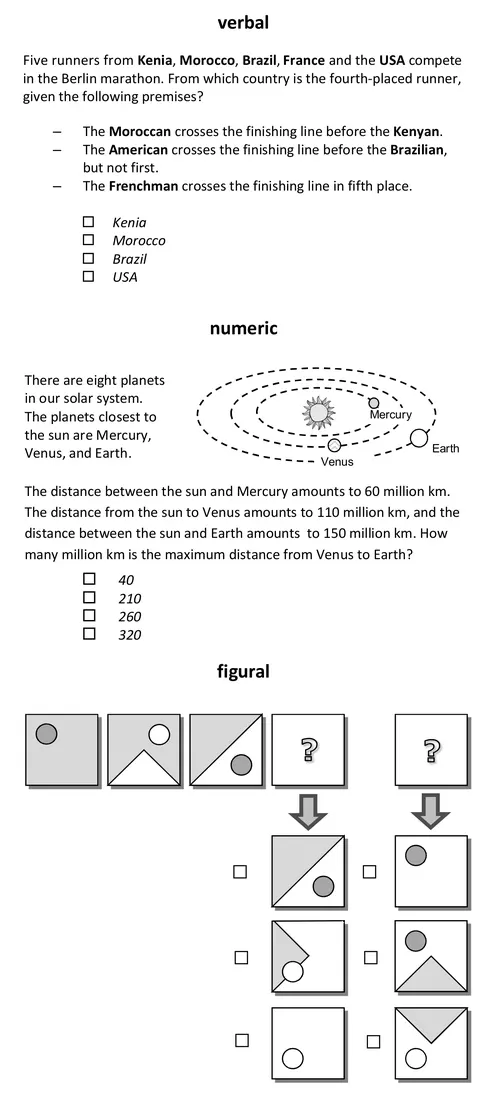
• Sequential reasoning tasks require drawing conclusions from certain premises. The cognitive operations that are required to solve such tasks can be many, particularly when comparing stimuli with regards to their properties or determining class membership of elements. The focus of sequential reasoning tasks is not on finding or discovering regularities (induction), but on successfully applying rules. For prototypical tasks of sequential reasoning, Carroll (1993) listed deductive reasoning (identifying logical inferences from a verbal problem), syllogisms (evaluating the correctness of a conclusion based on two premises), and verbal reasoning (see Figure 14.3 a) for an illustration).
• Inductive reasoning tasks require finding similarities or differences in features or relations between stimuli. In contrast to the deductive reasoning tasks, the difficulty lies in identifying the underlying rules rather than applying them. These rules may represent a concept, a class membership, or a causal relationship. Typical tasks include classification (identifying a figure that does not belong
Figure 14.3: Example item for fluid intelligence: verbal, numeric,
and figural.
262 • Psychology of Human Thought • Chapter 14
Tasks for Measuring Intelligence Wilhelm & Schroeders
in an ensemble of similar figures) or working with matrices (identifying a figure that replaces a placeholder within a matrix so that the pattern found in rows and columns persist) (see Figure 14.3 c) for an illustration). Formally, all inductive intelligence tasks are essentially enthymemes, that is, deductive inferences in which one or more premises are implicitly "added" rather than explicitly formulated (Wilhelm, 2004).
a model with three correlated content factors, covering verbal, numeric, and figural stimulus material, described the data much better than a model with a single reasoning factor (Wilhelm, 2004). The model with three correlated content factors (with no other covariates) is statistically equivalent with a higher-order model in which the content factors load on a higher-order fluid intelligence factor. In line with previous research (e.g., Marshalek, Lohman, & Snow, 1983), the figural reasoning task showed the strongest relation with the overarching fluid intelligence factor, which suggests that the figural content is the best single indicator of fluid intelligence. In summary, the classification of fluid intelligence tasks based on its content is both theoretically and empirically well supported (see Figure 14.3 for example items). Please note that broad visual perception includes spatial ability parts that are close to the reasoning factors discussed here (Lohman, 1996).
• Quantitativereasoningtasks assess quantitative-numerical components of reasoning. These demands may be deductive, inductive, or a combination of both. Typical examples of quantitative reasoning are mathematical word problems or number series (see Figure 14.3 b) for an illustration). In general, the difficulty lies in mathematical modeling, the numerical-formalization of a problem, rather than in the actual calculation (Carroll, 1993).
Developing a sound and efficient fluid intelligence task is more of an art than a science (Kyllonen & Christal, 1990). This position is predominantly due to a theoretical deficit: most available intelligence tasks suffer from a lack of well-founded theoretical assumptions about the cognitive processes required to successfully complete the tasks in question. Such an underlying theory could be used to derive procedures that generate items automatically, and it could provide a priori estimates of item difficulty. For example, for the figural aspect of fluid intelligence, numerous taxonomies for constructing matrix items have been proposed (Carpenter, Just, & Shell, 1990). In his review, Primi (2001) reduced the complexity of influencing factors on item difficulty to four main attributes: (1) the number of elements, (2) the number of transformations or rules, (3) the type of rules, and (4) the perceptual organization. The success of this proposal and similar efforts is mixed, and moreover, most efforts are limited to specific types of tasks.
A closer examination of the tasks subsumed below Carroll’s three reasoning factors suggests that the sequential reasoning factor is predominantly a verbal reasoning factor, the inductive factor is mostly covered by tasks with figural content, and quantitative reasoning relies on numeric content. This interpretation is also supported by Carroll’s observations (see Table 6.2 in Carroll, 1993, pp. 217) and his interpretation of the factors of the individual studies. Wilhelm (2004) used confirmatory factor analysis to examine this relationship between 12 different fluid intelligence tasks more closely. Among these tasks, prototypical indicators of deductive reasoning (e.g., propositions and syllogisms) and inductive reasoning tasks (e.g., series and matrices) were selected. The comparison of competing measurement models revealed that a model in which the correlation between inductive and deductive thinking was freely estimated described the data as well as a model in which inductive and deductive thinking were modeled as a common factor. Thus, a distinction between inductive and deductive thinking is artificial and unnecessary from the perspective of differential psychology. Another important finding was that
A promising approach to circumvent these problems and to gain a more profound understanding of reasoning is to instead rely on the concept of work-ing memory capacity (WMC). With respect to going beyond task-specific models of what changes the difficulty and nature of a task, WMC can be applied to many working memory items by specifying
Psychology of Human Thought • Chapter 14 • 263
Wilhelm & Schroeders Intelligence
the storage and processing demands of a task. In a memory updating task, for example, subjects might be shown digits presented in four different locations. These digits disappear, and subjects briefly receive instructions for simple computations at the location of individual digits, one after another. After several such computations, subjects are asked to provide the final results for each of the locations. Such tasks can easily be generated by computers, and their difficulty can be predicted very well with just a few task attributes. WMC tasks might not only prevent some of the problems prevalent with reasoning measures but they are also the key to understanding fluid intelligence and intelligence in general (Engle, 2018; Oberauer, Farrell, Jarrold, & Lewandowsky, 2016).
learn and know (Cattell, 1971). This notion suggests an assessment of gc via factual knowledge tests that captures both school and extracurricular content (for an example item see Figure 14.4). As learning opportunities become more and more diverse across one’s lifespan and after regular schooling, the assessment of gc becomes increasingly difficult. An ideal measurement of gc must include the whole variety of knowledge that people can acquire during their lives (and that are somewhat valued culturally). Consequently, it would require as many different tasks as there are occupations, recreational activities, and other differential learning opportunities. The central role of knowledge in the concept of crystallized intelligence is also emphasized by Ackerman (1996), who stated that gc measures should not be an in-depth assessment of knowledge within a specific domain or a few selected domains; rather, gc measures should be conceptually broad.
The relation between WMC and fluid intelligence has received considerable attention (Kane, Hambrick, Tuholski, Wilhelm, Payne & Engle, 2004; Oberauer, Schulze, Wilhelm, & Süß, 2005) and there is a broad consensus that this relation is very strong, though not perfect (Kyllonen & Christal, 1990). The main reasons for the very strong, but not perfect, relation might be twofold. First, despite being unwanted, many reasoning tasks do have knowledge requirements that might bias the relation with WMC in a downwards fashion. Second, many WMC tasks have an intrinsic speed requirement by limiting stimulus exposition or time windows for responding. If these biases were adjusted for, the relations between fluid intelligence and WMC might be perfect (Wilhelm, Hildebrandt, & Oberauer, 2013).
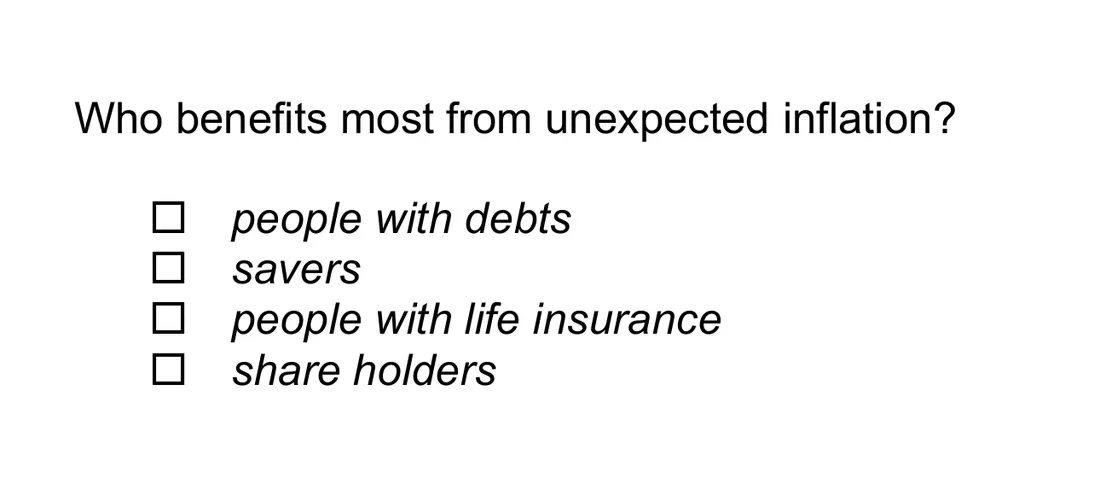
Figure 14.4: Example item for crystallized intelligence.
In reality, gc is predominantly assessed via verbal indicators such as vocabulary and verbal fluency tasks. There is no doubt that language skills are important and a result of formal education and, thus, culturally-shared knowledge. This idea is also consistent with the description of gc in Carroll’s Three-Stratum Theory (1993). However, the factoranalytic results could instead be an artifact of current assessment practices which have an overrepresentation of verbal ability measures.
14.2.1.2 Tasks for Measuring CrystallizedIntelligence
According to Cattell (1971), crystallized intelli-gence should be seen as the result of the investment of fluid intelligence in learning situations, but also depends on additional sources such as investment traits (Ackerman, 1996) and interests (Su, Rounds, & Armstrong, 2009). Thus, gc reflects the impact of education, learning, and acculturation on knowledgerelated intelligence tasks. During school years, the item universe for gc measurement is at least partly predetermined through the canon of formal education and through cultural standards that roughly prescribe what children and adolescents are expected to
But it is also apparent that language command describes only a section of culturally-shared knowledge. In fact, in a large-scale educational assessment study, Schipolowski, Wilhelm, and Schroeders (2014) administered various language tasks, including reading comprehension, listening comprehension, language use and writing, together with a broadly sampling knowledge test covering 16 con-
264 • Psychology of Human Thought • Chapter 14
Validity of Intelligence Tests Wilhelm & Schroeders
tent domains (e.g., physics, art, law) to an unselected sample of 6,071 adolescents. The correlation between latent variables representing language command and knowledge was very high (ρ = .91), but significantly different from unity. About 17% of the variance in the knowledge factor was independent of individual differences in language command and fluid intelligence (and vice versa). Thus, a restriction to purely language-related content must be regarded as deficient in light of the abovementioned definition of gc because it equates a part of gc with the overarching gc factor (Amthauer, Brocke, Liepmann, & Beauducel, 2001). Please note that command of language may or may not be different from a concept-labeled verbal ability by some researchers.
& Hunter, 1998; Schmidt, 2002). Intelligence in this context mostly refers to the ability to reason (gf) and domain-related knowledge (gc). The pre-dictive validity of both components seems to vary during the course of life. In a comprehensive review, Baumert and colleagues (2009) compared the results of various educational-psychological studies and showed that the predictive power of domainspecific knowledge in comparison to reasoning becomes more important the older students are. Obviously, the contributions of gf and gc are hard to distinguish because they are strongly correlated. The relevance of knowledge on significant outcomes and its underrepresentation in contemporary intelligence assessment led Ackerman (2000) to the conclusion that domain-specific knowledge is the “dark matter” of adult intelligence. His PPIK theory (intelligenceas-process, personality, interests, and intelligenceas-knowledge; Ackerman, 1996), builds on Cattell’s gf-gc-theory. It distinguishes several types of knowledge (e.g., occupational knowledge) to give domainspecific knowledge the space it deserves.
Cattell (1971) also drew attention to the fact that verbal ability tasks do not necessarily cover gc adequately, especially if the verbal content is strongly over-trained knowledge or decontextualized. Furthermore, knowledge tests also have the greatest potential to minimize the risk of being confounded with fluid intelligence. The maximum separation of gc and gf should be an overriding principle in constructing efficient and distinct measures of cognitive ability (Carroll, 1993). Language skills and reasoning abilities are minimal requirements for knowledge tests, as they are necessary to understand the question and answer options at a basic level. Taken together, we conclude that declarative knowledge tests should take into account as many areas of knowledge as possible to be used as marker variables of gc, as they include a variety of learning experiences that go beyond language skills and competencies.
Much research was conducted to shed light on the developmental interplay between gf and gc. In the investment theory, Cattell (1971) proposed that crystallized knowledge develops through the investment of fluid ability. However, empirical evidence for this assumption is sparse. For example, Ferrer and McArdle (2004) used linear dynamic models to study the trajectories of gf and gc from childhood to early adulthood. The results showed no coupling between gf and gc within the studied age range, which clearly contradicts the investment theory. When reviewing available empirical evidence and methodological approaches on the development of gf and gc, it becomes evident that there is no direct or simple explanation to account for the development and mutual relation between cognitive abilities in general, and gf and gc in particular. To overcome this issue, Savi, Marsman, van der Maas and Maris (2018), for example, proposed to abandon factor analytic methods in intelligence research and instead conceptualize intelligence as evolving networks in which new knowledge and processes are wired together during development. This approach might also bridge the gap between the study of individual differences in intelligence and phenomena
14.2.2 Validity of Intelligence Tests
Up until this point, we have presented different conceptualizations of intelligence and ways to measure it. We can also take a very pragmatic position while discussing the strengths and benefits of intelligence testing. Intelligence tests are used in psychology, educational research, and other behavioral sciences for a wide range of purposes because intelligence is one of the best predictors of educational, vocational, academic success, and job performance (e.g., Schmidt
Psychology of Human Thought • Chapter 14 • 265
Wilhelm & Schroeders Intelligence
primarily studied in cognitive psychology, such as forgetting.
working in the fields of behavior or molecular genetics of traits have gained a more profound understanding of heritability and use more advanced statistical methods and designs to study the relevance of nature and nurture.
The great importance of intelligence is evident not only in school or university education (Kuncel & Hezlett, 2007; Schmidt & Hunter, 1998), but also in professional training (Ziegler, Dietl, Danay, Vogel, & Bühner, 2011). As a cautionary note, even though intelligence is the most influential single predictor of academic achievement, it still accounts for only about a quarter of variation in the outcome. Accordingly, successful learning at school and the university depends on a plethora of individual characteristics—such as the personality trait conscientiousness (Barrick & Mount, 1991) or interests (Holland, 1997)— in addition to intelligence.
For example, Plomin and von Stumm (2018) summarized recent findings on genome-wide association studies, identifying genome sequence differences that account for 20% of the 50% heritability of intelligence. Such reports on the genetic transmission of intelligence seem to be contradicted by the fact that schooling affects both scholastic achievement (for a comprehensive account, see the classes of evidence described by Ceci, 1991) and intelligence (Becker, Lüdtke, Trautwein, Köller, & Baumert, 2012; Cliffordson & Gustafsson, 2008). However, there is nothing contradictory about these findings once genetic effects are interpreted correctly (Johnson, Turkheimer, Gottesman, & Bouchard, 2010). Also, in a recent meta-analysis of quasi-experimental studies with strong designs (i.e., those that allow statements about increases in intelligence as a function of schooling), Ritchie and Tucker-Drob (2018) summarized overwhelming evidence for education being the most consistent, robust, and durable method for raising intelligence. They found an increase between 1 and 5 IQ points for every additional year of schooling.
A last aspect of predictive validity we would like to touch upon has to do with death. Initially labeled “ultimate validity” (O’Toole & Stankov, 1992), the
relevance of intelligence for longevity becomes increasingly clear. It turns out intelligence might be an essential contributor to epidemiological outcomes in that premorbid intelligence predicts all sorts of health related behaviors and diseases which in turn are related with mortality (Batty, Deary, & Gottfredson, 2007).
14.2.3 Training of Intelligence
Somewhat related, it can be shown that non detrimental or supporting environments have a positive effect on intelligence over a broader time period (Flynn, 1984). Despite contradicting results, the so-called Flynn-effect might in fact not have leveled off in the past two decades (Trahan, Stuebing, Fletcher, & Hiscock, 2014). Beside the aforementioned changes in the educational system, different factors have been discussed for being responsible for the IQ gains. In particular, education and healthrelated factors such as better nutrition and reduced pathogen stress appear to be related to IQ gains (Pietschnig & Voracek, 2015).
“How Much Can We Boost IQ and Scholastic
Achievement” was the title of an influential and very controversial paper published in the late sixties (Jensen, 1969). In this paper, Jensen drew a somewhat pessimistic conclusion concerning interventions intended to improve IQ or scholastic achievement. In their notorious book, “The Bell Curve: Intelligence and Class Structure in American Life”, Herrnstein and Murray (1994) also concluded with negative inferences concerning the improvement of IQ and scholastic achievement. The contributions by Gottfredson (1997) and Neisser et al. (1996) for defining intelligence as a concept (discussed earlier in this chapter) were, in fact, both reactions to the controversy triggered by the Hernstein and Murray book. Importantly, both publications suggested relatively explicitly that many of the observed group differences in IQ and scholastic achievement are determined genetically. Obviously, today’s scientists
The evidence presented so far is correlative and at a macroscopic level. If we want to answer the question laid out at the beginning of this section, we should take a closer look at the experimental evidence. Prior to evaluating such evidence, the benchmark for such an evaluation should be clear.
266 • Psychology of Human Thought • Chapter 14
Conclusions Wilhelm & Schroeders
Training effects on intelligence should a) persist after the training ended (effect duration), b) be present in non-trained tasks (effect transfer), c) be specific to the targeted intelligence so that not everything is improving but only trained aspects, d) be stronger in trained than in non-trained subjects (who should be engaged in other training instead of simply waiting), and e) be rational and sensible in the way that the intervention is tailored to what it should accomplish and it provides a non-trivial gain.
approach. Studies with a more substantial dosage provide a much better read and a more realistic picture (Schmiedek, Lövdén, & Lindenberger, 2010).
Another field in which fostering intellectual functioning was studied is cognitive ageing. The useit-or-lose-it hypothesis (Hultsch, Hertzog, Small, & Dixon, 1999) suggests that being intellectually active prevents an age-associated cognitive decline. Obviously, it is difficult to collect strong data on cognitively-active lifestyles over decades and, thus unsurprisingly, there still seems to be no conclusive evidence (Salthouse, 2006). Given that intellectually engaging activities will hardly have adverse effects, living a mentally active life is not a bad choice. However, if you are hoping to maintain or improve your intelligence by skipping physical activity in exchange for intellectual activity—this is probably a bad idea in the long run, as physical exercise has been shown to be beneficial for intellectual functioning (Kramer & Colcombe, 2018).
Moreover, bearing in mind the current replication crisis (Open Science Collaboration, 2015), training studies should fulfill the requirement of experimental studies concerning sample size, sound measurement instruments, a priori specified outcome variable, etc.. Unfortunately, many popular studies that received extensive mass media coverage do not adhere to these requirements (Melby-Lervag, Redick, & Hulme, 2016). Accordingly, many of the bold claims about successfully training intelligence or its most important facets (e.g., Jaeggi, Buschkuehl, Jonides, & Perrig, 2008) can be attributed to methodological flaws and are not due to some miraculous interventions (Melby-Lervag et al., 2016).
14.3 Conclusions
Reviewing most interventions shows that they were designed with the hope that a few hours of training would bring about long-lasting, transferable, and relevant improvements in highly general intellectual abilities. This claim is not only bold; it is completely unrealistic. Even if we adhere to a lifestyle that spares us intellectual effort, we can hardly be functioning members of society if we do not regularly engage in effortful, intellectual, and challenging thinking. In other words, our everyday lives provide daily intellectual exercises, no matter how trivial and dull they feel from time to time. Whether we like it or not, we use our intellectual capacity constantly. Training must provide a sufficiently large additional dosage to make a real difference. Moreover, the mechanisms being stressed by intelligence training should also be suited to bring about the desired change. Alas, most training—in a sense of over-learning rather simple tasks—just have people repeatedly completing different variations of the same type of question. Simply adjusting the difficulty of questions to say 50% is not an impressive improvement of the retesting-ad nauseam-
We want to use this section to point out a few pervasive problems in intelligence research, raise open questions, and hint to potential solutions for such problems. We began this chapter by highlighting that intelligence research is about individual differences and covariation, whereas most other chapters in this book are about the general psychology of cognition and experimental effects. There is some lamentation about the unfortunate nature of the barriers between these two disciplines (Cronbach, 1957). Indeed, the intelligence model we introduced as widely accepted has a substantial lack of cognitive sophistication. For example, despite its essential role in intelligence research, our understanding of most reasoning tasks is severely limited. Popular definitions of the construct often stress the novelty of reasoning tasks as an essential feature, yet we have no clear idea of what novelty actually means. Usually, these discussions move on by pointing to induction, deduction, and sometimes abduction—but rarely is there ever a connection between reasoning tasks used in intelligence research and the same tasks being used in experimental settings to study
Psychology of Human Thought • Chapter 14 • 267
Wilhelm & Schroeders Intelligence
competing theories about inductive thinking, for example. Taken together, the lamentation about these two disciplines of psychology remains justified.
factor labels suggest so. Additionally, researchers are at a loss when it comes to choosing a glr test because the method selected heavily affects outcomes. A much stronger connection with experimental approaches is essential to further our understanding of this factor.
In the end, gc can be considered as a collection of all sorts of pragmatic and knowledge-driven thinking. We have merely begun to understand the breadth of all the aspects we are subsuming here: wisdom, command of a language, foreign-language aptitude, declarative and procedural knowledge of all sorts etc.. Crystallized intelligence needs a lot more attention. And research on gc demands specific methods due to its intrinsic orientation towards change and its idiosyncrasy that grows over the course of one’s life.
The discussion of potential shortcomings of the taxonomy we actually endorse seems endless. Should originality and creativity really be located below learning and retrieval? What about interpersonal abilities, such as emotional competence? Clearly, there is no shortage of questions and problems. It is therefore important to understand this taxonomy as a starting point rather than as an end result. There is much to be improved, but intelligence testing in all its varieties is also a major success story from an applied perspective. It is a strong predictor for several desirable outcomes and it is no doubt essential for determining how cognitively rich our lives are.
A closer look at the general learning and recognition factor provokes a few questions, too. The factors below glr mostly refer to specific methods for measuring memory. Of course, no one can claim that associative memory is a different memory store than free recall memory, for example, even though the
Summary
1. We began this chapter by briefly reviewing milestones of intelligence research and juxtaposed competing models of individual differences in intelligence.
2. We described contemporary accepted models on the structure of intelligence in which fluid and crystallized intelligence are the most important factors.
3. We argued for an extension of the use of the term intelligence to all tasks essentially reflecting individual differences in maximal cognitive effort.
4. In the second section, we presented prototypical tasks for fluid and crystallized intelligence.
5. We discussed a number of weaknesses in contemporary intelligence models and argued that from a pragmatic viewpoint - the measurement of intelligence is still a success story.
6. We discussed several efforts to improve intelligence, a class of interventions that should interest not only individuals but also society as a whole.
268 • Psychology of Human Thought • Chapter 14
Conclusions Wilhelm & Schroeders

Review Questions
1. Think about the models in Figure 14.1. Which one do you think best captures individual differences in human intelligence? Why?
2. Can you think of maximal cognitive effort concepts that are not part of the CHC-model?
3. Where in Figure 14.2 would you locate emotion perception? What skills and abilities make a good insurance broker?
4. Can you come up with example items for a fluid intelligence task? Are these items deductive or inductive; are they verbal, numeric, or figural?
5. Why is the enthusiasm concerning interventions for working memory premature?
Hot Topic: Sex Differences in Crystallized Intelligence?
Few topics in ability research are regarded as controversial as sex/gender differences in cognitive abilities. According to the Gender Similarity Hypothesis (Hyde, 2005), sex differences in cognitive abilities are mainly small and unsystematic. This general conclusion is empirically supported for fluid intelligence but is challenged for crystallized intelligence, when measured with knowledge tests. Most studies show that males outperform females in general knowledge, with an average overall effect of d = .26 (Schroeders, Wilhelm, & Olaru, 2016). A closer examination on the level of domains reveals a more complex pattern: for example, females clearly outperform men in health-related domains, such as aging and nutrition, but large differences in favor of males were found for technology and the natural sciences (Ackerman, Bowen, Beier, & Kanfer, 2001). It is striking that such stereotypic sex-related differences in knowledge domains seem to match the sex differences in interest as reported in the famous "Men and Things, Women and People" meta-analysis by Su and colleagues (2009). On the other hand, we should avoid overgeneralizing such differences. For example, the magnitude and direction of sex or gender differences in mathematical competencies varies dramatically across countries (Stoet & Geary, 2013).

Oliver Wilhelm
An aspect that is often neglected in studies on group differences in cognitive abilities is the aspect of item sampling. The same way participants of a study are selected from a population (person sampling), items can be thought of as being drawn from a population of items (item sampling). In the construction and validation of psychological measures, we usually assume that we draw items from a theoretically infinite item universe. In a recent study, we put this idealistic assumption to the test (Schroeders et al., 2016). We used metaheuristic sampling procedures (i.e., ant-colony-optimization algorithms) to compile psychometrically sound short forms of a knowledge test. The algorithm was set for two criteria, a) to select items from an initial set that adhere to strict psychometric criteria concerning fit of the data to a model, and

Ulrich Schroeders (Photo: Sonja Rode/ Lichtfang.net)
Psychology of Human Thought • Chapter 14 • 269
Wilhelm & Schroeders Intelligence
b) to deliberately tilt sex differences to either favor males or females. The results show that sex differences vary considerably depending on the indicators drawn from the item pool. In other words, we could compile knowledge tests for sciences and technology in which females outperformed males. They also could compile health tests in which males outperformed females. This result questions the generalizability of previously reported findings on sex differences in crystallized intelligence. On a more general stance, the results corroborate the notion of Loevinger (1965, p. 147) that the random sampling assumption of items (and tests) is unrealistic because test development is "almost invariably expert selection rather than sampling". Unfortunately, many studies concerning group differences in cognitive abilities fail to acknowledge item selection effects.
References
Ackerman, P. L., Bowen, K. R., Beier, M. E., & Kanfer, R. (2001). Determinants of individual differences and
gender differences in knowledge. Journal of Educational Psychology, 93, 797–825. doi:10.1037/0022- 0663.93.4.797
Hyde, J. S. (2005). The gender similarities hypothesis. American Psychologist, 60, 581–592. doi:10.1037/0003-
066x.60.6.581
Loevinger, J. (1965). Person and population as psychometric concepts. Psychological Review, 72, 143–155.
doi:10.1037/h0021704
Schroeders, U., Wilhelm, O., & Olaru, G. (2016). The influence of item sampling on sex differences in
knowledge tests. Intelligence, 58, 22–32. doi:10.1016/j.intell.2016.06.003
Stoet, G., Geary, D. C. (2013). Sex differences in mathematics and reading achievement are inversely
related: within- and across-nation assessment of 10 years of PISA data. PLoS ONE, 8, e57988. doi:10.1371/journal.pone.0057988
Su, R., Rounds, J., & Armstrong, P. I. (2009). Men and things, women and people: a meta-analysis of sex
differences in interests. Psychological Bulletin, 135, 859–884. doi:10.1037/a0017364
References
Ackerman, P. L. (1996). A theory of adult intellectual de-
Amthauer, R., Brocke, B., Liepmann, D., & Beauducel, A.
velopment: Process, personality, interests, and knowledge. Intelligence, 22, 227–257. doi:10.1016/s0160- 2896(96)90016-1
(2001). Intelligenz-Struktur-Test 2000 R. Göttingen: Hogrefe.
Barrick, M. R., & Mount, M. K. (1991). The big five personality dimensions and job performance: a meta-analysis. Personnel Psychology, 44, 1–26. doi:10.1111/j.1744-6570.1991.tb00688.x
Ackerman, P. L. (2000). Domain-specific knowledge as
the "dark matter" of adult intelligence: Gf/Gc, personality and interest correlates. The Journals of Geron-tology Series B: Psychological Sciences and SocialSciences, 55, 69–84. doi:10.1093/geronb/55.2.p69
Batty, G. D., Deary, I. J. & Gottfredson, L. S. (2007).
Premorbid (early life) IQ and later mortality risk: systematic review. Annals of Epidemiology, 17, 278–288. doi:10.1016/j.annepidem.2006.07.010
Ackerman, P. L., Beier, M. E., & Bowen, K. R. (2000).
Explorations of crystallized intelligence: Completion tests, cloze tests, and knowledge. Learning and Indi-vidual Differences, 12, 105-121. doi:10.1016/s1041- 6080(00)00034-0
Baumert, J., Lüdtke, O., Trautwein, U., & Brunner,
M. (2009). Large-scale student assessment studies measure the results of processes of knowledge acquisition: Evidence in support of the dis-
270 • Psychology of Human Thought • Chapter 14
References Wilhelm & Schroeders
tinction between intelligence and student achievement. Educational Research Review, 4, 165–176. doi:10.1016/j.edurev.2009.04.002
ican Psychologist, 12, 671-684. doi:10.1037/14156- 015
Davies, M., Stankov, L., & Roberts, R. (1998). Emotional
Becker, M., Lüdtke, O., Trautwein, U., Köller, O.,
intelligence in search of an elusive construct. Journalof Personality and Social Psychology, 75, 989-1015. doi:10.1037/0022-3514.75.4.989
& Baumert, J. (2012). The differential effects of school tracking on psychometric intelligence: Do academic-track schools make students smarter? Journal of Educational Psychology, 104, 682–699. doi:10.1037/a0027608
Ebbinghaus, H. (1895). Über eine neue Methode zur
Prüfung geistiger Fähigkeiten und ihre Anwendung bei Schulkindern. Zeitschrift für die Psychologie, 13, 401–459. doi:10.1037/h0064465
Binet, A., & Simon, T. (1904). Méthodes nouvelles pour le diagnostic du niveau intellectuel des anormaux. L’année Psychologique, 11, 191–244. doi:10.3406/psy.1904.3675
Engle, R.W. (2018). Working memory and executive atten-
tion: A revisit. Perspectives on Psychological Science, 13, 190–193. doi:10.1177/1745691617720478
Boring, E. G. (1923). Intelligence as the tests test it. New
Ferrer, E., & McArdle, J. J. (2004). An experimental analysis of dynamic hypotheses about cognitive abilities and achievement from childhood to early adulthood. Developmental Psychology, 40, 935–952. doi:10.1037/0012-1649.40.6.935
Republic, 36, 35–37.
Bridgeman, B. (2005). Unbelievable results when pre-
dicting IQ from SAT scores: A comment on Frey and Detterman (2004). Psychological Science, 16, 745– 746. doi:10.1111/j.1467-9280.2005.01606.x
Flynn, J. R. (1984). The mean IQ of Americans: Massive
gains 1932–1978. Psychological Bulletin, 95,29–51. doi:10.1037/0033-2909.95.1.29
Brown, R. E. (2016). Hebb and Cattell: The genesis of the theory of fluid and crystallized intelligence. Frontiers in Human Neuroscience, 10, 1–11. doi:10.3389/fnhum.2016.00606
Galton, F. (1883). Inquiries into Human Faculty and its
Development. London: The Eugenics Society with Dent & Sons. doi:10.1037/14178-000
Brunner, M. (2008). No g in education? Learn-ing and Individual Differences, 18, 152–165. doi:10.1016/j.lindif.2007.08.005
Gardner, H. (1983). Frames of Mind: The Theory of
Multiple Intelligences, Basic Books, New York, NY.
Carpenter, P. A., Just, A. J. & Shell, P. (1990). What
Gardner, H. (1999). Intelligence Reframed: Multiple In-
one intelligence test measures: A theoretical account of the processing in the Raven Progressive Matrices test. Psychological Review, 97, 404–431. doi:10.21236/ada221448
telligences for the 21st Century, Basic Books, New York, NY.
Gottfredson, L. S. (1997). Why g matters: The com-
plexity of everyday life. Intelligence, 24, 79–132. doi:10.1016/s0160-2896(97)90014-3
Carroll, J. B. (1993). Human Cognitive Abilities: A Sur-
vey of Factor-Analytic Studies. New York: Cambridge University Press. doi:10.1017/cbo9780511571312
Gustafsson, J. E. (1999). Measuring and understanding
g: Experimental and correlational approaches. In P. L. Ackerman, P. C. Kyllonen & R. D. Roberts (Eds.), Learning and Individual Differences. Process, Traitand Content Determinants (pp. 275–292). Washington, DC: APA Books. doi:10.1037/10315-012
Cattell, R. B. (1971). Abilities: Their Structure, Growth,
and Action. Boston: Houghton Mifflin Company.
Ceci, S. J. (1991). How much does schooling influence
general intelligence and its cognitive components? A reassessment of the evidence. Developmental Psychol-ogy, 27, 703–722. doi:10.1037//0012-1649.27.5.703
Guttman, L. & Levy, S. (1991). Two structural laws
for intelligence tests. Intelligence, 15, 79–103. doi:10.1016/0160-2896(91)90023-7
Cliffordson, C., & Gustafsson, J. E. (2008). Effects of age
and schooling on intellectual performance: Estimates obtained from analysis of continuous variation in age and length of schooling. Intelligence, 36, 143–152. doi:10.1016/j.intell.2007.03.006
Hernstein, R. J., & Murray, C. (1994). The Bell curve:
The Reshaping of American Life by Difference in In-
telligence. New York: The Free Press.
Holland, J. L. (1997). Making vocational choices: A the-
Cronbach, L. J. (1949). Essentials of psychological testing.
ory of vocational personalities and work environments. Odessa, FL: Psychological Assessment Resources.
New York: Harper & Brothers. Cronbach, L. J. (1957). The two disciplines of scientific psychology. Amer-
Psychology of Human Thought • Chapter 14 • 271
Wilhelm & Schroeders Intelligence
Holzinger, K. J., & Swineford, F. (1937). The bifactor method. Psychometrika, 2, 41–54. doi: 10.1007/BF02287965
Lord, F.M., & Novick, M.R. (1968). Statistical theories
of mental test scores. Reading, MA: Addison-Wesley.
Lohman, D. F. (1996). Spatial ability and g. In I. Dennis &
Hultsch, D. F., Hertzog, C., Small, B. J., & Dixon, R. A.
P. Tapsfield (Eds.), Human abilities: Their nature andmeasurement (pp. 97-116). Mahwah, NJ: Erlbaum. doi:10.4324/9780203774007
(1999). Use it or lose it: engaged lifestyle as a buffer of cognitive decline in aging? Psychology and Aging, 14, 245–263. doi:10.1037/0882-7974.14.2.245
MacCann, C., Joseph, D. L., Newman, D. A., & Roberts,
Jaeggi, S. M., Buschkuehl, M., Jonides, J., & Perrig,
R. D. (2014). Emotional intelligence is a secondstratum factor of intelligence: Evidence from hierarchical and bifactor models. Emotion, 14, 358–374. doi:10.1037/a0034755
W. J. (2008). Improving fluid intelligence with training on working memory. Proceedings of theNational Academy of Sciences, 105, 6829–6833. doi:10.1073/pnas.0801268105
Marshalek, B., Lohman, D. F., & Snow, R. E. (1983).
Jensen, A. (1969). How much can we boost IQand scholastic achievement. Harvard Educational Review, 39, 1–123. doi:10.17763/haer.39.1. l3u15956627424k7
The complexity continuum in the radex and hierarchical models of intelligence. Intelligence, 7, 107–127. doi:10.1016/0160-2896(83)90023-5
Mayer, J. D. (2018). Intelligences about things and in-
Johnson, W., Turkheimer, E., Gottesman, I. I., &
telligences about people. In R. J. Sternberg (Ed.). The nature of human intelligence (pp. 270-286).
Bouchard, T. J. (2010). Beyond heritability: twin studies in behavioral research. Current Directions in Psy-chological Science, 18, 217–220. doi:10.1111/j.1467- 8721.2009.01639.x
Cambridge, England: Cambridge University Press. doi:10.1017/9781316817049.018
Mayer, J. D., Salovey, P., & Caruso, D. R. (2004).
Kane, M. J., Hambrick, D. Z., & Conway, A. R. A. (2005).
Emotional intelligence: Theory, findings, and implications. Psychological Inquiry, 15, 197-215. doi:10.1207/s15327965pli1503_02
Working memory capacity and fluid intelligence are strongly related constructs: Comment on Ackerman, Beier, and Boyle (2005). Psychological Bulletin, 131, 66–71. doi:10.1037/0033-2909.131.1.66
McGrew, K. S. (2009). CHC theory and the human cogni-
tive abilities project: Standing on the shoulders of the giants of psychometric intelligence research. Intelli-gence, 37, 1–10. doi:10.1016/j.intell.2008.08.004
Kane, M. J., Hambrick, D. Z., Tuholski, S. W., Wil-
helm, O., Payne, T. W., & Engle, R. W. (2004). The generality of working memory capacity: a latentvariable approach to verbal and visuospatial memory span and reasoning. Journal of Experimental Psy-chology. General, 133, 189–217. doi:10.1037/0096- 3445.133.2.189
Melby-Lervåg, M., Redick, T. S., & Hulme, C. (2016).
Working memory training does not improve performance on measures of intelligence or other measures of “far transfer” evidence from a meta-analytic review. Perspectives on Psychological Science, 11, 512–534. doi:10.1177/1745691616635612
Kramer, A. F., & Colcombe, S. (2018). Fitness effects on
the cognitive function of older adults: A meta-analytic study – revisited. Perspectives on Psychological Sci-ence, 13, 213–217. doi:10.1177/1745691617707316
Neisser, U., Boodoo, G., Bouchard, T. J., Jr., Boykin, A.
W., Brody, N., Ceci, S. J., . . . Urbina, S. (1996). Intelligence: Knowns and unknowns. American Psycholo-gist, 51, 77–101. doi:10.1037/0003-066X.51.2.77
Kuncel, N. R., & Hezlett, S. A. (2007). Standardized
tests predict graduate students’ success. Science, 315, 1080–1081. doi:10.1126/science.1136618
Oberauer, K., Farrell, S., Jarrold, C., & Lewandowsky,
S. (2016). What limits working memory capacity? Psychological Bulletin, 142, 758–799. doi:10.1037/bul0000046
Kyllonen, P. C., & Christal, R. E. (1990). Reasoning
ability is (little more than) working-memory capacity?! Intelligence, 14, 389–433. doi:10.1016/s0160- 2896(05)80012-1
Oberauer, K., Schulze, R., Wilhelm, O., & Süß, H. M.
(2005). Working memory and intelligence – their correlation and their relation: comment on Ackerman, Beier, and Boyle (2005). Psychological Bulletin, 131, 61–65. doi:10.1037/0033-2909.131.1.61
Landy, F. J. (2005). Some historical and scientific is-
sues related to research on emotional intelligence. Journal of Organizational Behavior, 26, 411–424. doi:10.1002/job.317
272 • Psychology of Human Thought • Chapter 14
References Wilhelm & Schroeders
Oostrom, J. K., De Soete, B., & Lievens, F. (2015).
Savi, A. O., Marsman, M., van der Maas, H. L. J.,
Situational judgment testing: A review and some new developments. In I. Nikolaou, & J. K. Oostrom (Eds.), Employee recruitment, selection, and as-sessment: Contemporary issues for theory and prac-tice (pp. 172-189). Sussex, UK: Psychology Press. doi:10.4324/9781315742175
& Maris, G. (2018). The wiring of intelligence. doi:10.31234/osf.io/32wr8
Schipolowski, S., Wilhelm, O., & Schroeders, U. (2014).
On the nature of crystallized intelligence: The relationship between verbal ability and factual knowledge. Intelligence, 46, 156–168. doi:10.1016/j.intell. 2014.05.014
O’Toole, B. I., & Stankov, L. (1992). Ultimate valid-
ity of psychological tests. Personality and Individ-ual Differences, 13, 699–716. doi:10.1016/0191- 8869(92)90241-G
Schmid, J. & Leiman, J. M. (1957). The development
of hierarchical factor solutions. Psychometrika, 22, 53–61. doi:10.1007/bf02289209
Pashler, H., McDaniel, M., Rohrer, D., & Bjork, R.
Schmidt, F. L. (2002). The role of general cognitive ability and job performance: Why there cannot be a debate. Human Performance, 15, 187-210. doi:10.1080/08959285.2002.9668091
(2008). Learning styles concepts and evidence. Psy-chological Science in the Public Interest, 9, 105–119. doi:10.1111/j.1539-6053.2009.01038.x
Pietschnig J, Voracek M. (2015). One century of global
Schmidt, F. L., & Hunter, J. E. (1998). The validity and
IQ gains: a formal meta-analysis of the Flynn effect (1909–2013). Perspectives on Psychological Science, 10, 282–306. doi:10.1177/1745691615577701
utility of selection methods in personnel psychology: Practical and theoretical implications of 85 years of research findings. Psychological Bulletin, 124, 262–274. doi:10.1037//0033-2909.124.2.262
Plomin, R., & von Stumm, S. (2018). The new genetics of
intelligence. Nature Reviews Genetics, 19, 148–159. doi:10.1038/nrg.2017.104
Schmiedek, F., Lövdén, M., & Lindenberger, U. (2010).
Hundred days of cognitive training enhance broad cognitive abilities in adulthood: Findings from the COGITO study. Frontiers in Aging Neuroscience, 2, 1–10. doi:10.3389/fnagi.2010.00027
Primi, R. (2001). Complexity of geometric inductive
reasoning tasks: Contribution to the understanding of fluid intelligence. Intelligence, 30, 41–70. doi:10.1016/s0160-2896(01)00067-8
Schulte, M. J., Ree, M. J., & Carretta, T. R. (2004). Emo-
Ritchie, S. J., & Tucker-Drob, E. M. (2018). How much does education improve intelligence? A metaanalysis. Psychological Science, 29, 1358–1369. doi:10.31234/osf.io/kymhp
tional intelligence: not much more than g and personality. Personality and Individual Differences, 37, 1059–1068. doi:10.1016/j.paid.2003.11.014
Schroeders, U. (2018). Ability. In M. H. Bornstein (Ed.),
Roberts, R. D., Zeidner, M., & Matthews, G. (2001).
The SAGE Encyclopedia of Lifespan Human Develop-
Does emotional intelligence meet traditional standards for an intelligence? Some new data and conclusions. Emotion, 1, 196–231. doi:10.1037/1528-3542.1.3.196
ment (pp. 1–5). Thousand Oaks, CA: SAGE Publications. doi:10.4135/9781506307633.n8
Spearman, C. (1904a). “General Intelligence” objectively
Sackett, P. R., Zedeck, S., & Fogli, L. (1988). Relations
determined and measured. American Journal of Psy-chology, 15, 201–293. doi:10.2307/1412107
between measures of typical and maximum job performance. Journal of Applied Psychology, 73, 482–486. doi:10.1037//0021-9010.73.3.482
Spearman, C. (1904b). The proof and measurement of as-
sociation between two things. The American Journalof Psychology, 15, 72–101. doi:10.2307/1412159
Salovey, P., & Mayer, J., & Caruso, D. (2004), Emo-
tional Intelligence: Theory, Findings, and Implications, Psychological Inquiry, 15, 197–215. doi:10.1207/s15327965pli1503_02
Sternberg, R. (1977). Component processes in analog-
ical reasoning. Psychological Review, 84, 353-378. doi:10.1037/0033-295X.84.4.353
Salthouse, T. A. (2006). Mental exercise and mental ag-
Su, R., Rounds, J., & Armstrong, P. I. (2009). Men and
ing: Evaluating the validity of the “use it or lose it” hypothesis. Perspectives on Psychological Science, 1, 68–87. doi:10.1111/j.1745-6916.2006.00005.x
things, women and people: a meta-analysis of sex differences in interests. Psychological Bulletin, 135, 859–884. doi:10.1037/a0017364
Psychology of Human Thought • Chapter 14 • 273
Wilhelm & Schroeders Intelligence
Thomson, G. H. (1919). On the cause of hierarchical or-
by mutualism. Psychological Review, 113, 842–861. doi:10.1037/0033-295x.113.4.842
der among correlation coefficients. Proceedings of theRoyal Society A, 95, 400–408. doi:10.2307/2331895
Visser, B. A., Ashton, M. C., & Vernon, P. A. (2006).
Thurstone, L. L. (1931). Multiple factor analysis. Psycho-
g and the measurement of Multiple Intelligences: A response to Gardner. Intelligence, 34, 507–510. doi:10.1016/j.intell.2006.04.006
logical Review, 38, 406–427. doi:10.1037/h0069792
Thurstone, L. L. (1934). The vectors of mind. Psychologi-
cal Review, 41, 1–32. doi:10.1037/h0075959
Wilhelm, O. (2004). Measuring reasoning ability. In Wil-
helm, O., & Engle, R. W. (Eds.). Handbook of Under-standing and Measuring Intelligence (pp. 373–392). Sage Publications. doi:10.4135/9781452233529.n21
Thurstone, L. L. (1938). Primary mental abilities. Chicago: University of Chicago Press.
Thurstone, L. L., & Thurstone, T. G. (1941). Facto-rial studies of intelligence. Chicago: University of Chicago Press.
Wilhelm, O., Hildebrandt, A., & Oberauer, K. (2013).
What is working memory capacity, and how can we measure it? Frontiers in Psychology, 433. doi:10.3389/fpsyg.2013.00433
Trahan, L. H., Stuebing, K. K., Fletcher, J. M., &
Hiscock, M. (2014). The Flynn Effect: A Meta- Analysis. Psychological Bulletin, 140, 1332–1360. doi:10.1037/a0037173
Ziegler, M., Dietl, E., Danay, E., Vogel, M., & Bühner,
M. (2011). Predicting training success with general mental ability, specific ability tests, and (un)structured interviews: A meta-analysis with unique samples. In-ternational Journal of Selection and Assessment, 19, 170–182. doi:10.1111/j.1468-2389.2011.00544.x
van der Maas, H. L. J., Dolan, C. V., Grasman, R. P.
P. P., Wicherts, J. M., Huizenga, H. M. & Raijmakers, M. E. J. (2006). A dynamical model of general intelligence: The positive manifold of intelligence
274 • Psychology of Human Thought • Chapter 14
Glossary Wilhelm & Schroeders
Glossary
content validity A form of validity that addresses
fluid intelligence Reason, plan, solve abstract and
whether or not the items of a test or the tests of a battery represent a predefined or circumscribed item universe. 261
complex problems that can not be solved without effortful thinking. 262
predictive validity Extent to which measures such
as gf-tests predict relevant outcomes such as college grade point average. 265
crystallized intelligence Breadth and depth of
cultural knowledge often measured with declarative knowledge tests or tests of language proficiency. 264
working memory capacity A person’s capacity
to simultaneously store and process information. 263
Psychology of Human Thought • Chapter 14 • 275