 Starvard
The Psychology of Human Thought · Chapter 17 of 19
Chapter 17: Development of Human Thought
by Kathleen M. Galotti
My then fourteen-year-old daughter wanted to upgrade her cellphone to an expensive smart phone model. She “mentioned” this topic several days a week, for several months. At first, she described all the advantages for her, personally: she’d be able to take more pictures, use Instagram and Snapchat more easily, and text more friends for free. Although numerous, none of these reasons were particularly compelling for me. Eventually, she created a several-slide powerpoint, describing costs and benefits that did matter to me—including being able to track where she was, the ability to create a local hotspot for the internet, and chores she promised to do if/when she got the model of phone she was angling for. So persuasive was she that I ended up getting two iPhones—one for each of us (thanks to a two-for-one special).
come under the broader term of thinking, and we will explore definitions and connections among these various instances of thought. We will then take a chronological look at how these different realms of thought develop. We will look at some precursors in infancy and the toddler years. We’ll have much more to learn about the development of thought in the preschool years, when children become much more verbal. Examination of the elementary school years will show that children gather a lot of information to construct a knowledge base, even as they refine many of their thinking skills. Finally, we’ll see dramatic improvements in many if not all realms of thinking when we examine adolescence and young adulthood.
17.1 Defining the Domain: Realms ofThought
This ability to plan and marshall a convincing argument illustrates a textbook example of a developing cognitive ability. In earlier points of her development, my daughter could do little more than express her desires (often loudly) or offer one-sided and non-compelling arguments (“I really, really, re-ally want it”). Her proclivity to adopt my point of view and use that to offer reasons and incentives that persuaded me to adopt her perspective is a gradually emerging ability, and one that will be the focus of this chapter.
Let’s start by defining a few key terms that we’ll be discussing in this chapter. Consider the term, thinking. It’s a pretty broad term and used to cover a lot of different kinds of mental activities, including making inferences, filling in gaps, searching through mental spaces and lists, and deciding what to do when in doubt. I’ll use it in this chapter as the overall label for mental activities that process information.
First, we’ll talk about different realms of thought, including problem-solving, reasoning, decision making, planning and goal setting. All of these terms
The terms problem solving, reasoning and de-cision making are often used interchangeably with the term thinking. Many psychologists see the first
https://doi.org/10.17885/heiup.470.c6680 Psychology of Human Thought • Chapter 17 • 327
Galotti Development of Human Thought
three as special cases of the fourth. Specifically, when cognitive psychologists speak of problem solving, they refer to instances where a person is trying to see a solution to some sort of impediment (see Chapter 9, “Problem Solving”). When they speak of reasoning, they mean a specific kind of thinking done to draw inferences, such as you might do in solving certain puzzles or reading a mystery novel (see Chapter 7, “Deductive Reasoning”, and Chapter 8, “Inductive Reasoning”). Reasoning often involves the use of certain principles of logic. The term, decision making, then, refers to the mental activities that take place when one chooses among alternatives (see Chapter 10, “Decision Making”).
their knowledge base, the richer their thinking about propositions derived from it.
With those introductory remarks in mind, let’s turn to a chronological look at the development of thinking in infancy through adolescence.
17.2 Infancy and Toddlerhood
It might seem a little incongruous to have a section on thought in infancy. After all, one of the great cognitive developmental theorists, Jean Piaget, argued that infants were at a stage of development where, essentially, they did not have thought (Piaget, 1952). Piaget believed that individuals passed through a series of stages in their cognitive development, with each stage defined by a qualitatively different set of intellectual structures through which the individual processed information and understood the world. The first stage of cognitive development, which operates from birth to roughly 2 years, was named the sensorimotor stage by Piaget, because his belief was that infants and toddlers were limited in their cognition to sensory experiences and motor responses. Put another way, from birth through the first 18 to 24 months, infants and toddlers were said to lack a capacity for mental representation, the ability to construct internal depictions of information.
Goal setting as used here means a mental activity in which one sets specific intentions to achieve some specific objective or aim. This term is intertwined with planning, which indicates a projection into the future of a trajectory by which goals can be attained, including sourcing the materials and resources needed and taking the steps necessary to achieve an objective.
It is important to note here that thinking tasks we’ll talk about make use of two other important cognitive realms: language, and the knowledge base. Language refers to the ways people comprehend and produce utterances (whether in speech or in writing; see Chapter 11, “The Nature of Language”, and Chapter 12, “Language and Thought”). Being a proficient language user certainly helps when it comes to understanding and expressing one’s arguments, decisions, or plans.
One of Piaget’s most famous demonstrations of (the lack of) infant cognition is on the so-called “object permanence” task, depicted in Figure 17.1. A young (say, five- or six-month-old) infant is seated facing a desirable object or toy. Suddenly, some sort of screen is placed between the infant and the object. Typically, the infant fairly immediately appears to lose all interest, as if the object or toy has somehow ceased to exist! Piaget’s explanation is that objects out of sensorimotor contact are truly “out of mind”, because the infant has no capacity for mental representation.
The knowledge base refers to the sum total of stored information that an individual possesses (see Chapter 4, “Concepts: Structure and Acquisition”, and Chapter 5, “Knowledge Representation and Acquisition”). For example, I know hundreds of thousands of words; I have previously memorized multiplication tables up to 12 and can quickly retrieve from memory many multiplication facts; I remember names of teachers and classmates from my kindergarten year up through graduate school; I also know about parenting, dog training techniques, mystery stories, Pokemon Go and some television series (currently I’m binge-watching Scandal). When people think, they think about things, and the richer
Because he believed that infants lack that capacity, Piaget would conclude that infants really don’t do very much, if any, “thinking.” However, some recent work has challenged Piagetian interpretations of infant cognition, and reawakened the idea that infants do have some knowledge and some rudimen-
328 • Psychology of Human Thought • Chapter 17
Infancy and Toddlerhood Galotti
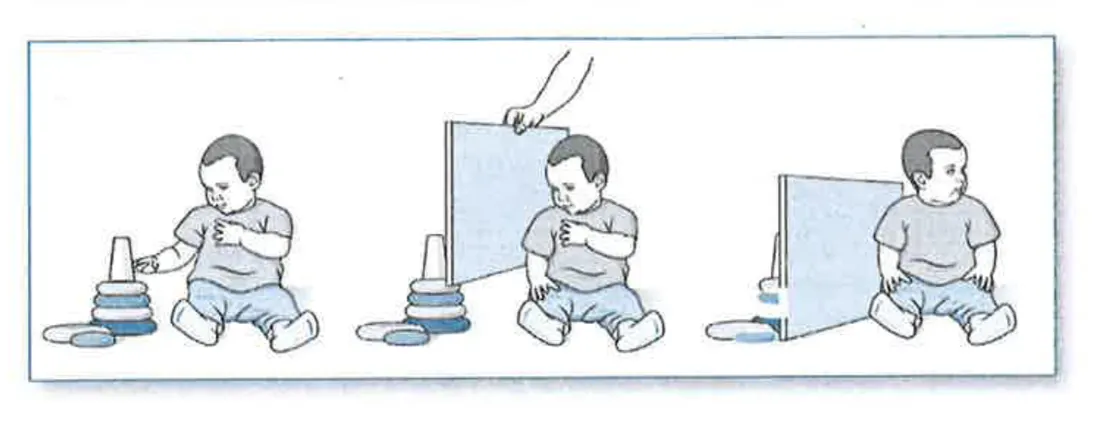
Figure 17.1: According to Piaget, until object permanence develops, babies fail to understand that objects still exist when no longer in
view. Source: Galotti (2017, p.113).
tary mental activity that can be clearly labelled as “thinking.”
existence of the occluded box anyway. But Baillargeon’s results showed something clearly at odds with Piagetian predictions. Her 6.5- and 8-monthold participants, and even some 4-month-old female participants, looked longer at the “on-track” “impossible” event. Baillargeon interpreted this result to mean that the infants “(a) believe that the box continued to exist, in its same location, after the screen was lowered; (b) believed that the car continued to exist, and pursued its trajectory, when behind the screen; (c) realized that the car could not roll through the space occupied by the box; and hence (d) were surprised to see the car roll past the screen when the box lay in its path” (Baillargeon, 1999, p. 128).
One of the most prolific researchers posing this challenge to Piaget is psychologist Renée Baillargeon. Here, we will only cover a small fraction of her elaborate body of work. In one classic study (Baillargeon, 1986), she seated infants (6-8 months old) in front of a screen set up to the right of an inclined ramp. During the first phase of the study, infants saw the screen raised and lowered. Behind the screen was a track for a small toy car. After the screen was lowered, infants saw a small toy car go down the inclined ramp and to the right, behind the screen.
Next, infants were given the impossible/possible events task, in which they were tested with one of two events—the first, a “possible” event, occurred when the screen was raised. It revealed a box sitting behind the track. As in the first phase of the study, after the screen was lowered, the car rolled down the ramp and across the track behind the screen. The second, “impossible” event was very similar to the possible event, except that the box was actually placed on the track instead of behind it.
In a related study, Baillargeon and DeVos (1991) presented infants 3.5 months old with an unusual stimulus display. Each infant saw one of two events first. These events presented either a short carrot or a tall carrot moving behind a large rectangular yellow screen, followed, a few seconds later, by the emergence of an identically appearing carrot appearing from the right-hand side of the screen. In other words, it looked as though the same carrot simply traveled behind the occluding screen. After a 1-second pause, the experimenter slid the carrot back behind the yellow occluding screen, paused for 2 seconds, and then slid the leftmost carrot out from behind the left edge of the screen. This cycle of carrots disappearing and reappearing continued until the infant reached a predetermined criterion of amount of time looking at the stimulus or looking away having previously attended to it.
Now, according to Piaget, 6-month-old infants ought not to react any differently to the “possible” than to the “impossible” event. Lacking a sense of object permanence, they should be just as unsurprised to see a car roll in front of a box as “through” a box—after all, if infants have no expectations of objects continuing to exist when hidden behind a screen, then they would have forgotten all about the
Psychology of Human Thought • Chapter 17 • 329
Galotti Development of Human Thought
Next came either a “possible” or “impossible” event. This event was the same as the corresponding habituation event, except that the occluding screen had a new color, blue, meant to draw infants’ attention to the fact that the screen was new. It also had a new shape: a large rectangle with a smaller rectangle “cut out” from the top. The idea was that short carrots ought to fit completely behind the new screen all the way across, and thus the possible event ought not to have been perceived as all that surprising. However, a tall carrot would not have fit behind the new screen—its top ought to have been visible as it moved through the “cut out” portion of the screen if it were moving from one end to the other. Thus, the tall carrot moving behind the new screen ought to have been an impossible event.
In a recent review, Baillargeon, Scott, and Bian (2016) present evidence from many different studies from many different laboratories that young infants and toddlers can reason about agents’ goals and states and can use this information to predict an agent’s future actions. Here’s just one example (from Woodward, 2009): an infant sees an adult seated at a table with two different toys (let’s call them A and B) in front of her. She reaches for and grasps one of the toys (A). Infants watch repetitions of this action for some predetermined amount of time, becoming habituated to seeing this action. Next, they see the same adult in front of the same two toys, which have now traded positions. Infants as young as five months look longer when the adult reaches for the new toy (B) than they do when the adult reaches for (A). According to Baillargeon et al (2016) these infants: “(a) attributed to the agent a preference or liking for object A, as the agent always chose it over object B, and (b) expected the agent to continue acting on this preference. . .” (p. 162). This finding has been replicated in several laboratories.
Results showed that although infants looked for an equal amount of time at the two habituation events (i.e., tall vs. short carrots moving behind the rectangular yellow screen), they looked longer at the impossible than the possible test event. Baillargeon and DeVos (1991) took this result as evidence that their three-and-a-half-month-old infants “(a) realized that each carrot continued to exist af-
Baillargeon along with other developmental psychologists such as Elizabeth Spelke and Susan Carey argue that infants are born with some amount of “core knowledge.” The existence of these innate sys-
ter it slid behind the screen, (b) assumed that each carrot retained its height behind the screen, (c) believed that each carrot pursued its trajectory behind the screen, and therefore, (d) expected the tall carrot to be visible in the screen window [the opening in the blue test screen] and were surprised that it was not” (p. 1233).
tems does not imply that infants can articulate all their principles. Indeed, infants aren’t known for their articulation abilities in any domain. Instead, the implication here is that infants come into the world prepared to make certain assumptions, entertain certain hypotheses, or hold certain expectations of the way objects will or won’t behave. Thus, they do have some knowledge, and thus, they can do some rudimentary reasoning about it.
These conclusions (and others from Baillargeon’s additional studies not described here) strongly suggest that even fairly young infants possess a fair amount of knowledge about what objects are and how they behave. Baillargeon (2008) believes that infants begin with an innate principle of persistence, “which states that objects persist, as they are, in time
17.3 The Preschool Period
and space” (p. 11). From this initial knowledge, infants gather perceptual information and use it to construct more complex and detailed representations of objects and, in so doing, learn more about how objects behave and what their properties are. So, if you believe Baillargeon’s interpretations (and not everyone does; see Cohen & Cashon 2013 for a critique), young infants do have some knowledge about objects. What about knowledge about social beings?
It is in the preschool period that we see the first glimmers of what cognitive psychologists call “higher order cognitive processes”—processes that operate on mental representations. These glimmers are fleeting and fragile, but also unmistakable signs of growing maturity of thought.
One of my personal favorite demonstrations of preschooler reasoning competence comes from the
330 • Psychology of Human Thought • Chapter 17
The Preschool Period Galotti
work of Hawkins, Pea, Glick, and Scribner (1984). They demonstrated that, under certain circumstances at least, preschoolers aged 4 and 5 years could draw deductive inferences (see Chapter 7, “Deductive Reasoning”). They began by constructing various reasoning problems, examples of which are shown in Table 17.1. There were three types of problems. The first consisted of premises that were congruent with the child’s world knowledge—for example, “Bears have big teeth. Animals with big teeth can’t read books. Can bears read books?” Note that whether a child actually reasoned from the premises or from her world knowledge of the general illiteracy of bears, she would have arrived at the deductively correct conclusion, “No.” Preschoolers were expected to do particularly well on these problems, even if their scores overstated their true reasoning ability.
Thus, the authors concluded, preschool children, under limited circumstances, can reason deductively.
Moreover, the order in which the problems were administered was crucially important. Children who reasoned with fantasy premises first tended to perform better on all problems, even the congruent and incongruent ones, than did the children who received congruent problems first, incongruent problems first, or problems in a jumbled order. Hawkins et al. (1984) argued that presenting fantasy problems first sets a context for children to help cue them as to how to correctly solve the problem. When congruent or incongruent problems were presented first, children mistakenly recruited their real-world knowledge to answer the questions, instead of relying strictly on the premises.
Of course, being able to draw a deductive inference in certain circumstances does not prove that preschoolers are fully capable of deductive reasoning. Adults can reason better than preschoolers on just about every problem, but do especially well with incongruent content. Indeed, Markovits and Barrouillet (2004) argue that what happens with cognitive development is increasing control over complex forms of reasoning, and being able to divorce one’s store of knowledge about the world from the information presented in the premises to a problem.
A second type of problem included information that was incongruent with the child’s world knowledge—for example, “Glasses bounce when they fall. Everything that bounces is made of rubber. Are glasses made of rubber?” Here, the real-world correct answer is directly at odds with the answer a reasoner would derive from strictly reasoning from the premises to answer the question. Preschoolers were expected to do particularly poorly on these problems, as it was expected they would answer the questions using their world knowledge rather than use abstract reasoning to derive a valid conclusion.
Another important development in children’s thinking in the preschool period concerns the development of theory of mind. A person’s theory of mind is the ability to reason about mental states (Apperly, 2012). Thus, theory of mind guides a person’s beliefs and expectations about what another person is thinking, feeling, or expecting; it guides one’s ability to predict accurately what another person’s reaction will be to a specific set of circumstances (Flavell, Green, & Flavell, 1995). This ability develops rapidly between the ages of two and five.
The most theoretically interesting type of problem was one using so-called “fantasy” premises—for example, “Every banga is purple. Purple animals always sneeze at people. Do bangas sneeze at people?” Notice that in these problems, there is no relevant world knowledge for the child to call upon. Hawkins et al. (1984) believed, then, that fantasy problems would be the ones most likely to reveal whether or not preschool children could, in fact, draw logical inferences.
One common task used to investigate preschool children’s theory of mind is the so-called false belieftask (Wimmer & Perner, 1983). For example, children might be told a story about a boy who puts a toy in a box and leaves the room. While he is away, his sister enters the room, takes the toy out of the box, plays with it, and puts it away in a different location. Children are then asked where the boy (who was not present in the room at the time the toy was
The results were clear-cut. Children were presented with 8 problems of each kind. Overall, children gave correct responses to 7.5, 1.0, and 5.8 congruent, incongruent, and fantasy problems, respectively. A chance level of performance was 4, and thus children performed significantly better than chance on the fantasy (and congruent) problems.
Psychology of Human Thought • Chapter 17 • 331
Galotti Development of Human Thought
Table 17.1: Types of problems used by Hawkins, Pea, Glick, and Scribner (1984). Source: Galotti (2017, p. 230), adapted from
Hawkins, Pea, Glick, and Scribner (1984, p. 585).
ModelAffirmative ExampleNegative Example
A is B Every banga is purple. Bears have big teeth.
B is C Purple animals always sneeze at people. Animals with big teeth can’t read books.
A is C Do bangas sneeze at people? Can bears read books?
A has B Pogs wear blue boots. Rabbits never bite.
C is an A Tom is a pog. Cuddly is a rabbit.
C has B Does Tom wear blue boots? Does Cudly bite?
A does B when ... Glasses bounce when they fall. Merds laugh when they’re happy.
B is C Everything that bounces is made of rubber. Animals that laugh don’t like mushrooms.
A has C Are glasses made of rubber? Do merds like mushrooms?
moved) will think the toy is. In other words, can the children disentangle their own state of knowledge about the toy from the state of knowledge or belief of someone who lacks their information?
tions. Thus, theory of mind is not something that a child “finishes” developing at age 5. However, most researchers agree that there is rapid development in theory of mind during the preschool period, and it seems to correlate with developments in language, pretend play, symbolic understanding, and inhibitory control, the ability to maintain focus and resist the temptation to become distracted (Carlson, Moses & Claxton, 2004; Lillard & Kavanaugh, 2014; Wellman, Cross, & Watson, 2001).
Another theory of mind task is the unexpectedcontents task (e. g., Gopnik & Astington, 1988), in which a child is handed a box of, say, crayons but opens it to discover that the box really contains small candies. The child is then asked to predict what another child, who has no previous experience with the crayon box, will think is inside. Typically, children younger than about 4 years answer that they knew all along that the box contained candies rather than crayons, even though they initially answered “crayons” when asked what was in the box. Further,
17.4 Middle Childhood
One of the more noticeable aspects of cognitive development in middle childhood is the growth of the knowledge base (see Chapter 5, “Knowledge Representation and Acquisition” ). School-aged children in the United States learn an incredible amount of what adults would consider “basic” information— vocabulary words; how to read; how to use different punctuation marks; addition, subtraction, multiplication, and division facts; historical and geographical facts; information about certain authors; and information about animals, planets, and machines, to take just a few examples from my children’s elementary
young preschoolers respond that someone else coming into the room later will think that the crayon box contains candies rather than crayons.
Apperly (2012) makes the argument that although theory of mind is studied widely in preschoolers, it’s a mistake to believe that only preschoolers struggle with this concept. Infants, as we’ve just seen, have some (if incomplete) knowledge about others’ goals; adults show stable individual differences in their ability to predict others’ motivations and inten-
332 • Psychology of Human Thought • Chapter 17
Adolescence Galotti
school’s curriculum. Add to that knowledge of domains that aren’t formally taught in schools—how to play Minecraft, how to operate an iPhone, or characters from the Magic Tree House or Harry Potterbook series are just a few examples.
even though the biconditional relationship (all andonly yellow things are dinosaurs) were not. That is, they were able to revise their beliefs about what relationships held in light of new evidence. The ability to make this revision seemed, in contrast, to escape the five-year-olds.
With this tremendous acquisition of knowledge going on, children need to find efficient ways of storing and representing it. (As an analogy, think about files on your laptop. It didn’t matter very much what you called them when you only had a small number, but when you get up into the thousands of files, how you organize them might well determine whether or not you are ever going to find a particular one again.) How children represent and organize their knowledge is certainly a matter of active debate and discussion in the field. Presumably, their knowledge bases underlie their ability to draw inferences from examples they see. Like so many other topics in this chapter, we’ll only have space to cover a couple of examples.
These results echo ones reported earlier by Deanna Kuhn (1977) who presented children aged 6-14 with conditional reasoning problems all pertaining to the fictional land of Tundor. She began with a pretest disguised as a game where she would give them one piece of information about Tundor (e.g., “John is tall, and Bob is short”) and then ask questions (e.g., “Is Bob tall?”) to which the child could respond “yes”, “no”, or “maybe.” The pretest gave examples of questions that could be answered definitively as well as ones that could not, based on the given information. Only children who correctly answered both pretest questions were allowed to continue.
Kalish, Kim, and Young (2012) reported on three studies of preschoolers and young school-aged children that we will focus on. The task presented children with a number of individual examples of a category, e.g., small plastic frogs or dinosaurs that were either yellow or blue. Typically, children would first see a biconditional relation between color and species. For example, they might be shown four yellow dinosaurs and four blue frogs, one at a time. What makes this relationship biconditional is that all yellow things are dinosaurs, and all dinosaurs are yellow.
Next, Kuhn (1977) gave children conditional reasoning problems. For example, “All of the people in Tundor are happy. Jean lives in Tundor. Is Jean happy?” (The correct, logically valid answer is yes, and this is considered a fairly easy inference to draw) or, “All people who live in Tundor own cats. Mike does not live in Tundor. Does he own a cat?” (Here, the correct answer is maybe; no logically necessary inference can be drawn; though even adults make mistakes on this type of problem). Kuhn found that even the first graders show some reasoning ability, particularly on easy problems. Children did less well on the more difficult problems (the ones adults make mistakes on), unsurprisingly. In similar studies, Janveau-Brennan and Markovits (1999) conclude that children are likely reasoning in ways fundamentally similar to the way adults reason, at least by the time they are in middle childhood, and when they are reasoning with concrete kinds of content rather than abstract propositions.
In a second phase of the task, children were presented (again, one at a time) with examples some of which undermined the biconditional relationship. For example, children might see six yellow frogs and two yellow dinosaurs. So, after this information is presented, it is no longer true that all yellow things are dinosaurs, nor that all frogs are blue. However, there are conditional relationships that remain true even after this phase of the task. For example, the relationship, If an item is a dinosaur, it is yellowremains true, although it allows for the possibility of other yellow things, for example, frogs, existing.
17.5 Adolescence
Older (seven-year-old) children were able to see that some conditional relationships (if dinosaur, thenyellow) were true after the second phase of the task
Cognitive developmental psychologists have long noticed another major change in thinking that occurs right around puberty. Adolescents are much
Psychology of Human Thought • Chapter 17 • 333
Galotti Development of Human Thought
more capable than younger children of thinking hypothetically, and about the future; and to be able to think abstractly versus only with concrete instances as they were in childhood (Byrnes, 2003; Galotti, 2017). A now-classic study by Daniel Osherson and Ellen Markman (1975) illustrates this last point very well.
circumstances. For example, most sixteen-year-olds in the United States are high school students who live with parents or guardians. But as they prepare for adult life, they have to be able to imagine what it will be like to live independently, find and keep a job, decided on whether and what kind of further education they will seek, among other life-framing decisions.
Children, adolescents, and adults were shown small plastic poker chips in assorted solid colors, and were told that the experimenter would be saying some things about the chips and that they should indicate after each statement if it was true, if it was false, or if they “couldn’t tell.” Some of the statements were made about chips held visibly in the experimenter’s open hand. Other, similar statements were made about chips hidden in the experimenter’s closed hand. Among the statements used were logical tautologies (statements true by definition)—for example, “Either the chip in my hand is yellow, or it is not yellow”; logical contradictions (statements false by definition)—for example, “The chip in my hand is white, and it is not white”; and statements that were neither true nor false by definition but depended on the color of the chip (e.g., “The chip in my hand is not blue and it is green”).
This kind of thinking is crucial to what cognitive developmental theorists call identity development. This term refers to the development of a mature sense of who you are and what your goals, values, and principles are. Lifespan developmental psychologist Erik Erikson (1968) was the first to highlight the construction or discovery of identity as a major developmental task, typically first encountered during adolescence. Psychologist James Marcia (1966), however, is the one credited with operationalizing this idea and developing measures to study it.
Marcia (1966) saw identity development as proceeding through two or more phases, and these are depicted in Figure 17.2. Marcia asserted that identity status is defined jointly by two factors: whether or not the person had made a definite choice or commitment (e.g., to a career, to a value system, to a romantic partner) and whether or not the person had gone through some sort of “crisis”, or period of active doubt and exploration, in making that choice.
Younger children (those in grades 1, 2, 3 and even 6) had difficulty distinguishing between statements that were empirically true or false (i.e., true in fact) and those that were logically true or false (i.e., true by necessity or definition). They did not respond correctly to tautologies and contradictions, especially in the hidden condition. They tended to believe, for example, that a statement such as “Either the chip in my hand is red, or it is not red” cannot be assessed unless the chip is visible. Tenth graders and adults, in contrast, were much more likely to respond that even when the chip couldn’t be seen, if the statement was a tautology or contradiction, the statement about it could be evaluated on the basis of the syntactic form of the sentence. Said another way, adolescents and adults are able to examine the logical!form of a statement, instead of insisting that none of the “hidden” statements could be evaluated.
A teen in the identity diffused status has not made any commitments and has not developed a relevant set of values or principles with which to guide his goal setting and decision making in a given realm (e.g., career, education, political philosophy, religious affiliation). He has not experienced a period of crisis or doubt but, rather, either is in the early phase of identity development or is simply drifting along, with no set plan for the future.
An adolescent in the foreclosure status, in contrast, is very committed to a plan and/or to a set of values and principles. Similar to her identity diffused colleagues, however, she has never experienced a crisis or period of doubt. Typically, this indicates that she has adopted someone else’s goals and plans, most often those of a parent or another significant adult figure. Thus, adolescents in this status tend to have a very narrow vision for their future—and not much autonomy or power in mak-
Thinking about the future is also an important emerging capability in adolescence (Nurmi, 1991). Being able to project oneself into a future context requires an ability to think beyond the current set of
334 • Psychology of Human Thought • Chapter 17
Adolescence Galotti
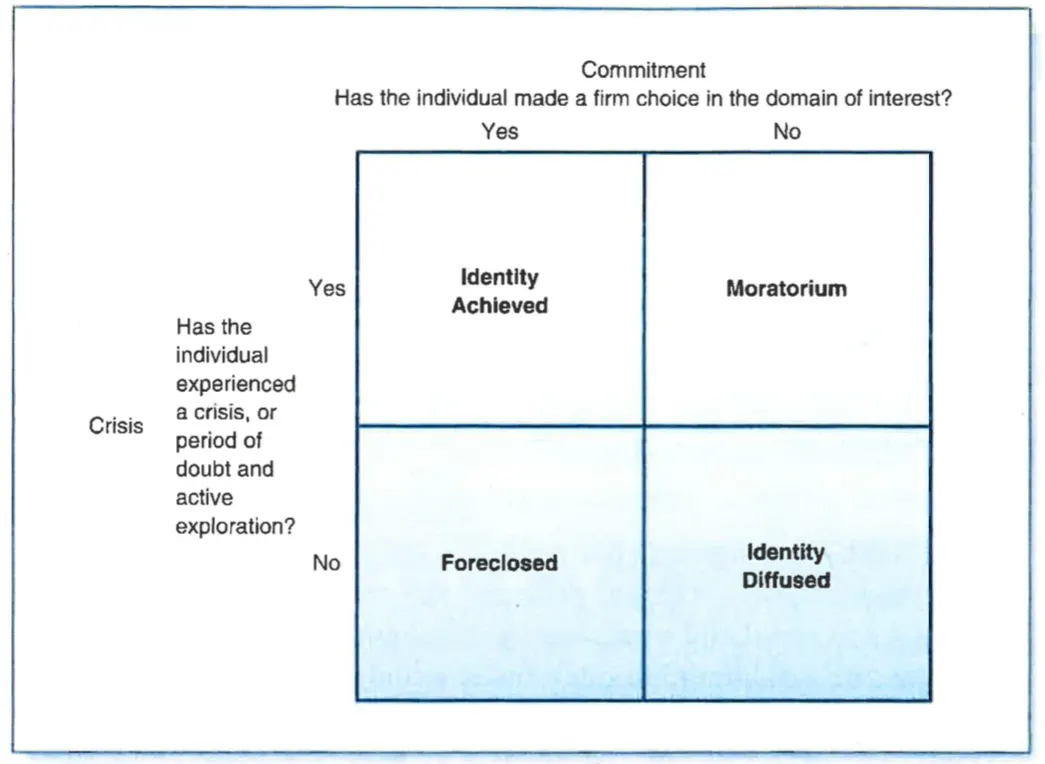
Figure 17.2: Marcias Identity Statuses. Source: Galotti (2017, p. 399).
ing decisions. Students at my college who enter my office on their very first day of college, announcing they are “premed” or “prelaw” because both of their parents are doctors or lawyers and they’ve known since they were 5 what they’d be, tend to present rather textbook examples of foreclosure.
moving into the identity achieved status, or, in less successful cases, retreat into identity diffusion.
Marcia (1966) held that only individuals who experienced moratorium could move into the identityachieved status. The individual here has made one or more personal commitments, after having struggled to find her or his own path toward that decision. This student has considered alternative options and weighed both the pros and the cons. This status is seen as marking a successful end to adolescent development, as a bridge has been built from one’s childhood to one’s future adulthood. Accompanying identity achievement are increases in self-acceptance.
The moratorium identity status is often typified by college students who “want to keep all their options open.” They are actively exploring different options, experimenting and trying on for size the possibility of different majors, different careers, and different religious or political affiliations. The moratorium student is usually struggling and not in what others would call a “stable” state—that is, this individual is likely to remain in this period for only a brief period—a year or two (Moshman, 2011). Moratorium is a period of delay, in which the individual knows that a commitment must soon be made but is not yet ready to make it. Individuals in this status usually either resolve this crisis in a positive way,
Many theorists find Marcia’s (1966) proposal a useful analogy for understanding one major realm of adolescent development (Moshman, 2011). Identity encompasses an adolescent’s value system as well as her view of knowledge and herself as a learner and an agent in the world.
Psychology of Human Thought • Chapter 17 • 335
Galotti Development of Human Thought
17.6 Conclusion
flexible, and sometimes even more hypothetical with increasing levels of cognitive development.
Many questions remain to be resolved. How many of the changes we’ve described are due to factors such as biological maturation, say, versus education, experience, and expertise? Are there periods of rapid change in thinking, or is the entire process an orderly and continuous one? How different are the trajectories of thinking for children who grow up in very different cultures? Are the developmental paths for thinking general-purpose and broad, or does thinking develop differently in different domains? Stay tuned to the field of cognitive development to find the answers to these important questions!
Our look at the development of thought has been brief and selective. I’ve tried to give you some flavor of the changes occurring during the first two decades of life when it comes to higher-order cognitive processes. We have seen a gradual increase in knowledge of the world—the inputs used in thinking and reasoning and decision making. Although infants are not without relevant knowledge of the world, certainly they have much less when compared with a child in third grade or an adolescent. We’ve also seen that thinking becomes more abstract, more
Summary
1. The term, thinking, covers a number of cognitive processes that processes information. Examples include problem solving, reasoning, decision making, goal setting, and planning.
2. Thinking often makes use of two other cognitive realms: language, and the knowledge base.
3. Although Piagetian theory holds that before the age of about two, infants lack capacity for mental representation and therefore, thought, recent work poses a strong challenge to this tenet. Psychologist Renee Baillageron and her colleagues have shown that even three- to six-month-old infants have expectations about the way objects behave, indicating they already have some knowledge and some rudimentary reasoning abilities.
4. Preschoolers show an ability to draw deductive inferences under certain conditions. These abilities are fragile, but present.
5. Preschoolers develop an elaborate theory of mind during the ages from two to five, learning to understand and predict what beliefs, expectations, emotions, and preferences another person might hold.
6. Children’s inferential reasoning begins to look very similar to that of adults when the inferences involve concrete examples.
7. Adolescents are much more capable than younger children of thinking hypothetically, about the future, and abstractly. This enriched ability is critical to another task of adolescence, developing an identity, a mature sense of who you are and what your goals, values, and principles are.
336 • Psychology of Human Thought • Chapter 17
Conclusion Galotti

Review Questions
1. Explain what the “core knowledge” approach to infant cognition is, and describe how it challenges Piagetian theory.
2. What does it mean to say that reasoning abilities are pretty fragile in preschoolers, and become more robust with development?
3. Describe a typical theory of mind task, and what the results indicate about preschoolers’ ability to think about other people.
4. Why is the question of how knowledge is stored and structured so important for understanding the development of the ability to draw inferences?
5. Cognitively speaking, what happens in adolescence? How do these changes impact different realms of an adolescent’s life?
Hot Topic
My research program is centered around the question, how do ordinary people facing important decisions go about the process of choosing an option? I’ve studied adults choosing a first-grade program for their children; pregnant women choosing birthing options; college students choosing majors, courses, housing, and summer plans, to name just a few. Here, I’ll focus on the studies of college students choosing a major (Galotti, 1999; Galotti, Ciner, Altenbaumer, Geerts, Rupp, & Woulfe, 2006; Galotti, Wiener & Tandler 2014). Many of these studies were longitudinal in design—meaning that we asked the same people about their decision-making process at two or more different points in time, in order to study changes over time. At each point, we asked students to describe the options they were actively considering (e.g., Psychology, Computer Science, English) as well as the criteria they were using to decide among options (e.g., How many requirements are there? Do I like the profs who teach the classes? Are there labs? Will it help get me into med school?). We also asked students to assess their emotional reactions to the decision-making process (e.g., How stressful was it? How comfortable with the process were they?).

Kathleen Galotti (Photo: Tania Legvold)
Across studies, college students considered about 4-5 options and about 5-7 criteria. As the final decision drew near, students were likely to reduce the number of options under consideration (from about 4-5 to about 3-4), but not the number of criteria they were using. When we looked at whether or not the same options or criteria were being used at different points in time, the answer was that about half of the options and half of the criteria were different. Students generally reported that this decision was moderately stressful and difficult, and that it was guided by their overall values, with an emphasis on the future. Some work suggests, however, that the way students approach a specific decision is largely a function of what that decision is about. The implication here is that people approach different decisions has at least as much to do with the specifics of a particular decision as it does with the characteristics of the decision maker.
Psychology of Human Thought • Chapter 17 • 337
Galotti Development of Human Thought
References
Galotti, K. M. (1999). Making a “major” real life decision: College students choosing an academic major.
Journal of Educational Psychology, 91, 379–387. doi:10.1037/0022-0663.91.2.379
Galotti, K. M., Ciner, E., Altenbaumer, H. E., Geerts, H. J., Rupp, A., & Woulfe, J. (2006). Decision-making
styles in a real-life decision: Choosing a college major. Personality and Individual Differences, 41, 629–639. doi:10.1016/j.paid.2006.03.003
Galotti, K. M., Wiener, H. J. D., & Tandler, J. M. Real-Life Decision Making in College Students I: Con-
sistency Across Specific Decisions (2014). American Journal of Psychology, 127, 19–31. doi:10.5406/ amerjpsyc.127.1.0019
References
Apperly, I. A. (2012). What is “theory of mind?” Con-
of Experimental Child Psychology, 87, 299–319. doi:10.1016/j.jecp.2004.01.002
cepts, cognitive processes and individual differences. Quarterly Journal of Experimental Psychology, 65, 825–839. doi:10.1080/17470218.2012.676055
Cohen, L. B., & Cashon, C. H. (2013). Infant percep-
tion and cognition. In R. M. Lerner, M. A. Easterbrooks, & J. Mistry (Eds). Handbook of psychol-ogy: Developmental psychology, Vol.6 (pp 65– 89). Hoboken, NJ, US: John Wiley & Sons Inc. doi:10.1002/0471264385.wei0603
Baillargeon, R. (1986). Representing the existence and
the location of hidden objects: Object permanence in 6- and 8-month-old infants. Cognition, 23, 21–41. doi:10.1016/0010-0277(86)90052-1
Baillargeon, R. (1999). Young infants’ expectations about
Erikson, E. H. (1968). Identity: Youth and crisis. New
hidden objects: A reply to three challenges. Devel-opmental Science, 2, 115–132. doi:10.1111/1467- 7687.00061
York: Norton.
Flavell, J. H., Green, F. L., & Flavell, E. R. (1995). Young
children’s knowledge about thinking. Monographs ofthe Society for Research in Child Development, 60(Serial No. 243), 1–96. doi:10.2307/1166124
Baillargeon, R. (2008). Innate ideas revisited: For a
principle of persistence in infants’ physical reasoning. Perspectives on Psychological Science, 3, 2–13. doi:10.1111/j.1745-6916.2008.00056.x
Galotti, K. M. (2017). Cognitive development: Infancy
through adolescence (2nd ed.) Thousand Oaks, CA: Sage.
Baillargeon, R., & DeVos, J. (1991). Object permanence
in young infants: Further evidence. Child Develop-ment, 62, 1227–1246. doi:10.2307/1130803
Gopnik, A., & Astington, J. W. (1988). Children’s under-
standing of representational change and its relation to the understanding of false belief and the appearancereality distinction. Child Development, 59, 26–37. doi:10.2307/1130386
Baillargeon, R., Scott, R. M., & Bian, L. (2016). Psycho-
logical reasoning in infancy. Annual Review of Psy-chology, 67, 159–186. doi:10.1146/annurev-psych- 010213-115033
Hawkins, J., Pea, R. D., Glick, J., & Scribner, S. (1984).
Byrnes, J. P. (2003). The development of decisionmaking. Journal of Adolescent Health, 31, 208–215. doi:10.1016/S1054-139X(02)00503-7
“Merds that laugh don’t like mushrooms”: Evidence
for deductive reasoning by preschoolers. Develop-mental Psychology, 20, 584–594. doi:10.1037/0012- 1649.20.4.584
Carlson, S. M., Moses, L. J., & Claxton, L. J.
(2004). Individual differences in executive functioning and theory of mind: An investigation of inhibitory control and planning ability. Journal
Janveau-Brennan, G., & Markovits, H. (1999). The development of reasoning with causal conditionals. Developmental Psychology, 35, 904–911. doi:10.1037/0012-1649.35.4.904
338 • Psychology of Human Thought • Chapter 17
References Galotti
Kalish, C. W., Kim, S., & Young, A. G., (2012). How
Osherson, D. N., & Markman, E. (1975). Language and the ability to evaluate contradictions and tautologies. Cognition, 3, 213–226. doi:10.1016/0010- 0277(74)90009-2
young children learn from examples: Descriptive and inferential problems. Cognitive Science, 36, 1427– 1448. doi:10.1111/j.1551-6709.2012.01257.x
Kuhn, D. (1977). Conditional reasoning in children. Developmental Psychology, 13, 342–353. doi:10.1037/0012-1649.13.4.342
Piaget, J. (1952). The origins of intelligence in chil-dren (M. Cook, tr.). New York, NY: Norton. doi:10.1037/11494-000
Lillard, A. S., & Kavanaugh, R. D. (2014). The contri-
Sloutsky, V. M., Kloos, H., & Fisher, A. V. (2007).
bution of symbolic skills to the development of an explicit theory of mind. Child Development, 85, 1535– 1551. doi:10.1111/cdev.12227
When looks are everything: Appearance similarity versus kind information in early induction. Psycho-logical Science, 18, 179–185. doi:10.1111/j.1467- 9280.2007.01869.x
Marcia, J. E. (1966). Development and validation of ego-
identity status. Journal of Personality and Social Psy-chology, 3, 551–558. doi:10.1037/h0023281
Wellman, H. M., Cross, D., & Watson, J. (2001). Meta-
analysis of Theory-of-mind development: The truth about false belief. Child Development, 72, 655–684. doi:10.1111/1467-8624.00304
Markovits, H., & Barrouillet, P. (2004). Introduction:
Why is understanding the development of reasoning important? Thinking and Reasoning, 10, 113–121. doi:10.1080/13546780442000006
Wimmer, H., & Perner, J. (1983). Beliefs about beliefs:
Representation and constraining function of wrong beliefs in young children’s understanding of deception. Cognition, 13, 102–128. doi:10.1016/0010- 0277(83)90004-5
Moshman, D. (2011). Adolescent rationality anddevelopment:Cognition,morality,and identity. (3rd ed). New York, NY: Psychology Press. doi:10.4324/9780203835111
Woodward, A. L. (2009). Infants’ grasp of others’ inten-
Nurmi, J.-E. (1991). How do adolescents see their fu-
tions. Current Directions in Psychological Science,18, 53–57. doi:10.1111/j.1467-8721.2009.01605.x
ture? A review of the development of future orientation and planning. Developmental Review, 11, 1–59. doi:10.1016/0273-2297(91)90002-6
Psychology of Human Thought • Chapter 17 • 339
Galotti Glossary
Glossary
decision making The cognitive process(es) by
mental representation An internal depiction of
which an individual selects one course of action from among alternatives. 327
information. 328
planning Devising and coordinating actions aimed
at achieving a goal and at monitoring the effectiveness of the actions for reaching the goal. 328
goal setting The cognitive process(es) by which
an individual identifies achievements wanted sometime in the future. 328
problem solving The cognitive process(es) used
in transforming starting information into goal state, using specified means of solution. 327
identity development The formation of a reflec-
tive concept of the self, used to define who one is and what one’s goals, values, and principles are. 334
reasoning The cognitive processes used in drawing
inferences from given information to generate conclusions. 327
knowledge base Stored information including all
general knowledge possessed by an individual. 327, 328
theory of mind An understanding of what another
person might be thinking, feeling, believing, or expecting or what her reaction might be to a specific set of circumstances. 331
language A system of communication that is gov-
erned by a system of rules (a grammar) that allows an infinite number of ideas to be expressed. 328
thinking The cognitive process(es) used in trans-
forming or manipulating information. 327
340 • Psychology of Human Thought • Chapter 17